
Selling a house as is in Maryland means listing your property in its current condition, with no repairs or renovations before closing, while still meeting the state’s mandatory disclosure requirements. This approach attracts cash buyers, real estate investors, and buyers willing to take on a fixer-upper in exchange for a lower price. Maryland’s specific legal rules, transfer tax structure, and attorney-led closing process make this sale type distinct from a standard retail transaction. This guide covers every step: disclosure obligations, pricing strategy, marketing channels, closing timelines, and the pitfalls that cost sellers money.
What legal disclosure requirements apply when selling a house as is in Maryland?
Selling as is doing not mean selling blind. Maryland law requires sellers to disclose all known latent defects, regardless of whether the property is listed as is. A latent defect is a hidden problem that a buyer cannot reasonably discover through a standard walkthrough, such as a failing foundation, water intrusion behind walls, or a defective septic system.
Maryland gives sellers two formal options for disclosure. The first is a full disclosure statement, which details every known issue with the property. The second is an as-is disclaimer, which signals that the buyer accepts the property in its current condition. The critical point: even with an as-is disclaimer, failing to disclose known defects exposes you to legal liability after closing. The disclaimer does not erase your obligation to report what you know.

Vague disclosures create the most legal risk. Listing specific issues with detailed descriptions protects you legally and actually helps marketing, because buyers can price in the problems rather than walk away from uncertainty. A disclosure that says “some water damage in basement” is weaker than one that says “recurring water intrusion in northeast corner of basement during heavy rain, present since 2019.”
Real estate attorneys play a direct role in Maryland as-is sales. They prepare and review disclosure documents, flag gaps in your paperwork, and reduce the chance of post-closing disputes. Hiring an attorney early is not optional in Maryland’s closing environment. It is the standard practice.
Key disclosure steps for Maryland as-is sellers:
- Complete the Maryland Residential Property Disclosure and Disclaimer Statement form.
- Document every known defect with dates, descriptions, and any repair attempts.
- Disclose environmental hazards such as lead paint, asbestos, or underground storage tanks.
- Have an attorney review the disclosure before listing.
- Update the disclosure if new issues surface before closing.
Pro Tip: Get a pre-listing inspection even if you plan to sell as is. The report gives you a documented record of the property’s condition, which strengthens your disclosure and reduces buyer negotiation leverage after the fact.
How should you price your Maryland home when selling as is?
Pricing is where most as-is sellers lose money. The standard approach is to start with a Comparative Market Analysis (CMA) using recently sold homes in your area, then apply a discount that reflects the property’s condition. As-is properties typically sell at a 10%–20% discount below renovated comparable sales. The lower end of that range applies when the home is structurally sound but cosmetically dated. The higher end applies when structural repairs are needed.
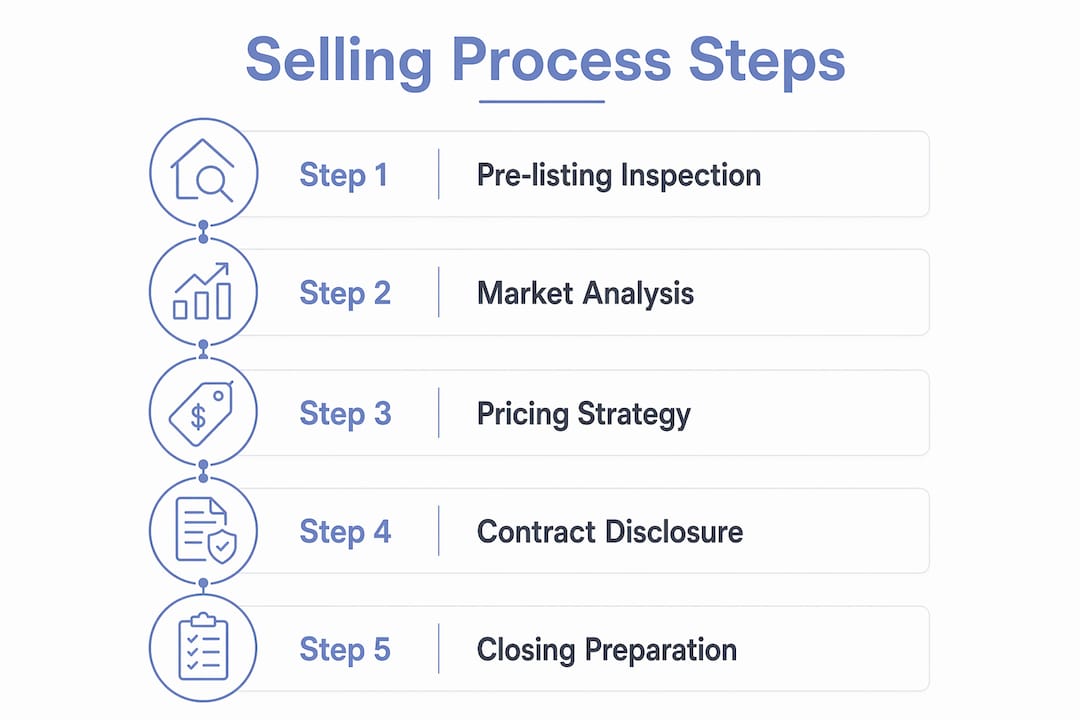
A CMA for an as-is sale should include distressed sales and investor transactions, not just retail comps. Standard agent CMAs often pull only retail sales, which inflates the baseline and leads to overpricing. Overpriced as-is listings sit on the market, accumulate days-on-market stigma, and eventually sell for less than a correctly priced listing would have.
Here is a practical pricing sequence:
- Pull sold comps within a half-mile radius from the past six months.
- Identify the renovated retail value of your home based on those comps.
- Subtract the estimated cost of all needed repairs, plus a buyer’s risk premium of 5%–10%.
- Cross-check against any distressed or investor sales in the same area.
- Set your list price at the lower end of the resulting range to generate early offers.
- Decide in advance how far you will negotiate and what your floor price is.
Structural problems require a larger discount than cosmetic ones. A roof replacement, foundation crack, or HVAC failure will cost a buyer $10,000–$50,000 or more. Buyers factor in not just the repair cost but also the time, risk, and financing complexity of major repairs. Price accordingly.
Pro Tip: Request written repair estimates from licensed contractors before listing. Sharing those estimates with buyers removes guesswork, builds trust, and shortens negotiation time.
What are the best sales channels for a Maryland as-is property?
The right sales channel depends on how fast you need to close and how much you want to net. Three main options exist: listing on the MLS, selling directly to a cash buyer or investor, and working with a real estate agent who specializes in distressed properties.
Listing on the MLS with keywords like “as-is,” “handyman special,” or “investor opportunity” targets the buyers most likely to purchase without repair contingencies. MLS exposure maximizes your audience, which can drive competing offers even on distressed properties. The tradeoff is time. MLS as-is listings in Maryland often take 30–90 days to close, depending on the market and buyer financing.
Direct cash buyer sales move faster. Investors and cash buyers skip the appraisal and financing contingency steps that slow down retail transactions. The offer price will be lower than a retail MLS sale, but the certainty and speed often offset that gap for sellers who need to close quickly.
Comparing your main options:
| Sales channel | Typical timeline | Price outcome | Repair contingencies |
|---|---|---|---|
| MLS listing (as-is) | 30–90 days | Closest to market value | Possible, negotiable |
| Direct cash buyer | 7–14 days | Below market, no repairs | None |
| Agent with investor network | 14–45 days | Moderate | Rare |
When marketing to investors, present the property’s potential clearly. Share the estimated after-repair value (ARV), the cost of needed repairs, and any rental income data if the property has income history. Investors underwrite deals quickly when the numbers are transparent. Hiding problems slows the process and kills deals at due diligence.
Pro Tip: Post your listing in local real estate investor Facebook groups and attend local Real Estate Investors Association (REIA) meetings in Maryland. Direct investor outreach often produces faster offers than waiting for MLS inquiries.
What timeline and closing process should Maryland sellers expect?
The timeline for an as-is sale in Maryland depends almost entirely on how the buyer is financing the purchase. Cash transactions can close in as few as 7–14 days. Financed purchases, even with an as-is listing, typically take 30–45 days because the lender requires an appraisal, underwriting, and title work.
Maryland operates an attorney-centric closing environment. Baltimore-area closings almost always involve attorneys. Rural transactions may use title companies, but attorney oversight remains standard across the state. This matters because the attorney prepares and reviews the settlement statement, transfer tax affidavits, and IRS Form 1099-S. Errors in any of these documents can delay funding.
Sellers should budget for closing costs carefully. Maryland sellers typically pay 8%–10% of the sale price in total closing costs, which includes real estate commissions, state and county transfer taxes, and settlement fees. That figure is higher than the national average and surprises many first-time sellers.
Maryland’s transfer tax structure adds complexity. The state transfer tax is 0.5%, typically split between buyer and seller. Counties layer on additional transfer and recordation taxes. In Montgomery County and Howard County, the combined tax burden can reach 3%–4% of the sale price before commissions are added. Sellers in those counties should factor this into their net proceeds calculation from day one.
Key closing documents Maryland sellers need to prepare:
- Signed contract of sale with all addenda
- Maryland Residential Property Disclosure and Disclaimer Statement
- Transfer tax affidavit
- IRS Form 1099-S (prepared by the settlement attorney)
- Payoff statements for any existing mortgages or liens
- HOA payoff letter if applicable
Accurate document preparation prevents funding delays. The settlement attorney will flag missing or incorrect paperwork before the closing date, but catching problems early keeps the timeline on track.
Key Takeaways
Selling a house as is in Maryland requires realistic pricing, full legal disclosure, and a clear understanding of the state’s attorney-led closing process to close quickly and avoid liability.
| Point | Details |
|---|---|
| Disclosure is mandatory | Maryland requires disclosure of all known latent defects, even in as-is sales. |
| Price with a real discount | As-is homes sell 10%–20% below renovated comps; structural issues require the larger discount. |
| Cash buyers close fastest | Direct cash buyer sales can close in 7–14 days versus 30–45 days for financed deals. |
| Closing costs run high | Budget 8%–10% of the sale price for total closing costs, including Maryland’s layered transfer taxes. |
| Attorneys run Maryland closings | Hire a real estate attorney early to manage disclosure documents and settlement paperwork. |
What I’ve learned from Maryland as-is sales
The sellers who get burned in Maryland as-is transactions almost always make the same two mistakes. They overprice the home because they anchor to what the house would be worth if it were renovated, and they underdisclose because they worry that listing every defect will scare buyers away. Both instincts are wrong, and both cost money.
Realistic pricing generates faster offers and fewer renegotiations at inspection. Buyers who know what they are getting into do not come back with a $40,000 repair credit demand after the home inspection. Full disclosure does the same thing. It filters out buyers who cannot handle the property’s condition and attracts the investors and cash buyers who can.
The attorney-centric closing process in Maryland is not a bureaucratic obstacle. It is actually a protection for sellers. A good real estate attorney catches title issues, lien problems, and document errors before they become your problem at the closing table. Do not skip that step to save $500 in legal fees.
My honest advice: if you need to sell fast and the property needs significant work, go directly to a cash buyer with a proven track record in Maryland. The lower offer price is real, but so is the certainty of closing. A retail MLS sale at a higher price that falls through after 60 days costs you more in carrying costs, stress, and lost time than the price difference ever justified.
— Travis
Selling your Maryland home as is with Decostabuyshomes
Maryland homeowners who need to sell without repairs, without delays, and without the uncertainty of a retail listing have a direct option available.
Decostabuyshomes purchases as-is properties across Maryland with cash offers, no repair requirements, and closings that can happen in days rather than months. The process is straightforward: you describe the property, receive a fair cash offer, and choose your closing date. There are no agent commissions, no inspection contingencies, and no last-minute renegotiations. If you want to skip the complexity of the Maryland property sale process and move on your timeline, get a cash offer from Decostabuyshomes and see what your home is worth today.
FAQ
What does selling as is mean in Maryland?
Selling as is in Maryland means listing your property in its current condition without making repairs before the sale. Maryland law still requires you to disclose all known latent defects to the buyer.
Do I have to disclose defects in an as-is sale in Maryland?
Yes. Maryland requires disclosure of all known latent defects regardless of as-is status. Failing to disclose known problems creates legal liability even after the sale closes.
How much below market value will I get for an as-is home in Maryland?
As-is properties typically sell at a 10%–20% discount below renovated comparable homes. The exact discount depends on whether the issues are cosmetic or structural.
How fast can I close an as-is sale in Maryland?
Cash buyers can close in as few as 7–14 days. Financed as-is sales follow the standard 30–45 day timeline because lender requirements still apply.
What closing costs should I expect as a Maryland seller?
Maryland sellers typically pay 8%–10% of the sale price in total closing costs, including state and county transfer taxes, real estate commissions, and settlement fees.