
For fast fix-and-flip purchases that need a quick close, asset-backed hard-money-style loans usually win. For bespoke, relationship-based financing on small or unusual deals, private-money arrangements often fit better. Both draw from nonbank capital, but the right fit depends on your timeline, your project, and how much flexibility you need from the person writing the check.
TL;DR:
- Hard money loans focus mainly on collateral and closing quickly, making them ideal for fast fix-and-flip projects with tight timelines.
- Private lenders may also evaluate borrower experience and credit, offering more flexibility for unusual or relationship-driven deals.
- Rates typically range from 7% to 15%, with origination points of 1 to 3, and loans usually last 6 to 18 months.
- The liquidation process can be faster and less regulated, but the lack of consumer protections requires careful vetting of lenders and loan terms.
- Selling directly to an investor eliminates financing risks and delays, offering a faster, simpler alternative to borrowing.
Table of Contents
- What hard money and private money actually mean
- Hard money vs private money: a side-by-side look
- What terms and costs to expect
- Matching the funding route to your project
- Risks and regulatory realities to understand
- How to vet a hard-money or private-money lender
- Why this comparison matters to how we buy
- A direct sale skips the lending question entirely
- FAQ
- Sources
What hard money and private money actually mean
Confusion about these terms is common because they overlap so much in everyday use. The American Association of Private Lenders treats “hard money” as a subset of the broader “private lending” category: a hard-money lender bases its decision mainly on the real estate collateral, while “private lender” covers the wider range of nonbank financing, some of which also weighs borrower credit and experience. AAPL has pushed lenders toward the “private lender” label since 2009 to shed the negative connotation attached to “hard money,” though both terms still turn up interchangeably in lender listings and loan ads.
A few terms worth knowing before you compare offers:
- Asset-based lending: underwriting built primarily around the property’s value rather than the borrower’s income or credit score.
- ARV (after-repair value): the estimated resale value once renovations are complete, used to size rehab loan amounts.
- Bridge loan: short-term financing that covers the gap between buying a property and either selling it or securing permanent financing.
- Portfolio lender: a lender that keeps loans on its own books instead of selling them, often giving it more flexibility on terms.
- Business-purpose loan: financing for investment or commercial use, distinct from a consumer-purpose mortgage on a primary residence.
When you search “hard money lenders” or “private money lending,” expect to find the same pool of nonbank lenders under both labels. Read the underwriting criteria rather than the name on the website.
Hard money vs private money: a side-by-side look
The practical differences show up in who funds the loan, how fast it closes, and what it costs.
- Underwriting: hard-money-style lenders lean almost entirely on collateral and exit strategy, while many private lenders also weigh borrower experience and credit, a shift the AAPL notes has become more common as the industry matures.
- Capital source: some private lenders fund loans with their own money or a small circle of investors, while others operate more like institutions, pooling capital from outside investors. When a lender raises funds this way under SEC Rule 506©, it can advertise broadly but must verify that every investor is accredited, a sign you’re dealing with an institutionalized capital-raising operation rather than an individual lender.
- Speed to close: collateral-first underwriting generally moves faster because there’s less income documentation to chase, which is why hard-money-style loans are the go-to for competitive bids with tight closing windows.
- Cost structure: rates and points vary by lender and deal quality, and both categories carry origination fees charged as points rather than a flat fee.
- Loan-to-value: advance rates are typically tied to purchase price for acquisition loans and to ARV for rehab budgets, with the rehab portion released in draws as work completes.
Because the nonbank lending market carries less regulatory oversight than the conventional mortgage market, documentation quality varies widely between lenders, which is why the comparison matters as much as the label.
What terms and costs to expect
Before you sign anything, know what a typical deal structure looks like so you can spot an outlier offer.
- Loan term: most hard-money and private-money loans run 6 to 18 months, built around a flip, refinance, or resale rather than long-term ownership.
- Interest rates and points: rates in the U.S. private-lending market commonly fall between roughly 7% and 15%, with origination points typically in the 1 to 3 point range, depending on collateral quality and borrower track record.
- Prepayment and exit terms: some notes include prepayment penalties or minimum interest guarantees, so read the promissory note closely for language about early payoff, default interest, and extension fees.
- LTV and ARV sizing: acquisition advances are usually set against purchase price, while rehab draws are sized against ARV, meaning a property with strong comparable sales can unlock a larger rehab budget than one in a soft pocket of the market.
Every note reads differently, so compare the actual document, not just the headline rate.
Matching the funding route to your project
The right choice usually comes down to what you’re optimizing for: speed, cost, or flexibility.
- Need a same-week close to win a competitive bid? An asset-based, hard-money-style lender with a repeatable funding process is usually the faster path.
- Working a small, unusual, or relationship-driven deal? A private-money lender willing to negotiate draw schedules or underwrite around a nonstandard exit can be worth a slightly higher rate.
- Refinancing into permanent financing soon? Prioritize a lender comfortable with a short hold period and clear payoff terms.
Pro Tip: Call two or three lenders with the same deal scenario and compare their actual term sheets side by side rather than relying on advertised rate ranges.
Risks and regulatory realities to understand
Hard-money and private-money loans are business-purpose financing, which means they generally fall outside the consumer protections that apply to owner-occupied mortgages. That distinction has real consequences:
- Foreclosure can move faster: business-purpose loans often skip many of the timelines and notice requirements built into consumer mortgage law, so a missed payment can escalate quickly.
- State usury laws still apply: interest rate caps and required disclosures vary by state, so confirm your state’s rules before agreeing to a rate.
- Lender capital sources matter: a lender funded by pooled investor capital under Rule 506© must verify accredited investor status, which signals a more structured operation but doesn’t guarantee better terms for you as the borrower.
- Compliance obligations differ by lender type: the CFPB’s small-business lending guidance outlines how certain originations count toward whether a lender is a covered financial institution, which affects what disclosures you can expect.
If you’re weighing a missed-payment scenario against a faster exit, our breakdown of forbearance versus deferment covers how those options play out for both borrowers and investors.
How to vet a hard-money or private-money lender
A short checklist can save you from a bad deal before you sign anything.
- Ask for a sample note and loan agreement so you can review fee structure and default terms before you’re under contract.
- Request proof of funds and ask how the lender services the loan, since some lenders sell notes to third parties shortly after closing.
- Get clarity on ARV methodology and advance rates, and ask directly what happens if a draw inspection delays funding.
- Check references from past borrowers to confirm the lender’s track record matches its marketing.
Pro Tip: Treat a refusal to show sample documents or an unwillingness to explain fees in plain language as a hard stop, not a negotiating point.
If you’re comparing a lender’s proof of funds against your own cash-offer documentation, our guide on cash offer proof of funds walks through what that paperwork should include.
Why this comparison matters to how we buy
Financing availability directly affects how certain a deal feels for everyone involved. When private lending tightens or a lender’s capital source dries up, buyers lose financing mid-contract and sellers lose time. We built our acquisition process around direct cash offers specifically so sellers and investor partners aren’t exposed to that kind of lender risk.
— Travis
A direct sale skips the lending question entirely
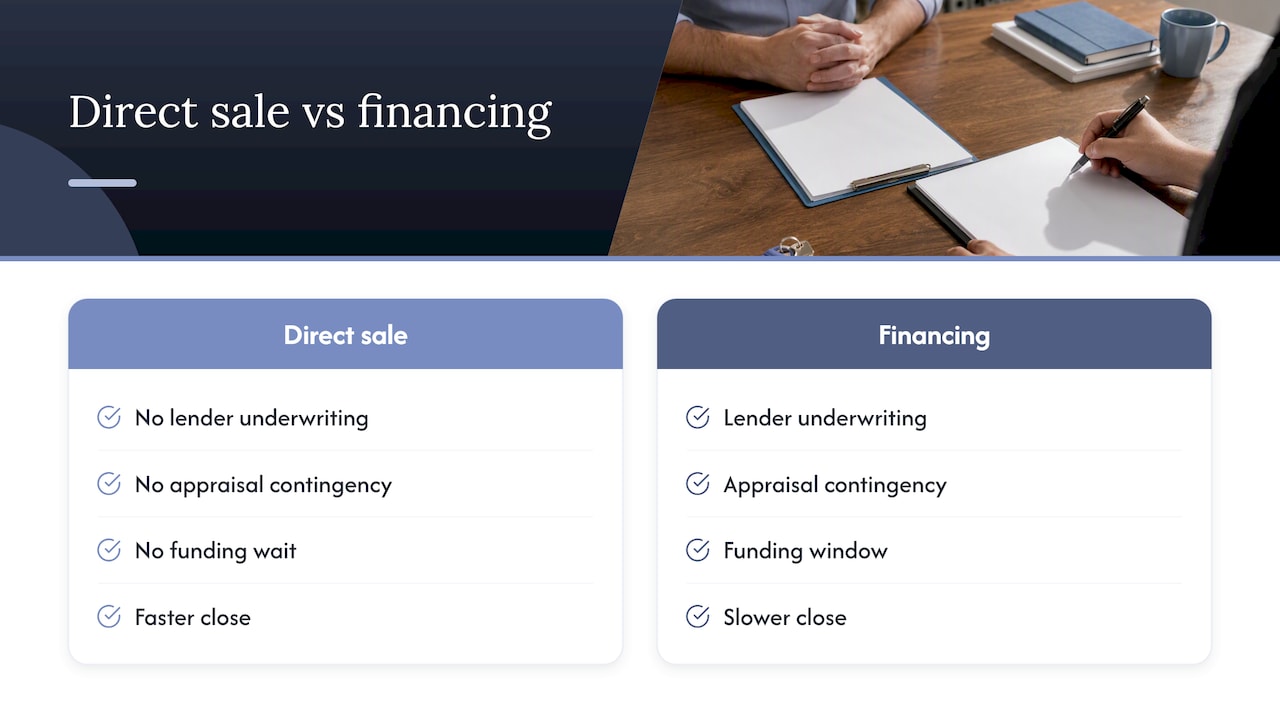
If arranging short-term financing sounds like more risk and paperwork than you want to take on, selling directly to an investor removes that step altogether. There’s no lender underwriting, no appraisal contingency, and no waiting on a funding window, which means a faster close with fewer ways for the deal to fall apart.

Our Sell Your House option gives you a cash offer without the fees, repairs, or closing costs that typically eat into a sale. If you want to see how that compares to working with another investor or lender, our guide on selling your house to an investor lays out the real trade-offs so you can decide with full information.
This article is general information, not a substitute for advice from a qualified financial advisor. Consult a qualified financial professional about your own circumstances before acting on anything here.
FAQ
What is the difference between hard money and private money?
Hard money is generally a subset of private money, with underwriting based mainly on the property’s value rather than borrower credit. Private money is the broader category and can include lenders who also weigh borrower experience, income, or credit history, according to AAPL’s terminology guidance.
What is the difference between private loans and federal loans?
Private loans come from nonbank lenders, investment funds, or individuals and carry terms set by that lender, while federal loan programs come from government agencies with standardized rates and consumer protections. Real estate investors using hard-money or private-money financing are typically dealing with business-purpose private loans, not federal programs.
Why is private credit so attractive?
Private credit appeals to real estate investors because it can close faster than conventional financing and often accommodates deals that don’t fit standard underwriting boxes, such as a property needing major rehab. That flexibility comes with a tradeoff: rates and points tend to run higher than conventional loans, and oversight is lighter than in the regulated mortgage market, per AAPL’s analysis of the private capital markets.
What is a disadvantage of a conventional loan?
Conventional loans typically take longer to close because of extensive income verification, appraisal contingencies, and underwriting review, which can cost an investor a competitive deal. They also tend to have stricter property-condition requirements, making them a poor fit for a distressed property that needs rehab before it can qualify.
Sources
- The Demise of “Hard Money” in a Private Lending World | American Association of Private Lenders
- General solicitation and Rule 506© | U.S. Securities and Exchange Commission