
Highest and best use is the single most profitable use a property could legally and physically support, one that a developer could actually finance and build. It determines a property’s market value regardless of what currently sits on the lot, and it’s tested through four sequential filters: legally permissible, physically possible, financially feasible, and maximally productive. An appraiser or investor who skips this analysis can badly misjudge what a parcel is really worth.
TL;DR:
- A property’s highest and best use depends on legal, physical, financial, and productivity factors applied sequentially to ensure accurate valuation.
- The comparison of land as vacant versus as improved determines whether redevelopment or retention maximizes value, factoring in demolition and renovation costs.
- Market analysis, including supply, demand, rents, and demographic trends, is essential to prove financial feasibility and project’s maximum productivity.
- Environmental, zoning, and entitlement risks can restrict potential uses, and assumptions about rezoning or remediation must be conservative and well-documented.
- The gap between current value and redevelopment potential signals the investment’s risk level, with larger gaps indicating higher upside but also increased execution risk.
Table of Contents
- What Is Highest and Best Use in Real Estate?
- How Do You Analyze a Property “As Vacant” vs. “As Improved”?
- What Market and Financial Analysis Proves Feasibility?
- What Legal and Environmental Constraints Limit Highest and Best Use?
- A Worked Example: Residual Land Value in Practice
- How Should Investors Run an HBU Checklist Before Buying?
- Where Did the Highest and Best Use Concept Come From?
- Where Does Highest and Best Use Analysis Break Down?
- How Does HBU Analysis Play Out Across Different Property Types?
- Why Does HBU Change How Investors Assess Risk?
- A Practitioner’s Take on Where HBU Analysis Actually Goes Wrong
- Sources
What Is Highest and Best Use in Real Estate?
The Appraisal Institute’s definition, echoed in International Valuation Standards, describes highest and best use as the reasonably probable and legal use of vacant land or an improved property that is physically possible, appropriately supported, financially feasible, and results in the highest value. That phrase is the backbone of American appraisal practice, and it shows up in nearly identical form across USPAP guidance and IVS commentary.
The four tests run in strict order, and each one acts as a gate. A use that fails an earlier test never reaches the next one:
- Legally permissible. Zoning ordinances, deed restrictions, easements, and historic overlays define what’s allowed on the site. Pull the zoning map and check for variances or pending rezoning applications before assuming anything with this helpful step-by-step guide to check zoning NSW.
- Physically possible. Lot size, topography, soil conditions, access, and utility availability determine what the site can structurally support. A landlocked half acre can’t host a 40-unit building no matter how attractive the zoning looks on paper.
- Financially feasible. The use has to generate enough return to justify the cost of getting there. This is where market rents, absorption data, and construction costs enter the picture.
- Maximally productive. Among every use that clears the first three tests, this is the one producing the highest residual land value or the highest overall return.
The tests are applied in this exact order because sequencing saves work. There’s no reason to build a financial model for a use that’s illegal.
USPAP requires appraisers to develop an opinion of highest and best use whenever it’s necessary for credible assignment results. That’s not optional boilerplate. In litigation, condemnation, and lending contexts, an appraisal that skips this step is vulnerable to challenge.
How Do You Analyze a Property “As Vacant” vs. “As Improved”?
Every credible HBU study runs two parallel analyses, then compares them.
- Land as though vacant. Strip away the existing structure mentally and ask what use would generate the greatest land value on that site today, given current zoning and market conditions.
- Property as improved. Evaluate the site with its current structure, asking whether the existing improvement adds value versus removing it, and whether renovation, expansion, or conversion would beat straight retention.
- Compare the two conclusions. If land value minus demolition and carrying costs exceeds the value of the property in its current improved state, redevelopment wins. If not, the existing structure still contributes value, and retention is the higher and better use.
That comparison is where excess and surplus land get separated out. Excess land is a distinct, separately developable parcel, like a side lot big enough for its own building. Surplus land supports the existing improvement but has no independent development potential, such as a large side yard required for setback compliance. Excess land gets its own HBU analysis; surplus land doesn’t.
A classic real-world split: a 1960s ranch house on a quarter acre in a rezoned commercial corridor. As improved, the house might rent for $1,800 a month. As vacant, the land could support a small retail pad worth far more once demolition costs are netted out. The as-vacant analysis wins, and that gap is exactly what drives scrape-and-replace economics.
Pro Tip: Never skip the demolition cost line. Investors who mentally treat land as “free” once the house is gone routinely overpay, because clearing a structure, capping utilities, and grading a lot can run tens of thousands of dollars depending on size and hazardous material findings.
What Market and Financial Analysis Proves Feasibility?
Financial feasibility and maximum productivity can’t be argued from intuition. They get proven with numbers, and that starts with market analysis.
A credible market study covers a handful of core inputs, all of which appear in the market-analysis framework that underpins most institutional HBU reports:
- Supply and demand for the proposed use in the immediate trade area
- Absorption rates, meaning how fast comparable new product has leased or sold recently
- Comparable sales and rents for the use under consideration
- Demographic and employment drivers that support or undercut long-term demand
Once the market case is built, the financial test runs through a pro forma. The simplest version of a residual land value calculation looks like this: take the projected value of the completed project (sales revenue or capitalized net operating income), subtract total development costs including hard costs, soft costs, financing, and developer profit, and what’s left is the maximum amount the land can support.
A pro forma is only as good as its sensitivity checks. Run the numbers with construction costs up 15%, with cap rates widening by 50 basis points, and with remediation costs added in. If the conclusion flips under any of those stress tests, the “highest and best use” isn’t nearly as certain as the base case suggests.
Interim uses matter here too. When entitlement risk or market timing makes the ultimate use premature, something like surface parking or a short-term leaseback can be the rational interim highest and best use, generating cash flow while the site waits for its real moment.
What Legal and Environmental Constraints Limit Highest and Best Use?
Zoning is the most visible constraint, but it isn’t the only one, and it isn’t always fixed. A rezoning that the municipality has already signaled through its comprehensive plan is a reasonable assumption to build into an HBU study. A rezoning that depends on political goodwill and no formal process is speculation, and appraisers who bake it in without disclosure are asking for trouble.
- Deed restrictions and easements can quietly override zoning, capping density or use regardless of what the zoning map allows.
- Environmental contamination turns a promising redevelopment site into a financial dead end fast. Remediation for soil or groundwater contamination can run into six figures, and that cost alone frequently disqualifies an otherwise attractive theoretical use from clearing the financial feasibility test.
- Permitting and entitlement timelines are a real economic cost, not a paperwork inconvenience. Every month of delay is carrying cost, and in markets with slow planning departments, that erosion can turn a marginal deal into a loss.
- Tax assessment and condemnation proceedings lean heavily on HBU conclusions. Property tax appeals frequently hinge on proving the assessor used the wrong use in valuing land, and eminent domain compensation cases are fought largely over what use the land would have supported absent the taking.
A site with heavy remediation exposure often gets sold as-is rather than redeveloped. Homeowners facing that exact fork can weigh their options in this guide to selling a house with fire damage.
A Worked Example: Residual Land Value in Practice
Here’s a simplified case. A 0.3 acre parcel currently holds a small single-family rental generating $24,000 a year in net operating income.
Now test the as-vacant redevelopment scenario: rezoning already permits a 6-unit small multifamily building. Projected stabilized NOI is $84,000 a year, and at the same 6% cap rate, the completed project value comes to $1,400,000.
| Line item | Amount |
|---|---|
| Completed project value | A substantial amount |
| Hard and soft construction costs | Significant costs |
| Demolition and site prep | Notable expenses |
| Developer profit target | A calculated percentage |
| Residual land value | Calculated residual value |
The current improved value exceeds the residual land value here, so retention rather than redevelopment is the maximally productive use today. That gap can flip fast, though. If construction costs drop 10% or rents in the area jump enough to push stabilized NOI to $95,000, the residual land value climbs past the improved value and the conclusion reverses.
Pro Tip: Always run the residual land calculation twice, once with a base case demolition and remediation estimate and once with a worst-case number. If both scenarios still favor redevelopment, the conclusion is durable. If only the optimistic case works, that’s not a highest and best use finding, it’s a hope.
How Should Investors Run an HBU Checklist Before Buying?
Before committing capital, gather the documents and answer the questions that separate a defensible HBU opinion from a guess.
Documents to pull:
- Current zoning map and text, plus any pending rezoning applications
- Recent comparable sales for both the current use and the proposed use
- Construction and demolition cost estimates from a local contractor, not a national average
- Phase I environmental report if there’s any history of industrial, agricultural, or automotive use
Questions worth asking the municipality: Has this corridor been rezoned recently, and is there a comprehensive plan update in progress? What’s the realistic entitlement timeline for a project like this one?
Red flags: remediation costs that exceed 10% of projected project value, absorption data showing more than 18 months of unsold or unleased comparable inventory, and any rezoning assumption resting on informal conversations rather than a filed application.
When presenting findings to a lender or investment committee, lead with the conclusion and the two competing values side by side, then attach the supporting evidence. Anyone weighing a redevelopment purchase against a simpler transaction structure should also look at how a novation agreement can reduce upfront capital risk on a value-add acquisition.
Where Did the Highest and Best Use Concept Come From?
The idea traces back to classical economic land-rent theory, where economists like David Ricardo argued that land value reflects its most productive use, not its current occupant’s habits. American appraisal practice formalized that idea through the 20th century as courts wrestled with eminent domain compensation, where the constitutional requirement of “just compensation” forced a consistent method for valuing land based on its potential rather than its present state.
Property tax litigation pushed the concept further. Assessors needed a defensible standard for valuing vacant and underused parcels, and courts increasingly rejected assessments based solely on current use when a clearly more valuable use was legally and financially available. That legal pressure is a big part of why the four-test framework became so rigid and sequential. Courts wanted a repeatable, falsifiable method, not an appraiser’s gut feeling.
By the time USPAP was codified in the late 1980s, highest and best use was already embedded in professional practice. USPAP’s contribution was standardizing the requirement across the profession and tying it to credible assignment results rather than leaving it as a judgment call some appraisers made and others skipped. The concept has stayed remarkably stable since, even as the property types it gets applied to have multiplied from raw farmland to complex mixed-use redevelopment sites.
Where Does Highest and Best Use Analysis Break Down?
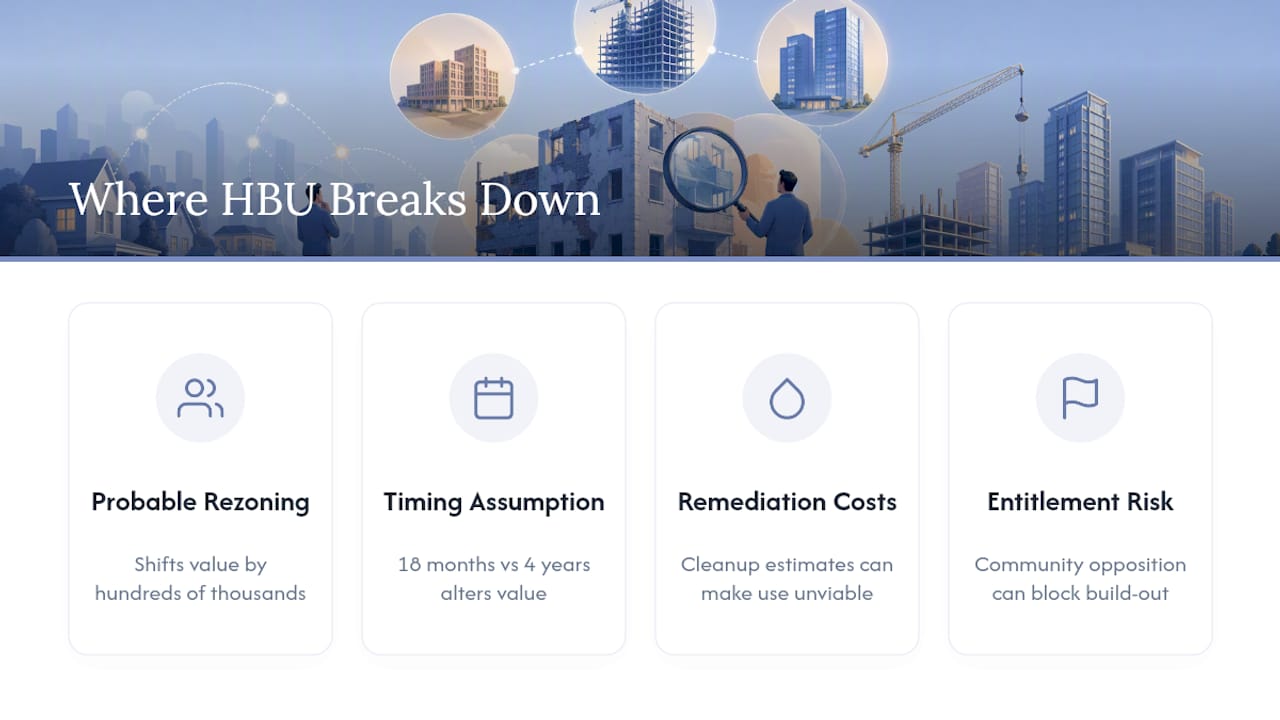
The biggest fight in practice isn’t over the framework, it’s over what counts as “reasonably probable.” Two appraisers looking at the same rezoning application can land on opposite conclusions about whether it’s likely to pass, and that disagreement alone can shift a valuation by hundreds of thousands of dollars.
Timing assumptions cause similar friction. An appraiser who assumes a rezoning happens in 18 months versus one who assumes 4 years will produce wildly different residual land values, since carrying costs compound and market conditions shift over that window. Lenders and assessors tend to punish optimistic timing hardest, because documenting interim-use assumptions explicitly protects the appraiser when a project stalls longer than projected.
Remediation cost estimates are another persistent sticking point. Environmental consultants routinely disagree on cleanup scope, and a use that pencils out under a conservative cost estimate can fail entirely under a more thorough one. Practitioners generally advise treating those numbers conservatively, since a theoretical use requiring significant cleanup often collapses under the financial feasibility test once real bids come in.
There’s also a structural tension between what’s theoretically optimal and what’s actually buildable given community opposition, political resistance to density, or infrastructure capacity limits that never show up on a zoning map. An HBU conclusion that ignores neighborhood pushback on a rezoning isn’t wrong on paper, but it can be practically unworkable, and appraisers who’ve been burned by that gap tend to build in a discount for entitlement uncertainty rather than assume the best case sails through.
How Does HBU Analysis Play Out Across Different Property Types?
A single-family home on an oversized lot in a gentrifying urban neighborhood is the most common scrape-and-replace scenario. The as-improved value reflects a dated three-bedroom ranch; the as-vacant value reflects what a builder would pay for a lot that supports two modern townhomes. Once the gap between those numbers exceeds demolition and carrying costs by a healthy margin, the highest and best use conclusion tips toward redevelopment, and that math is exactly what drives teardown pricing in appreciating markets. Homeowners sitting on that kind of lot can weigh their options in this guide on selling a teardown house.
Agricultural land on the urban fringe tells a different story. As-vacant analysis there often centers on whether annexation or utility extension is realistic within a defensible time horizon, not whether the zoning technically allows it someday. Absent a credible near-term path to urban infrastructure, continued agricultural use frequently remains the highest and best use even when a map shows future residential zoning.
Aging retail centers present a third pattern. A half-empty strip mall on a busy arterial road might show a stronger highest and best use as a mixed-use redevelopment or self-storage conversion than as continued retail, particularly where anchor tenants have already vacated and absorption data shows retail demand softening in that submarket.
Manufactured home communities add another wrinkle entirely: land value under the community frequently outstrips the aggregate value of the housing stock sitting on it, which is exactly why manufactured home park redevelopment has become such an active niche for investors running disciplined HBU math.
Why Does HBU Change How Investors Assess Risk?
An HBU conclusion isn’t just an appraisal exercise, it’s a risk filter for the deal itself. When the highest and best use matches current use, the investment thesis is straightforward: buy at or below improved value, hold or lightly improve, and the risk profile looks like ordinary income-property risk.
When the highest and best use points toward redevelopment, the risk profile changes entirely. Now the investor is underwriting entitlement risk, construction cost risk, and market timing risk on top of the acquisition itself. A deal that pencils beautifully on a base case pro forma can turn negative if permitting drags an extra year or if cap rates widen before stabilization.
That’s why sophisticated investors treat the gap between as-vacant and as-improved value as a signal of how much execution risk they’re taking on, not just a number to plug into an offer. A wide gap means big upside, but it also means the deal depends on things outside the investor’s direct control, like municipal approval timelines and construction labor availability. A narrow gap means less upside, but a much more predictable path to it.
Underwriting discipline matters most exactly here. Investors who build remediation and entitlement contingencies into their offers, rather than assuming the friendliest case, tend to survive the deals where timing slips. Those who don’t are the ones explaining to a lender why the redevelopment they promised in the pro forma is still sitting as a vacant lot two years later.
A Practitioner’s Take on Where HBU Analysis Actually Goes Wrong
Most HBU write-ups get the four tests right and still miss the point. The framework isn’t the hard part. The hard part is honesty about timing and cost assumptions, and that’s where I’d tell any investor to spend their skepticism.
Conventional advice treats zoning as binary: allowed or not allowed. Real deals live in the gray zone where rezoning is plausible but not guaranteed, and that uncertainty deserves a discount, not a footnote. I’ve seen more pro formas break on optimistic entitlement timing than on bad market assumptions.

If you’re underwriting a redevelopment play, prioritize the demolition and remediation numbers before you fall in love with the upside case. A residual land value calculation is only as trustworthy as its weakest input, and that’s almost always the cost side, not the revenue side. Get a real contractor bid before you get excited about a pro forma.
This type of analysis is commonly run on every value-add acquisition, weighing current-use value against redevelopment potential with disciplined underwriting rather than best-case assumptions, which is exactly why offers can hold up once due diligence starts. If your property sits at that kind of crossroads, our guide on selling to an investor walks through what a straightforward sale looks like against a longer redevelopment path, and our breakdown of selling as-is versus fixing up covers the same tradeoff from a different angle. For anything transaction-specific, talk to a licensed appraiser before you commit capital.
— Travis
This article is general information, not a substitute for advice from a qualified financial advisor. Consult a qualified financial professional about your own circumstances before acting on anything here.
Sources
For formal appraisal assignments, start with USPAP’s uniform appraisal standards and the Appraisal Institute’s HBU guidance. For policy and public-interest constraints on redevelopment, the Lincoln Institute’s HBU principles paper is the sharpest practitioner-level resource available. Environmental or entitlement questions belong with a licensed local consultant, not a national guide.
- What is Highest and Best Use in Appraisal? – McKissock Learning
- Uniform Appraisal Standards (archive) – justice.gov
- Highest & Best Use Principles – Lincoln Institute (PDF)
- Understanding the Highest and Best Use (HBU) Analysis in Real Estate – Colliers