
Selling an inherited house is defined as the legal transfer of a deceased person’s real property by their heir or estate representative to a new buyer. The process requires legal authority, an accurate property valuation, and a clear title before any sale can close. Most heirs encounter three immediate challenges: confirming who has the right to sell, understanding the tax implications of the stepped-up cost basis, and deciding whether to list on the open market or pursue a faster cash sale. Getting these three things right from the start protects your proceeds and prevents costly delays.
How to sell an inherited house: securing legal authority first
Legal authority is the single most important requirement before you list, negotiate, or sign anything. Listing or agreeing to sell before receiving proper court authorization risks contract nullification and legal challenges that delay closing. Two documents grant this authority.
Letters Testamentary are issued by a probate court to an executor named in the deceased’s will. Letters of Administration are issued when there is no will, and the court appoints an administrator. Both documents give you the legal standing to sign a deed and transfer title.
The probate process varies significantly by state. Heirs should consult a probate attorney in the state where the property is located, not where they live, because state laws differ drastically. A Texas probate can move in weeks under independent administration, while some states require court supervision of every step.
Three situations allow heirs to bypass probate entirely:
- Transfer-on-death deed: The property passes directly to the named beneficiary without court involvement.
- Joint tenancy with right of survivorship: The surviving owner automatically inherits the deceased’s share.
- Trust ownership: A trustee holds title and can sell under the trust’s terms without probate.
Pro Tip: Get certified copies of the Letters Testamentary or Letters of Administration as soon as the court issues them. Title companies, lenders, and government agencies each require their own original copy, and ordering them later adds weeks to your timeline.
How to secure and prepare the property before selling
Securing the property on day one prevents liability and protects its value. An unoccupied home deteriorates fast. Burst pipes, vandalism, and weather damage can erase tens of thousands of dollars in equity before you even list.
Key steps to take immediately after inheriting:
- Switch the insurance policy. A vacant inherited home often requires a separate vacant home insurance policy because standard homeowner coverage may lapse or exclude unoccupied properties. Vacant home policies cost more, but they are non-negotiable for liability protection.
- Keep utilities active. Running heat in winter and maintaining electricity prevents pipe damage and mold growth.
- Secure the property. Change the locks, check for water leaks, and remove any valuables.
- Order a date-of-death appraisal. A professional appraisal reflecting the exact date of death, rather than a current market appraisal, is critical for accurate tax basis and IRS defense.
- Obtain multiple certified death certificates. Banks, title companies, the IRS, and the DMV each require their own copy. Order at least eight to ten from the county registrar.
Pro Tip: Do not skip the date-of-death appraisal even if you plan to sell quickly. The IRS uses this figure to calculate your capital gains exposure. A missing or inaccurate appraisal is one of the most common and expensive mistakes heirs make.
The condition assessment comes next. Walk the property with a licensed home inspector before deciding whether to sell as-is or invest in repairs. Minor cosmetic updates like fresh paint and landscaping often return more than their cost. Major structural repairs rarely do, especially when the estate needs to close quickly.

What title issues can block the sale of inherited property?
A clean title is required to transfer ownership. Heirs typically need to clear liens, back taxes, and mortgages before completing the sale to avoid title problems and closing complications. A title search, ordered through a title company or real estate attorney, reveals every encumbrance on the property.
| Encumbrance type | What it means | How it affects the sale |
|---|---|---|
| Mortgage balance | Remaining loan owed to lender | Paid off at closing from sale proceeds |
| Reverse mortgage | Loan balance due upon owner’s death | Must be repaid or property sold within set timeframe |
| Property tax liens | Unpaid taxes owed to the county | Must be paid before title transfers |
| HOA dues | Unpaid homeowner association fees | Cleared at closing or negotiated with HOA |
| Mechanic’s liens | Unpaid contractor work | Requires payment or legal release before closing |
Reverse mortgages deserve special attention. When the borrower dies, the loan typically becomes due within a short window. Heirs must either repay the balance, refinance into a new loan, or sell the property to satisfy the debt.
Multiple heirs create another layer of complexity. All co-heirs must agree to sell unless a buyout agreement or court-ordered partition resolves the conflict. Mediation costs far less than litigation and preserves family relationships. If one heir refuses to cooperate, a partition action forces a court-supervised sale, which adds months and legal fees.
About half of U.S. states have adopted the Uniform Partition of Heirs Property Act (UPHPA). This law requires formal appraisals and gives co-heirs the right of first refusal before a forced sale can proceed at below-market prices. If your property is in a UPHPA state, you have meaningful legal protection against being pressured into a bad deal.
How do you price and market an inherited house?
Pricing inherited real estate requires two inputs: the date-of-death appraisal and a current comparative market analysis. The appraisal tells you the tax basis. The market analysis tells you what buyers will pay today. These two numbers are often different, and both matter.
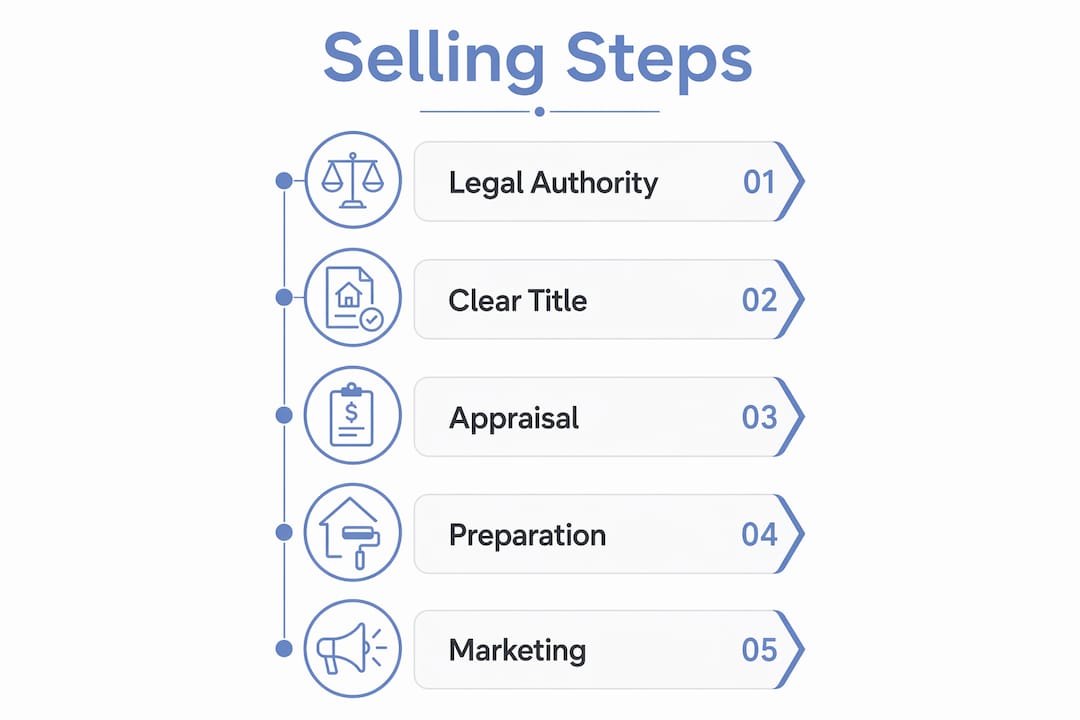
The date-of-death appraisal sets the stepped-up cost basis, which directly reduces your capital gains tax if you sell shortly after inheriting. The lower your taxable gain, the more you keep from the sale.
Heirs have two primary selling channels, each with real tradeoffs:
Listing on the open market generally yields 95–105% of market value but requires more effort, time, and preparation. A cash sale offers speed and fewer contingencies, typically at 60–80% of market value. The right choice depends on the property’s condition, the estate’s timeline, and how many heirs need to agree.
Pro Tip: When multiple heirs are involved, agree on a minimum acceptable price before engaging any buyer. Family disagreements at the offer stage kill deals and create legal costs that eat into everyone’s share.
In many states, probate sales require court confirmation of the sale price, which can add 1–2 months of delay and uncertainty because competing bids may surface at the confirmation hearing. If your state requires this step, price the property to attract serious buyers quickly and avoid drawn-out negotiations.
State-specific disclosure requirements also apply. Most states require heirs to disclose known material defects even when selling as-is. Consult a local real estate attorney to confirm what your state mandates.
How does closing work when selling inherited property?
The closing process for an inherited home follows the same general steps as a standard sale, with a few key differences in who signs and where the money goes.
- Deed execution. The executor or trustee signs the deed in their fiduciary capacity, not as an individual. The deed must clearly identify their legal role (for example, “Jane Smith, Executor of the Estate of John Smith”).
- Title insurance. The buyer’s lender requires a lender’s title insurance policy. Heirs should also purchase an owner’s title policy to protect against future claims tied to the estate.
- Funds go to the estate or trust account. Sale proceeds must flow into a dedicated estate or trust account, not a personal bank account. Commingling funds creates legal and tax problems.
- Lien payoffs and expenses. The title company pays off mortgages, liens, and closing costs directly from the proceeds before distributing the remainder.
- Tax reporting. The estate files IRS Form 1041 if it earns income during administration. Individual heirs report their share of any capital gain on their personal returns using Schedule D.
Key Takeaways
Selling inherited real estate requires legal authority, a clean title, and accurate pricing to protect every heir’s share of the proceeds.
| Point | Details |
|---|---|
| Legal authority comes first | Obtain Letters Testamentary or Letters of Administration before signing any listing agreement or contract. |
| Date-of-death appraisal is non-negotiable | This appraisal sets your tax basis and protects you in an IRS audit. |
| Title search prevents surprises | Clear all liens, back taxes, and mortgages before closing to avoid last-minute deal failures. |
| UPHPA protects co-heirs | About half of U.S. states require formal appraisals and first-refusal rights before a forced sale can proceed. |
| Sale channel affects net proceeds | Open market listings yield more but take longer; cash sales close faster at a lower price. |
What I’ve learned from working with heirs selling inherited homes
The biggest mistake I see heirs make is moving too fast on the wrong things and too slow on the right ones. They rush to list the property before probate closes, then stall for months arguing over price with siblings. That sequence costs everyone money.
The heirs who come out ahead do three things early. They hire a local probate attorney before they do anything else. They order the date-of-death appraisal within the first two weeks. And they have a direct conversation with every co-heir about the minimum acceptable price before a single buyer walks through the door.
Emotional attachment is real and it is valid. But a house that sat in the family for 30 years still has a market value, and buyers do not pay a premium for sentiment. Pricing based on what the family feels the home is worth, rather than what the market will bear, leads to months of carrying costs that eat directly into the final distribution.
Probate timelines also catch heirs off guard. Even in states with efficient processes, expect at least three to six months from filing to receiving Letters Testamentary. Plan your finances accordingly. Carrying a vacant property costs money every month in insurance, taxes, and utilities.
The heirs who handle this process well treat it like a business transaction from the start, while still honoring the emotional weight of what they are going through. Both things are possible at the same time.
— Travis
Selling an inherited home without the usual headaches
Inherited properties come with enough paperwork and family coordination without adding a complicated listing process on top. Decostabuyshomes buys inherited homes directly, often as-is, which means no repair costs, no open houses, and no waiting for a buyer’s financing to fall through.
The team at Decostabuyshomes understands probate timelines, co-heir dynamics, and the title issues that show up in inherited properties. That experience means a fair offer that reflects the real condition of the home and a closing schedule that works around the estate’s needs. If you need to sell an inherited property without the drawn-out process, reach out to Decostabuyshomes for a no-obligation offer.
FAQ
What legal document do I need to sell an inherited house?
You need either Letters Testamentary (if there is a will) or Letters of Administration (if there is no will), both issued by a probate court. Without one of these documents, any sale agreement you sign can be voided.
How does the stepped-up basis reduce taxes on an inherited home?
The stepped-up basis resets your cost basis to the property’s fair market value on the date of death. If you sell shortly after inheriting, your taxable capital gain is the difference between the sale price and that stepped-up value, which is often very small.
Can heirs sell an inherited house without going through probate?
Yes, if the property was held in a living trust, as joint tenancy with right of survivorship, or with a transfer-on-death deed, probate is not required. The trustee or surviving owner can sell directly without court involvement.
What happens if one heir refuses to sell the inherited property?
If co-heirs cannot agree, any heir can file a partition action in court to force a sale. Mediation is a faster and less expensive alternative that resolves most disputes before litigation becomes necessary.
How long does it take to sell an inherited house?
The timeline depends on whether probate is required. Probate can take three to twelve months depending on the state and estate complexity. Once legal authority is in hand, a cash sale can close in as little as two to three weeks, while a traditional listing typically takes sixty to ninety days.