
Selling a house as is in Michigan means listing your property in its current condition, making zero repairs, while still fulfilling every legal disclosure obligation the state requires. This approach suits homeowners facing financial pressure, inherited properties, or homes with deferred maintenance that would cost more to fix than the repairs would return. Michigan law mandates a Seller’s Disclosure Statement for all home sales, and seller closing costs typically run 7%–10% of the sale price, including agent commissions of 5%–6%. Understanding those numbers before you list protects you from surprises at the closing table.
What legal requirements apply when selling a house as is in Michigan?
Michigan law requires a Seller’s Disclosure Statement for every home sale, including as-is transactions. Selling as-is does not exempt you from disclosing known defects. The phrase “as-is” signals that you will not make repairs. It does not signal that buyers waive their right to know what is wrong with the property.
Failure to disclose known defects exposes you to legal action after the sale closes. Courts in Michigan have held sellers liable for concealing structural issues, water intrusion, and HVAC failures. A real estate attorney reviewing your disclosure statement before listing adds a layer of protection that a standard agent cannot provide.
Federal law adds another layer for older homes. Lead-based paint disclosure is mandatory in all states for homes built before 1978, with no exceptions for as-is sales. Buyers receive a 10-day window to test for lead paint unless they waive it in writing. Environmental hazards beyond lead paint, including underground storage tanks and known mold, also require disclosure under Michigan statute.
Key disclosure obligations at a glance:
- Seller’s Disclosure Statement: Required for all Michigan home sales, as-is or not
- Lead-based paint addendum: Mandatory for pre-1978 construction
- Known structural defects: Foundation cracks, roof leaks, and water damage must be disclosed
- Environmental hazards: Mold, asbestos, and contaminated wells require written notice
- HOA violations or liens: Any encumbrances on title must be reported
Pro Tip: Hire a real estate attorney to review your completed disclosure statement before you sign a listing agreement. Attorney fees for this review typically run $200–$400 and can prevent five-figure legal disputes after closing.
How should you price and prepare your Michigan home when selling as-is?
Accurate pricing is the single most important decision in an as-is sale. As-is homes typically sell for 5%–15% less than renovated comparables, depending on condition. Pricing 15%–20% below fully renovated comps moves a property faster. Pricing closer to 10% below works when the home is livable with only cosmetic issues.

The most common pricing mistake sellers make is pulling comps from renovated homes and applying a rough discount. That method produces unrealistic expectations. The correct approach uses a comparative market analysis, or CMA, built from actual as-is and distressed sales in your zip code. Your agent or an appraiser can pull those specific comps from MLS data.
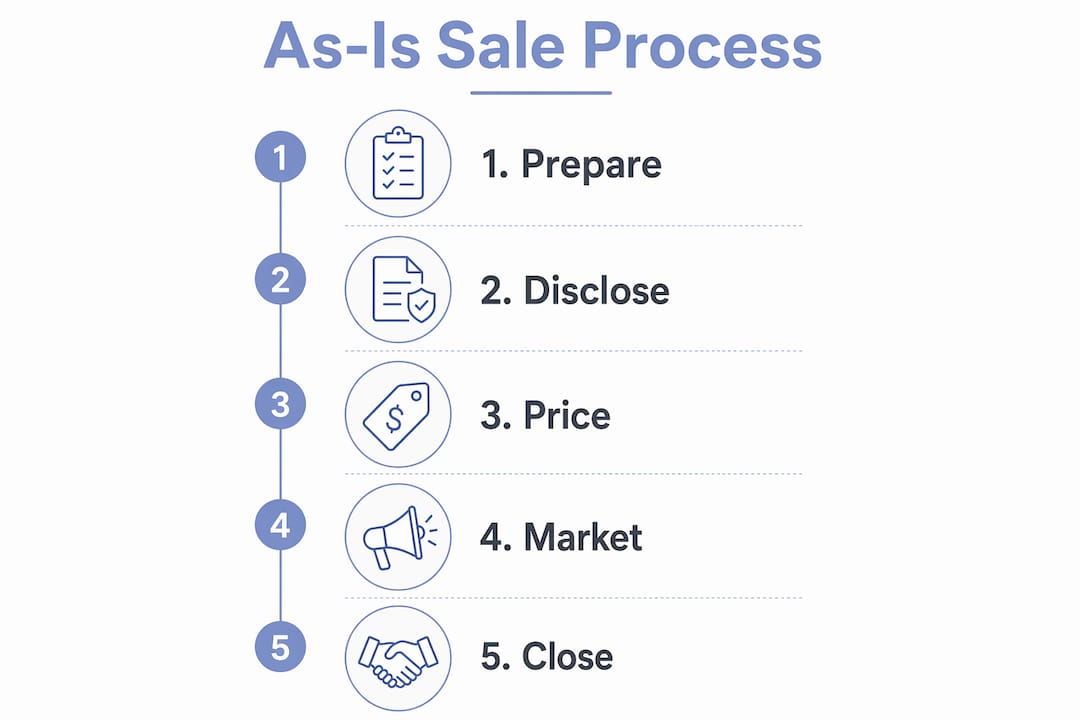
A pre-listing inspection costs $300–$500 and pays for itself by reducing renegotiations. When buyers see a completed inspection report upfront, they bid with confidence rather than padding their offers with a large repair buffer. Transparency at the listing stage shortens the negotiation cycle.
Low-cost preparation steps that improve buyer perception without triggering major repair costs:
| Improvement | Estimated Cost | Impact |
|---|---|---|
| Deep cleaning, inside and out | $150–$400 | Removes buyer’s first negative impression |
| Fresh neutral paint in main rooms | $300–$800 | Increases perceived livability |
| Basic landscaping and curb appeal | $100–$300 | Improves online listing photos |
| Decluttering and staging key rooms | $0–$200 | Helps buyers visualize the space |
| Replacing burned-out bulbs and fixtures | $50–$150 | Signals basic maintenance care |
Avoid expensive repairs that will not return their cost. A new roof on a $180,000 as-is home rarely adds $20,000 to the sale price. Spend on presentation, not renovation.
Pro Tip: Ask your agent to run comps specifically labeled “as-is,” “sold as-is,” or “investor sale” in the MLS remarks. Those sales give you the most accurate pricing baseline for your property.
What are the most effective marketing strategies for an as-is property sale?
Listing on the MLS generates competitive tension among buyers, which typically produces higher proceeds than a private cash offer. As-is is a marketing decision, not a discount coupon reserved for investors. Broad exposure attracts renovation loan buyers, owner-occupants willing to do their own work, and investors simultaneously.
Flat fee MLS services let you list without paying a full listing commission. Flat fee MLS services range from $95 to $998, compared to the 2.5%–3% listing side of a traditional commission. You still offer a buyer’s agent commission to attract represented buyers, but your total cost drops significantly.
The most effective buyer categories to target for as-is sales:
- Real estate investors and flippers: They move fast, pay cash, and skip financing contingencies. Expect offers at 60%–80% of after-repair value.
- Renovation loan buyers (FHA 203k, Fannie Mae HomeStyle): These buyers finance both the purchase and repairs in one loan. They pay closer to market value and are underused by as-is sellers.
- Owner-occupants with cash reserves: Buyers who want a deal and have the skills or budget to handle repairs themselves. They often outbid investors on livable properties.
- Wholesale buyers: They assign your contract to another investor. Offers are the lowest of any category, but closings happen in days.
- Target your listing photos toward the property’s potential, not its current flaws
- Write listing copy that names the neighborhood, lot size, and structural positives
- Disclose condition issues in the agent remarks, not the public description
- Price to attract multiple offers rather than one lowball negotiation
When to hire an agent with as-is experience: if your property has significant deferred maintenance, title complications, or you are selling inherited property in Michigan, an experienced agent reduces the risk of deal fallout from buyer cold feet.
What should you expect during the as-is sale process?
Buyers will still conduct inspections in an as-is sale. “As-is” means you will not make repairs, not that buyers forfeit their right to inspect. Most purchase agreements include an inspection contingency, and buyers use inspection findings to renegotiate price or walk away. You can counter by holding firm on price and pointing to your pre-listing inspection report.
Cash buyers offer speed and certainty but pay 60%–80% of after-repair value. That discount exists because the investor absorbs all repair costs and market risk. On a home with an after-repair value of $250,000 and $40,000 in needed repairs, a cash offer might land between $150,000 and $200,000. That gap is real, and sellers should weigh it against the time and cost of a traditional listing.
Transparency is your strongest negotiating tool in an as-is sale. Sellers who disclose everything upfront, price accurately, and respond to offers with market data close faster and face fewer post-sale disputes than sellers who hide problems and hope buyers miss them.
Common mistakes to avoid:
- Accepting the first cash offer without MLS exposure: You may leave tens of thousands on the table
- Using renovated comps to set your price: Leads to overpricing and extended days on market
- Refusing all contingencies: Financing and inspection contingencies are normal; eliminating them entirely narrows your buyer pool
- Skipping the disclosure statement: No legal exception exists for as-is sales in Michigan
- Ignoring the timeline difference: Cash transactions close in 7–21 days; financed deals take 30–60 days
For sellers comparing as-is sales across neighboring states, the legal framework differs but the pricing dynamics are similar.
Key Takeaways
Selling a house as is in Michigan requires accurate pricing, full legal disclosure, and broad market exposure to achieve the best possible outcome.
| Point | Details |
|---|---|
| Disclosure is not optional | Michigan requires a Seller’s Disclosure Statement even for as-is sales; omitting known defects creates legal liability. |
| Price from as-is comps | As-is homes sell 5%–15% below renovated comparables; use distressed sale data, not renovated comps. |
| MLS beats private offers | Listing on the MLS generates competitive bidding and typically yields higher proceeds than a single cash offer. |
| Pre-listing inspection pays off | A $300–$500 inspection reduces renegotiations and builds buyer confidence before offers arrive. |
| Cash offers trade price for speed | Cash buyers pay 60%–80% of after-repair value; weigh that discount against your timeline and repair budget. |
What I’ve learned from watching sellers leave money on the table
Most sellers who contact me about as-is sales have already received a cash offer from an investor. They want to know if it is fair. Nine times out of ten, the offer is not unfair. It is just the first offer, and the seller has no competing data to push back with.
The sellers who do best are the ones who treat as-is as a marketing position, not a surrender. They get a pre-listing inspection, pull real comps, list on the MLS for two to three weeks, and then evaluate all offers together. That process regularly produces 10%–20% more than the first private offer they received.
I also see sellers skip disclosure out of fear that it will kill the deal. That instinct is exactly backward. Buyers who discover undisclosed problems during inspection walk away or demand massive credits. Buyers who see a thorough disclosure upfront trust the seller and bid with confidence. Disclosure integrity is not just a legal requirement. It is a sales strategy.
One more thing: do not confuse speed with value. A seven-day cash close sounds appealing when you are stressed. But if that speed costs you $30,000 compared to a 45-day MLS sale, you are paying a very high price for convenience. Run the math before you sign anything.
— Travis
How Decostabuyshomes works with Michigan homeowners selling as-is
Michigan homeowners who want a straightforward path to selling their property without repairs have options beyond the standard listing process.
Decostabuyshomes works directly with sellers to evaluate as-is properties, provide transparent cash offers, and handle the paperwork from contract to close. The company’s approach centers on giving sellers multiple options rather than a single take-it-or-leave-it number. Whether your property is a single-family home, a manufactured home, or an inherited property with title complications, Decostabuyshomes structures solutions around your timeline and goals. Visit Decostabuyshomes to request a no-obligation consultation and get a clear picture of what your Michigan home is worth in its current condition.
FAQ
Does selling as-is in Michigan eliminate disclosure requirements?
No. Michigan law requires a Seller’s Disclosure Statement for all home sales, including as-is transactions. Failing to disclose known defects exposes sellers to post-sale legal liability.
How much less will I get for an as-is home in Michigan?
As-is homes typically sell for 5%–15% less than renovated comparables. The exact discount depends on condition, location, and how many buyers compete for the property.
Should I accept a cash offer or list on the MLS?
Listing on the MLS generates competitive offers and typically produces higher proceeds. Cash offers close faster but pay 60%–80% of after-repair value, which is a significant discount on most properties.
What is a pre-listing inspection and do I need one for an as-is sale?
A pre-listing inspection is a professional evaluation of your home’s condition completed before you list. It costs $300–$500 and reduces buyer renegotiations by giving all parties the same information upfront.
What are typical closing costs for sellers in Michigan?
Seller closing costs in Michigan run 7%–10% of the sale price. On a $250,000 home, agent commissions alone total $12,500–$15,000, with transfer taxes adding roughly $2,150.