
Selling a house as is in NY means listing your property in its current condition without making repairs, but New York law still requires you to disclose known defects. Under New York Real Property Law Section 462, sellers of one-to-four-unit residential properties must provide a Property Condition Disclosure Statement (PCDS) or give the buyer a $500 credit at closing. That credit is widely misunderstood. It does not waive your obligation to disclose material defects, and it does not protect you from a lawsuit if you actively conceal a problem. Knowing these rules upfront is what separates a smooth as-is sale from a costly legal dispute.
What does selling a house as is in NY legally require?
Selling as is is primarily a marketing and contract term. It sets buyer expectations early, but it does not reduce your legal obligations under New York state law.
The PCDS covers structural conditions, water damage, environmental hazards, and mechanical systems for all 1–4 unit residential properties. Sellers must complete it honestly before listing. The PCDS requirement applies whether you sell through an agent, list on the MLS, or sell directly to a cash buyer.
Key disclosure obligations include:
- Property Condition Disclosure Statement: Required for all 1–4 unit residential sales in New York. Skipping it means offering the buyer a $500 credit, not escaping liability.
- Lead-based paint disclosure: Federal law requires this for any home built before 1978. Non-disclosure can result in significant legal penalties and lawsuits even after closing.
- Open NYC Department of Buildings (DOB) violations: Open violations must be disclosed. Major violations can discount your sale price by tens of thousands of dollars, and buyers assume responsibility for curing them post-sale.
- Fraudulent concealment: Actively hiding a known defect exposes you to post-closing litigation regardless of any as-is contract language.
Pro Tip: The $500 PCDS credit is not a shortcut. Sellers who rely on it instead of completing the disclosure form carry higher legal risk if a concealed defect surfaces after closing.
How does selling as is affect your price and buyer pool?
An as-is sale almost always means accepting a lower price than a fully renovated comparable. The size of that discount depends on the severity of the property’s condition and which buyers you attract.

Who buys as-is homes in New York?
The buyer pool for as-is homes includes cash investors, house flippers, FHA 203(k) buyers, and first-time buyers willing to do sweat equity. Each group has different financing constraints and price expectations.
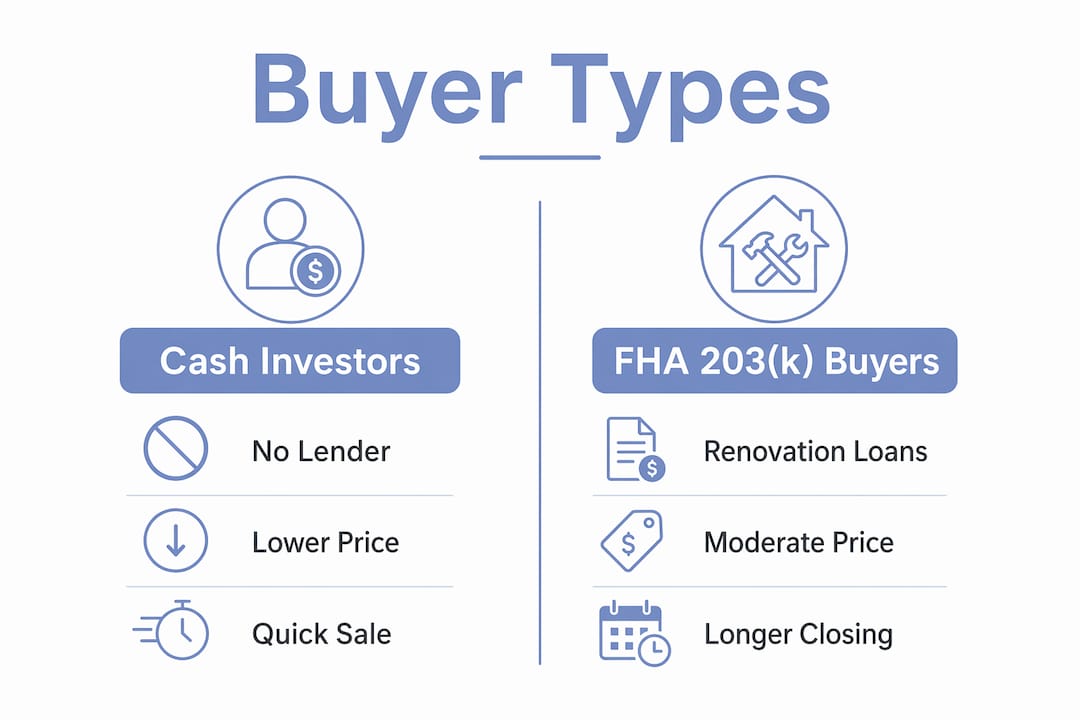
| Buyer type | Financing | Price expectation |
|---|---|---|
| Cash investor / flipper | No lender required | Lowest offers, fastest close |
| FHA 203(k) buyer | Renovation loan, lender required | Moderate, needs habitability baseline |
| Conventional buyer | Standard mortgage, strict appraisal | Closest to market value, slowest process |
| Sweat equity buyer | FHA or conventional | Moderate, tolerates cosmetic issues |
Conventional and FHA loans require minimum habitability standards. A property with a failed roof, no functioning heat, or significant structural damage will not qualify for standard financing. That limits your pool to cash buyers, which reduces competition and drives prices down.
The MLS versus private cash offers
Investors who approach sellers directly typically follow the 70% rule: they offer 70% of the after-repair value minus estimated repair costs. Listing as-is on the MLS exposes the property to competing buyers and often increases net seller proceeds by tens of thousands of dollars. Sellers who rely on cash offers alone risk accepting significantly less than the competitive market price. Competition among multiple investors bidding on MLS listings frequently improves offers beyond what any single private buyer will propose.
Pro Tip: Price your as-is home against actual as-is comparables, not renovated sales. Pricing correctly to the as-is market prevents stale listings and speeds up your sale.
How to sell your house as is in New York: step by step
A well-executed as-is sale follows a clear sequence. Skipping steps creates renegotiation risk and legal exposure.
-
Get a pre-listing inspection. A professional inspection costs roughly $300–$500 and gives you defensible documentation of your property’s condition. Sellers who proactively disclose inspection reports attract serious buyers and avoid deal-breaking surprises during the buyer’s due diligence period.
-
Complete your disclosures before listing. Fill out the PCDS accurately. If your home was built before 1978, attach the federal lead-based paint disclosure. Pull a DOB violation search and disclose any open items.
-
Price based on as-is comparables and repair estimates. Pull recent sales of similar distressed or unrenovated properties in your neighborhood. Subtract realistic repair costs from renovated comps to establish a defensible asking price. A comprehensive pre-listing inspection combined with repair estimates can justify your pricing and speed up investor due diligence.
-
List on the MLS and market to investors. An MLS listing reaches the widest buyer pool. Add language in the listing that the property is sold as is, subject to all inspections. Target investor networks, wholesaler groups, and renovation-focused buyers through your agent’s marketing.
-
Use clear as-is contract language. Proper contract language and legal review reduces buyer renegotiations and post-sale disputes. Specify in writing that no repairs will be made and that the buyer accepts the property in its current condition.
-
Negotiate inspection contingencies carefully. Buyers may still request an inspection period. Decide in advance whether you will accept inspection contingencies or require a waiver. Cash buyers often waive inspections entirely, which speeds closing.
-
Close with a real estate attorney. New York is an attorney-closing state. Your attorney reviews the contract, handles title, and protects you from last-minute renegotiations based on inspection findings.
Common challenges when selling a distressed property in New York
Overpricing is the single biggest mistake as-is sellers make. A home priced at renovated-market value will sit on the market, accumulate days on market, and eventually sell for less than a correctly priced listing would have.
“Paint, cleaning, and curb appeal improvements frequently attract more buyers and better prices. Targeted cosmetic repairs often yield better net returns than full renovations, especially in New York boroughs like Staten Island and Brooklyn.” — Joseph Ranola, Ranola Real Estate
Open DOB violations are another common obstacle. Buyers and their attorneys will pull a DOB search during due diligence. Undisclosed violations discovered late in the process give buyers leverage to renegotiate or walk away. Disclosing them upfront and adjusting your price accordingly keeps deals together.
Financing limitations create a narrower buyer pool than most sellers expect. Properties with major structural issues, mold, or code violations will not qualify for conventional or FHA loans. Sellers of these properties should price and market specifically to cash buyers and renovation investors from day one.
Small cosmetic fixes do pay off. Cosmetic fixes generally return positive ROI, while major renovations rarely recoup their costs in as-is sales. Cleaning, decluttering, fresh paint, and basic landscaping cost little but widen your buyer pool and support a higher asking price without crossing into full renovation territory.
If you are selling an inherited property, the process adds probate and title considerations on top of the standard as-is steps. A step-by-step guide to selling an inherited house can help you navigate those additional layers before you list.
Key Takeaways
Selling a house as is in New York requires honest disclosure, realistic pricing, and MLS exposure to maximize net proceeds while minimizing legal risk.
| Point | Details |
|---|---|
| Disclosure is mandatory | The PCDS is required by law; the $500 credit does not replace it or protect against concealment liability. |
| MLS beats private offers | Listing on the MLS creates competition that typically yields higher net proceeds than a single cash investor offer. |
| Pre-listing inspection pays off | A $300–$500 inspection documents condition, supports pricing, and reduces renegotiation risk at closing. |
| Cosmetic fixes improve returns | Paint, cleaning, and curb appeal improvements increase buyer interest without the cost of full renovation. |
| Price to as-is comparables | Pricing against renovated comps causes stale listings; correct as-is pricing speeds up the sale. |
What I’ve learned from watching sellers get this wrong
Most sellers who struggle with an as-is sale make the same two mistakes: they overprice, and they underdisclose. Both feel like self-protection in the moment. Neither one works.
Overpricing an as-is property does not protect your equity. It burns time on market, signals desperation to buyers, and usually results in a lower final price than a correctly priced listing would have achieved in the first week. I have watched sellers hold out for renovated-comp pricing on a property with a failed foundation, only to accept a lowball offer six months later after the listing went stale.
Underdisclosing is worse. The $500 PCDS credit is the most misunderstood tool in New York real estate. Sellers treat it as a get-out-of-jail-free card. It is not. If a buyer discovers a concealed defect after closing, that $500 credit will not stop a lawsuit. Full disclosure, backed by a pre-listing inspection report, is the only real protection you have.
The sellers I have seen do this well share one habit: they get the inspection done before they list, price honestly against as-is comps, and put everything on the table. That transparency does not scare buyers away. It attracts the right buyers and keeps deals from falling apart at the finish line. If you are selling a distressed property in New York, that combination of honesty and realistic pricing is your best path to a clean close.
— Travis
How Decostabuyshomes works with as-is sellers in New York
Decostabuyshomes works directly with New York homeowners who need to sell without making repairs. Whether you are dealing with a distressed property, an inherited home, or a house with open violations, Decostabuyshomes provides multiple selling options rather than a single take-it-or-leave-it cash offer. The process covers legal disclosure guidance, realistic pricing based on current market conditions, and access to a broad pool of investors and cash buyers. For homeowners comparing options across state lines, the as-is selling guide for Virginia offers useful context on how these transactions work in neighboring markets. To get started with a no-obligation conversation about your New York property, visit Decostabuyshomes.
FAQ
What is the Property Condition Disclosure Statement in New York?
The Property Condition Disclosure Statement is a form required by New York Real Property Law Section 462 for all 1–4 unit residential sales. Sellers must disclose known defects, or provide the buyer a $500 credit at closing.
Does selling as is mean I don’t have to disclose defects?
No. Selling as is limits your repair obligations but not your duty to disclose. Concealing known defects exposes you to legal liability even after the sale closes.
Will my as-is home qualify for FHA or conventional financing?
Properties with major structural issues, mold, or code violations typically do not meet FHA or conventional loan habitability standards. Most as-is sales in poor condition close with cash buyers or FHA 203(k) renovation loans.
Should I list on the MLS or sell directly to a cash buyer?
Listing on the MLS creates competition among buyers and typically produces higher net proceeds than a single private cash offer. Direct cash sales close faster but usually at a steeper discount.
How much does a pre-listing inspection cost in New York?
A pre-listing inspection typically costs $300–$500. It documents your property’s condition, supports your asking price, and reduces the risk of renegotiation during the buyer’s due diligence period.