
The fastest way to sell a hoarder house is either a direct cash offer from an investor (close in days to weeks, no cleanup required) or a targeted clean-and-rehab followed by a traditional listing. Which one wins for you comes down to one number: what it costs to make the house market-ready versus how much more you’d net after those repairs.
Here are the three realistic paths:
- Sell as-is to a cash buyer or investor. No cleanup, no showings, close in as few as 7–21 days. You accept a lower price in exchange for speed and zero out-of-pocket costs.
- Estate sale or auction plus partial cleanout. Recover value from contents first, then sell the empty or partially cleared property. Best when the house holds collectibles, antiques, or high-volume personal property.
- Full cleanout and rehab, then list on the open market. Highest potential net proceeds, but requires weeks to months of work and upfront capital.
If your repair estimate plus holding costs exceeds the incremental gain from a retail sale, the as-is route almost always wins. If the numbers flip, and the house is in a strong market with modest repairs needed, rehab and list. Everything else in this guide helps you figure out which side of that line you’re on.
Table of Contents
- How do you assess a hoarder house before choosing a sale path?
- What are your options for clearing out a hoarder house?
- Should you rehab the hoarder property or sell it as-is?
- How do investor and cash-buyer offers work on a hoarder property?
- When do estate sales or auctions make sense for a hoarder property?
- What do cleanout, rehab, and as-is sales actually cost and how long do they take?
- What legal and safety obligations apply when selling a hoarder house?
- Questions to ask buyers, cleanout crews, and estate-sale companies
- How Decostabuyshomes helps sellers who want a fast, as-is sale
- Key Takeaways
- The mistake most sellers make with a hoarder house
- Ready to skip the cleanup? Here’s how to get a cash offer from Decostabuyshomes
- Where to verify facts and find vetted vendors
How do you assess a hoarder house before choosing a sale path?
Before you commit to any route, you need a clear-eyed look at what you’re actually dealing with. A walkthrough with a checklist takes an hour and can save you from a $40,000 mistake.
What to look for:
- Mold and water damage. Check ceilings, walls near windows, and under sinks. Discoloration, soft drywall, or a musty smell are red flags.
- Pest evidence. Rodent droppings, insect nests, or chewed wiring are common in severe hoarding situations where food and debris have accumulated for years.
- Blocked mechanicals. If the HVAC, plumbing access, or electrical panel is buried or inaccessible, you can’t get a reliable repair estimate until the space is cleared.
- Structural signals. Sagging floors, bowing walls, or visible roof leaks suggest damage that goes beyond cosmetic cleanup.
- Biohazards. Human or animal waste, sharps, or chemical storage require licensed remediation, not a standard junk crew.
Take date-stamped photos of every room and every defect you find. These protect you during disclosure and give contractors a baseline for bidding.
Pro Tip: Before you schedule any cleanout crew or contractor, get a licensed structural engineer or home inspector to walk the property. A $300–$500 inspection report can reveal hidden damage that changes your entire sale strategy, and it gives you documented evidence for disclosure.
Professional cleanout firms bring equipment, PPE, and disposal plans that meet local regulations, which is especially important when the scope of hoarding is severe. If you find biohazards, stop and call a licensed remediation company before anyone else enters the property.
What are your options for clearing out a hoarder house?
Clearance is where most sellers get stuck, either emotionally or financially. The good news is you have four realistic options, and they are not mutually exclusive.

DIY cleanout
DIY works when the hoarding is primarily clutter (paper, clothing, general household items) with no biohazards, no structural damage, and when you have the time and physical capacity to do it. Budget for dumpster rentals, disposal fees, and your own labor. The hidden cost is time: a severe hoard in a 2,000-square-foot house can take weeks of sustained effort.
DIY is not realistic when there is mold, pest infestation, animal waste, or any material that requires special disposal. Attempting it without proper PPE puts you at genuine health risk.
Estate sale and auction companies
Estate sale companies come in, price and sell the contents, and typically take a percentage of proceeds as their fee. Fees and timelines vary by company and region, but most firms charge a substantial percentage of gross sales as their fee. The tradeoff: they handle the pricing, the buyers, and the foot traffic, but they will not remove items that don’t sell. You still need a plan for what’s left.
Auctions work similarly but move faster and often attract dealers and collectors who pay fair prices for unique items. They make the most sense when the house contains antiques, tools, collectibles, or high-value furniture.
Professional junk removal
Junk removal companies haul everything out, regardless of value. They are fast (often one to two days for a full house) and handle disposal. Professional cleanouts for hoarder houses commonly cost thousands of dollars depending on severity, with costs escalating when mold or biohazard remediation is also required.
Biohazard remediation
When the property contains human or animal waste, mold colonies, or chemical hazards, standard junk crews cannot legally or safely handle the job. You need a licensed biohazard remediation company. Always verify their state license and ask for proof of liability insurance before they enter.
Clearance option comparison:
| Option | Typical Cost | Timeline | Best For |
|---|---|---|---|
| DIY cleanout | Dumpster fees + labor | Days to weeks | Light clutter, no hazards |
| Estate sale company | 25%–40% of proceeds | 2–3 weeks to schedule | High-value contents |
| Professional junk removal | Thousands of dollars and up | 1–3 days | Full haul-out, no sorting |
| Biohazard remediation | Thousands of dollars and up | Days to weeks | Waste, mold, chemical hazards |
Should you rehab the hoarder property or sell it as-is?

This is the core decision, and it comes down to math. The as-is vs. fixing up decision guide from Decostabuyshomes lays out the framework clearly: if your repair costs plus holding costs exceed the incremental gain from a retail sale, the as-is route wins.
Here’s a worked example. Say the house has an after-repair value (ARV) of $280,000 in your local market. A retail buyer in move-in condition might pay $265,000. Now add up what it takes to get there:
- Cleanout and junk removal: $5,000
- Mold remediation: $8,000
- Plumbing and HVAC repairs: $15,000
- Cosmetic updates (paint, flooring, fixtures): $18,000
- Staging: $2,000 (professional staging packages commonly run $600–$4,000)
- Holding costs (mortgage, taxes, insurance, utilities for 3–4 months): $7,000
- Agent commissions and closing costs: $16,000
Total cost to rehab and list: roughly $71,000. Net proceeds: approximately $194,000.
Now compare that to a cash investor offer. An investor buying as-is might offer $185,000–$195,000 on a $280,000 ARV property, depending on their repair estimate and margin. You close in two to three weeks, pay no commissions, and spend nothing on cleanup. The net difference can be surprisingly small, and sometimes the as-is route actually comes out ahead once you account for the full cost of carrying the property.
When rehab costs approach or exceed the home’s after-repair value, sellers most often benefit from an as-is cash sale rather than investing in a losing renovation.
Pro Tip: Get at least two itemized contractor bids and one independent appraisal before you decide. Then request an as-is cash offer from an investor at the same time. Comparing the net numbers side by side, not just the headline prices, is the only way to make a fully informed decision.
How do investor and cash-buyer offers work on a hoarder property?
Investors subtract estimated repair and holding costs plus their profit margin when making offers, which explains why the number is lower than a retail sale. Understanding the math helps you evaluate whether an offer is fair or a lowball.
The typical process:
- You contact the investor and describe the property.
- They schedule a walkthrough (in person or via photos/video for remote properties).
- They deliver a written offer with a net proceeds estimate and a proposed closing date.
- You review, negotiate if needed, and sign a purchase agreement.
- Title work proceeds; cash closings can happen in as few as 7–21 days.
What investors subtract from ARV:
- Estimated repair and renovation budget
- Holding costs (taxes, insurance, utilities during their rehab period)
- Closing costs on both the buy and resale sides
- Their profit margin (typically 10%–20% of ARV)
As-is hoarder homes often attract investors and may sit longer if listed to the general market, which is why going directly to a cash buyer skips the uncertainty of a prolonged listing.
Before you sign, verify:
- Proof of funds (bank statement or hard-money commitment letter, not just a verbal claim)
- Clear purchase terms in writing, including price, closing date, and who pays closing costs
- Whether the offer has contingencies (inspection, financing) that could let them renegotiate
- Their track record: closed deals, references, or verifiable reviews
For more on vetting cash buyers, the cash home buyers legitimacy guide from Decostabuyshomes covers the red flags in detail.
When do estate sales or auctions make sense for a hoarder property?
Estate sales and auctions are not a full solution, but they can meaningfully reduce your net cleanup cost when the house contains items worth selling.
The practical rule: if the contents include antiques, collectibles, tools, jewelry, or high-quality furniture, an estate sale or auction can recover enough value to offset a significant portion of your cleanout costs. If the contents are primarily worn household goods and trash, the math rarely works in your favor.
Estate sale companies handle pricing, advertising, and running the sale over one to three days. They take a percentage of gross proceeds, commonly 25%–40%. What they do not do: haul away unsold items. You will need a junk removal crew for whatever is left after the sale.
Auctions move faster and attract dealers who can pay fair market value for unique pieces. Online auction platforms have expanded the buyer pool considerably for specialty items. The tradeoff is less control over final prices.
Practical use cases where estate sales or auctions make sense:
- An heir selling a parent’s estate with decades of accumulated collectibles or antiques
- A property with high-value tools, equipment, or a workshop
- A seller who wants to reduce haul-away costs before an as-is sale
- A situation where the estate needs to generate cash to cover probate or carrying costs
If you’re an heir managing a property with multiple family members involved, the inherited property with multiple owners guide from Decostabuyshomes covers the decision-making and signature requirements in detail.
What do cleanout, rehab, and as-is sales actually cost and how long do they take?
Setting realistic expectations upfront prevents the most common mistake sellers make: underestimating total costs and then running out of runway mid-rehab.
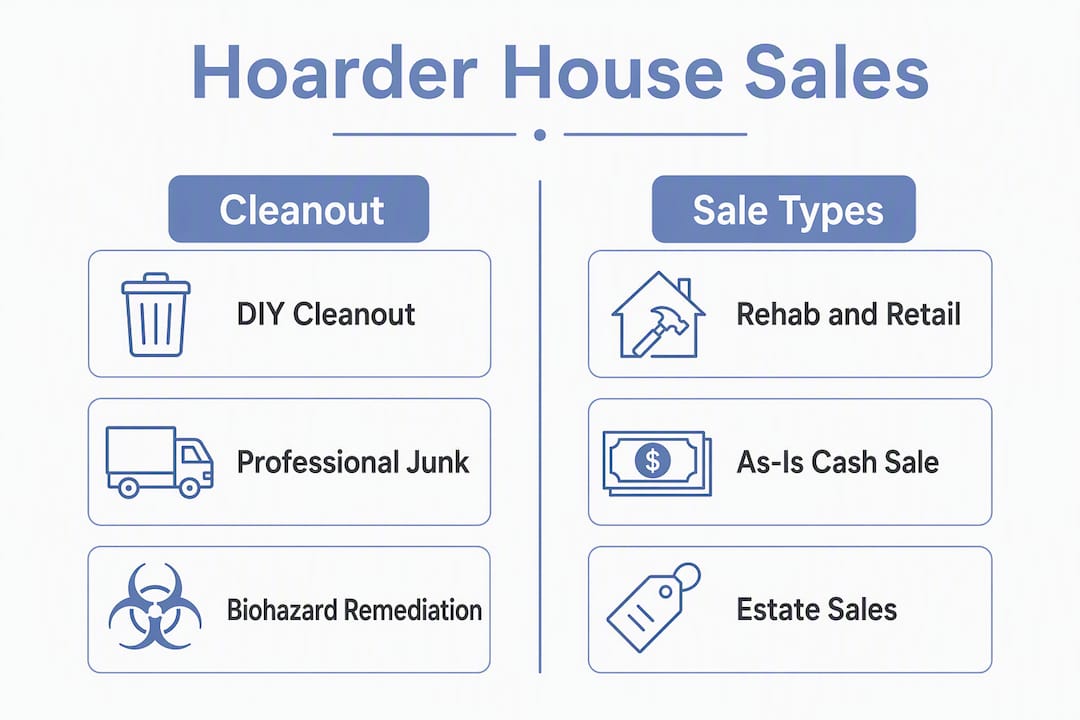
Cost and timeline reference:
| Route | Typical Cost Range | Typical Timeline |
|---|---|---|
| DIY cleanout | Dumpster fees + labor | 1–4 weeks |
| Professional junk removal | Low thousands and up | 1–3 days |
| Biohazard remediation | Thousands and up | 1–3 weeks |
| Minor cosmetic rehab | $10,000 | 4–8 weeks |
| Major structural + cosmetic rehab | $40,000 | 3–4 months |
| As-is cash sale | no out-of-pocket costs | 7–21 days to close |
| Estate sale + partial cleanout | a percentage of proceeds | 7–21 days |
Vacant or distressed properties carry added risks: standard homeowner’s insurance may lapse after 30–60 days of vacancy, and unoccupied homes are more vulnerable to vandalism and unnoticed water damage. Every month the property sits unsold adds holding costs that erode your net proceeds.
Two-scenario net proceeds comparison (using the $280,000 ARV example from earlier):
- Rehab and list: $265,000 sale price minus $71,000 in total costs = approximately $194,000 net
- As-is cash sale: $190,000 offer, no cleanup costs, no commissions, no holding costs = approximately $190,000 net
The gap is $4,000. For most sellers, the certainty, speed, and zero out-of-pocket cost of the as-is route is worth that difference. For sellers with time, capital, and a strong local market, the rehab route can widen that gap significantly.
What legal and safety obligations apply when selling a hoarder house?
Seller disclosure laws vary by state, but the general principle is consistent across the US: you must disclose material defects you know about. For a hoarder property, that typically includes structural damage, pest infestation, mold, and any known biohazard contamination. Failing to disclose known defects can expose you to post-sale litigation.
A practical rule for disclosure: if you saw it, document it and disclose it. Undisclosed defects discovered after closing are the most common source of real estate lawsuits. Honest, documented disclosures protect you legally and build buyer trust.
When biohazards are present, hire a licensed remediation company and require proof of their state license and liability insurance before they start work. The same applies to mold remediation contractors. A crew without proper credentials can create liability for you if their work is later found to be inadequate.
Before any showings or cleanout crews enter:
- Confirm utilities are safely accessible or shut off as needed
- Require all workers to use appropriate PPE (gloves, respirators, protective suits for biohazard work)
- Verify contractor licenses through your state’s contractor licensing board
- Check with your local health or code enforcement office if you suspect the property may have been flagged or condemned
Pro Tip: If you’re unsure whether a condition requires disclosure in your state, consult a real estate attorney before listing. A one-hour consultation is far cheaper than defending a post-sale lawsuit. For state-specific as-is disclosure guidance, the Maryland as-is sales guide from Decostabuyshomes is a useful reference for how these rules work in practice.
Questions to ask buyers, cleanout crews, and estate-sale companies
Before you sign anything or let anyone into the property, run through these questions.
For cash buyers and investors:
- Can you provide proof of funds today?
- What is your proposed closing date, and is it guaranteed?
- Who pays closing costs?
- Does your offer include any contingencies that could change the price?
- How many similar properties have you closed in the past 12 months?
For cleanout and remediation crews:
- Are you licensed for biohazard or mold remediation in this state?
- What is your disposal method, and do you provide documentation of proper disposal?
- Do you carry general liability and workers’ compensation insurance?
- Can you provide an itemized written bid?
- Can you provide references from similar jobs?
For estate-sale and auction companies:
- What is your fee structure, and is it a flat fee or percentage of gross sales?
- What happens to unsold items after the sale?
- What is your timeline from contract to sale completion?
- Do you handle advertising and security during the sale?
- What is your policy if items are damaged or stolen during the event?
How Decostabuyshomes helps sellers who want a fast, as-is sale
Decostabuyshomes buys residential properties in any condition, including severe hoarder houses, with no cleanup required from the seller. The process is straightforward: request an offer, schedule a walkthrough (in person or remote), receive a written cash offer with a clear net proceeds figure, and choose your closing date.
What sellers get: a cash offer with no agent commissions, no closing costs charged to the seller, no repair requirements, and a flexible closing timeline that fits your schedule, not ours.
How the process works:
- Contact Decostabuyshomes and describe the property
- Schedule a walkthrough at your convenience
- Receive a written offer within days
- Choose a closing date as soon as 7–21 days out
- Close with a title company; Decostabuyshomes covers closing costs
Decostabuyshomes works with homeowners, heirs, and estates across the United States. Whether the property needs a full biohazard cleanout, a structural overhaul, or simply a dumpster’s worth of junk removal, none of that is your problem when you sell as-is. The company’s fast-sell options resource walks through exactly what to expect from first contact to closing.
If you’re an heir navigating probate or a multi-owner estate, the step-by-step inherited house guide from Decostabuyshomes covers the additional steps involved.
Key Takeaways
Selling a hoarder house comes down to one calculation: if rehab and holding costs eat most of the gain from a retail sale, an as-is cash offer is the smarter move.
| Point | Details |
|---|---|
| As-is sale wins on speed | Cash buyers close in 7–21 days with no cleanup, commissions, or out-of-pocket costs. |
| Rehab wins when the math works | Full cleanout and rehab nets more only when repair costs are modest relative to the local ARV. |
| Estate sales offset cleanout costs | Use estate sales or auctions when contents include antiques, collectibles, or high-value items. |
| Disclosure protects you legally | Disclose all known defects in writing; undisclosed material defects are the leading cause of post-sale lawsuits. |
| Decostabuyshomes buys as-is | Decostabuyshomes makes cash offers on hoarder properties nationwide with no cleanup required and no seller closing costs. |
The mistake most sellers make with a hoarder house
Most sellers I talk to about hoarder properties make the same error: they commit to a full cleanout and rehab before they have any numbers. They spend weeks clearing the house, then get contractor bids, and only then realize the math doesn’t work. By that point they’ve already spent money and time they can’t recover.
The smarter sequence is to get your estimates first. Request a cash offer from an investor before you spend a dollar on cleanup. Get two contractor bids before you commit to rehab. Then compare the net numbers side by side. That one step, running the numbers in parallel rather than in sequence, is what separates sellers who come out ahead from those who don’t.
The emotional weight of a hoarder property is real, especially for heirs. The clutter can feel like an obstacle to even thinking clearly about the decision. The practical antidote is a small, defined action plan: pick one task per day, set a deadline for your decision, and work with professionals who are nonjudgmental about the property’s condition. A good cleanout crew and a straightforward cash buyer have seen everything. Document your progress with photos, keep a simple log of costs and decisions, and give yourself permission to choose the path that makes financial sense rather than the one that feels like the “right” amount of effort.
Ready to skip the cleanup? Here’s how to get a cash offer from Decostabuyshomes
If the rehab math doesn’t work in your favor, or you simply want to close fast without managing contractors, estate sales, and cleanout crews, Decostabuyshomes is built for exactly that situation. No cleanup required. No agent commissions. No closing costs charged to you. Just a straightforward cash offer and a closing date you choose.
Decostabuyshomes buys hoarder houses, inherited properties, and distressed homes across the United States in any condition. The offer process takes days, not months, and you’ll know your net proceeds number before you commit to anything. Use the as-is vs. fixing up decision guide to run your own numbers first, then request a fast cash offer when you’re ready to move. Have the property address, a rough description of its condition, and your preferred timeline ready when you reach out.
Where to verify facts and find vetted vendors
Before you hire anyone or sign anything, use these resources to check credentials and confirm your facts.
Licensing and contractor verification:
- Your state’s contractor licensing board (search “[your state] contractor license lookup”) to verify any contractor, remediator, or cleanout company
- The National Association of Realtors (NAR) at nar.realtor for agent verification and real estate guidance
- The Institute of Inspection, Cleaning and Restoration Certification (IICRC) at iicrc.org for certified mold and water damage remediators
- Your local health department or code enforcement office for biohazard and habitability questions
Appraiser lookup:
- The Appraisal Institute at appraisalinstitute.org to find a licensed, independent appraiser in your market
Home organization and staging after partial cleanouts:
- One Day Doors & Closets for practical guidance on reorganizing and presenting a home after a partial cleanout
Investor market context:
- HUD foreclosure buyer patterns for background on how investors evaluate and price distressed acquisitions
Quick verification steps:
- Always ask for a license number and verify it directly on the state board’s website, not just from the contractor’s business card
- Require a certificate of insurance naming you as an additional insured before any crew enters the property
- Search the company name on the Better Business Bureau at bbb.org and your state’s attorney general complaint database
- Get at least two itemized written bids for any job over $1,000
This article is general information, not legal or financial advice. Disclosure requirements, licensing rules, and tax implications vary by state. Confirm the specifics for your situation with a licensed real estate attorney or qualified professional in your area.