
Selling inherited property with multiple owners is defined as a co-ownership property sale where two or more heirs must coordinate legally and financially to transfer title. The process differs fundamentally from a standard home sale because legal authority to act depends on probate status, ownership structure, and state law. Inherited properties typically take 9–18 months to sell, compared to roughly 55 days for a traditional home. That gap exists because probate courts, title clearance, and multi-heir negotiations add layers that a single-owner sale never faces. Understanding who can legally sell, and when, is the first decision every heir must make.
How is ownership structured when selling inherited property with multiple owners?
The ownership structure determines everything: who can sign contracts, who receives proceeds, and whether unanimous consent is required. Three structures appear most often in inherited property situations.
Joint tenancy grants each co-owner an equal, undivided share with a right of survivorship. When one owner dies, their share passes automatically to the surviving owners, bypassing probate entirely. Tenancy in common is the more frequent outcome when multiple heirs inherit under a will or intestacy laws. Each heir holds a distinct percentage share, and there is no right of survivorship. A third scenario involves a trustee who holds title inside a living trust and has authority to sell without probate court involvement.

Only the executor or personal representative has authority to sell property still in probate. Individual heirs cannot act independently during that period, regardless of their ownership percentage. Once probate closes and title transfers to the heirs, all tenants in common must typically agree before a sale can proceed.
| Ownership type | Who controls the sale | Unanimous consent required? |
|---|---|---|
| Joint tenancy | Surviving co-owners | Yes, among survivors |
| Tenancy in common | All co-owners | Yes, in most states |
| Trust ownership | Trustee | No, trustee acts alone |
| Probate estate | Executor/administrator | Court approval may apply |
State probate rules differ on whether an executor needs formal court approval before listing a property. In some states, the executor can list and close without a court hearing. In others, the court must confirm the sale price before closing. Knowing your state’s rules before signing a listing agreement prevents costly delays.
Pro Tip: Hire a probate attorney in the state where the property is located, not just where the deceased lived. Real estate law is state-specific, and local counsel prevents procedural errors that can void a sale.
What are the steps to sell inherited property co-owned by multiple heirs?
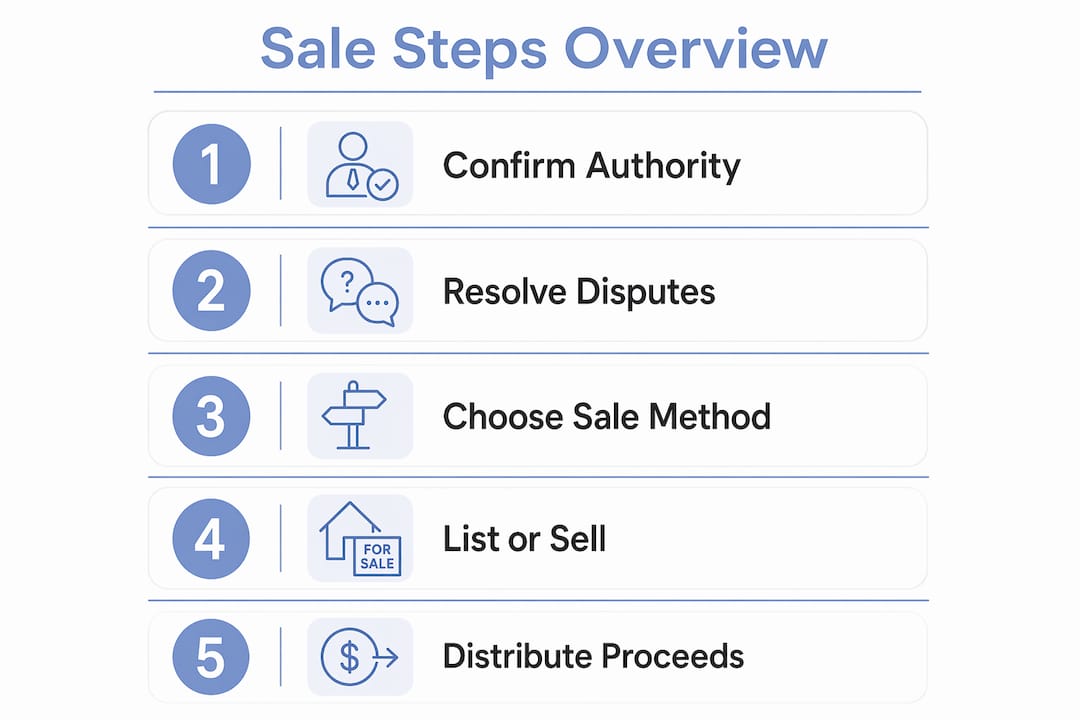
A structured process prevents the most common causes of delay: unclear authority, title problems, and heir disagreements over price.
-
Confirm legal authority. Obtain letters testamentary from the probate court if an executor is acting, or a certificate of trust if a trustee controls the property. Without this document, no title company will insure the sale.
-
Secure the property. Change locks, maintain insurance, and pay property taxes from estate funds. A vacant property that falls into disrepair loses value and creates liability for all heirs.
-
Clear title and check for liens. Order a title search immediately. Unpaid mortgages, mechanic’s liens, or IRS tax liens attach to the property and must be resolved before closing. Seller closing costs for title insurance, escrow fees, and recording fees typically run 1%–3% of the sale price.
-
Get an independent appraisal. A licensed appraiser or a comparative market analysis from a local agent sets a defensible price. This number becomes the anchor for heir negotiations and any buyout discussions.
-
Decide on condition: as-is or repaired. Repairs increase sale price but require upfront capital and heir agreement on cost-sharing. Selling as-is to a cash buyer eliminates repair risk entirely, though the offer will reflect that tradeoff. Heirs in Ohio, Virginia, or Maryland can review state-specific as-is selling options to understand what that process looks like locally.
-
Designate one communication lead. Appointing one heir as the communication lead and putting all agreements in writing significantly reduces confusion when multiple attorneys, agents, and title officers are involved.
-
Track all carrying costs in a shared ledger. Mortgage payments, utilities, insurance, and maintenance costs paid during the sale period must be documented. Shared expense ledgers prevent reimbursement disputes at closing.
-
Hire an agent with multi-heir experience. Most inherited property sales involve multiple heirs, and brokers without that background often underestimate the negotiation complexity. Ask agents directly how many probate or multi-heir transactions they have closed in the past two years.
Pro Tip: Open a dedicated estate bank account for all property-related income and expenses. This creates a clean paper trail and makes the final distribution of proceeds straightforward for every heir.
How can heirs resolve disagreements during a co-ownership property sale?
Sibling conflict is the leading cause of delays and failed inherited property sales. The disputes usually cluster around three issues: what price to accept, when to sell, and what to do when one heir is living in the property.
The legal reality is clear. A single heir cannot force a sale unilaterally in a tenancy in common. Every co-owner must consent, or the disagreeing heir must pursue a court remedy. That constraint makes early negotiation far more valuable than most heirs realize.
Mediation keeps property decisions within the family and costs a fraction of what a court-ordered partition sale demands. A neutral mediator with real estate or probate experience can resolve price disagreements, occupancy disputes, and timeline conflicts in a matter of weeks rather than months.
Buyout agreements offer a clean resolution when one heir wants to keep the home. The heir who wants the property buys the others out at fair market value, confirmed by an independent appraisal. Buyout agreements supported by independent appraisals resolve disputes more cheaply than litigation and preserve family relationships better than a forced sale.
When mediation and buyouts both fail, the last option is a partition action. A court orders the property sold and distributes proceeds according to ownership shares. The Uniform Partition of Heirs Property Act (UPHPA), adopted in many states, gives co-owners the right to an independent appraisal and a buyout opportunity before a forced sale proceeds. A court-ordered partition sale is slow, costly, and frequently produces below-market prices. Treat it as a last resort, not a first move.
- Put every agreement in writing, including who pays carrying costs during the sale period.
- Set a decision deadline for accepting or rejecting offers to prevent indefinite stalling.
- Engage a probate attorney before conflict escalates, not after.
- If one heir occupies the property, establish a written rental agreement or offset arrangement against their share of proceeds.
What sale methods are available for inherited property with multiple owners?
Heirs have four practical options. Each carries different timelines, costs, and levels of heir coordination required.
Listing with a real estate agent produces the highest sale price in most markets. The tradeoff is time. Between probate clearance, property preparation, marketing, and closing, the full process commonly runs 9–18 months. Agent commissions typically add 5%–6% of the sale price on top of closing costs.
Selling as-is to a cash buyer cuts that timeline dramatically. Cash sales can close in 7–30 days but usually come in below market value. For heirs who need a fast resolution, or who cannot agree on repairs, this option removes most of the friction. Heirs in Virginia can explore selling as-is in Virginia for a state-specific breakdown of what that process involves.
A family buyout works when one heir has the financial means to purchase the others’ shares. This keeps the property in the family, avoids agent commissions, and resolves the co-ownership cleanly. The key requirement is a fair market value appraisal that all heirs accept.
Renting the property together is an alternative when heirs cannot agree on selling but need income from the asset. This requires a formal property management agreement and a clear exit plan, or the disagreement simply resurfaces later.
| Sale method | Typical timeline | Price outcome | Heir coordination needed |
|---|---|---|---|
| Agent-listed sale | 9–18 months | Highest | High |
| Cash buyer/as-is | 7–30 days | Below market | Low |
| Family buyout | 30–90 days | Fair market value | Moderate |
| Rental arrangement | Ongoing | Income, no sale | High |
| Partition sale | 12–24 months | Below market | None (court-ordered) |
The right method depends on heir alignment, financial urgency, and property condition. Heirs who agree quickly and accept a cash offer often net more in real terms than heirs who spend 18 months in conflict before a court-ordered sale.
Key takeaways
Selling inherited property with multiple owners requires legal authority, heir alignment, and a sale method matched to the group’s timeline and financial goals.
| Point | Details |
|---|---|
| Legal authority comes first | Confirm executor, trustee, or co-owner authority before listing or negotiating. |
| Ownership type shapes consent rules | Tenancy in common requires all heirs to agree; trust ownership gives the trustee sole authority. |
| Designate one communication lead | A single point of contact reduces delays and miscommunication with agents and attorneys. |
| Mediation beats partition | Court-ordered partition sales are slow, costly, and produce below-market prices. |
| Cash sales resolve disputes fast | As-is cash sales close in 7–30 days and eliminate repair disagreements among heirs. |
What I’ve learned from watching heirs navigate multi-owner sales
The heirs who sell quickly and cleanly share one habit: they make decisions before emotions take over. The ones who struggle wait until a dispute forces their hand, and by then the options are expensive and the relationships are strained.
The most underused tool in these situations is a simple written agreement among heirs, signed before the property even goes on the market. It covers who pays carrying costs, what offer price triggers an automatic acceptance, and how disputes get resolved. That document costs a few hundred dollars in attorney time. A partition lawsuit costs tens of thousands and takes years.
I’ve also seen heirs dismiss cash buyers too quickly because the offer looks low on paper. When you factor in 12 months of property taxes, insurance, utilities, and agent commissions on a prolonged sale, the net difference often shrinks considerably. Run the numbers before you reject a fast offer.
The other mistake I see repeatedly is hiring a generalist agent for a probate sale. Multi-heir inherited property sales require a broker who understands probate timelines, can manage four different personalities with four different financial situations, and knows when to bring in a mediator. That skill set is not universal. Ask for references from other multi-heir transactions before you sign a listing agreement.
Early coordination, written agreements, and the right professionals on your team turn a complicated situation into a manageable one.
— Travis
How Decostabuyshomes works with inherited property heirs
Inherited properties with multiple owners present real complexity. Decostabuyshomes works directly with heirs to cut through that complexity with straightforward, as-is purchase offers that do not require repairs, extended timelines, or unanimous agreement on listing strategy.

Decostabuyshomes has experience with probate situations, co-ownership structures, and the practical realities of selling a home that multiple family members have a stake in. If your group needs a fast resolution, a fair offer, and a team that understands the legal context, Decostabuyshomes can provide a no-obligation cash offer that closes on your timeline. Heirs considering an as-is sale can also review the Maryland as-is selling guide for state-specific context before making a decision.
FAQ
Who has the legal authority to sell an inherited property?
During probate, only the executor or personal representative named by the court has authority to sell. Once probate closes, all tenants in common must agree to the sale.
Can one heir force the others to sell inherited property?
A single heir cannot force a sale without court involvement. A partition action filed in court can compel a sale, but the process is slow and costly, and the UPHPA gives other heirs buyout rights first.
How long does selling inherited property with multiple owners take?
Inherited property sales typically take 9–18 months, significantly longer than the roughly 55-day average for standard home sales, due to probate requirements and multi-heir negotiations.
What happens if heirs disagree on the sale price?
Mediation with a neutral third party is the fastest and least expensive resolution. If mediation fails, a court-ordered partition sale is the legal alternative, though it usually produces a below-market outcome.
Is selling as-is a good option for inherited property?
Selling as-is to a cash buyer closes in 7–30 days and removes repair cost disputes among heirs. The tradeoff is a lower sale price, but the speed and simplicity often outweigh that difference when heirs need a quick resolution.