
Yes, you can usually sell a house that has liens on it. The catch is that the buyer needs clear title at closing, which means every recorded lien must be paid off, formally released, or legally discharged before the deed transfers. How you get there depends on the lien type, how much equity you have, and how much time you have before closing.
Three things to do right now:
- Order a preliminary title report. You cannot negotiate what you cannot see. A title company or settlement agent can pull this for you, and it will show every recorded claim against the property.
- Get written payoff figures. Call your mortgage servicer and each lienholder and ask for a formal payoff statement. Verbal estimates are useless at the closing table.
- Tell your title company and buyer’s lender early. The sooner your settlement agent knows about a lien, the more options they have to work around it.
If a federal tax lien is involved, the IRS offers a Certificate of Discharge process (Form 14135) that can remove the lien from the specific property so the sale can close. The IRS typically aims to review applications within about 30–45 days, so you need to file at least 45 days before your closing date. If your equity is thin or the timeline is tight, a cash buyer like Decostabuyshomes can often close faster than a traditional sale and handle lien payoffs as part of the transaction.
Pro Tip: File for an IRS Certificate of Discharge well in advance of your target closing date. The IRS recommends allowing sufficient lead time, and missing this is a common reason a lien-encumbered sale falls apart at the last minute.
Table of Contents
- What types of liens can show up on your property?
- How do liens change the sale process and buyer financing?
- How do you find every lien on your property?
- What are your options when you need to sell a house with liens?
- What does clearing liens actually cost, and how long does it take?
- Common mistakes that sink a sale when liens are involved
- When should you call a professional, and which one?
- Key Takeaways
- Why liens are more manageable than most sellers think
- Decostabuyshomes can close your sale even when liens complicate the title
- Useful sources and official forms
What types of liens can show up on your property?
A lien is a recorded legal claim against your property. It attaches to the title and travels with the property until it is paid, released, or discharged. The type of lien determines its priority in line for your sale proceeds, and that priority determines what you owe first.
Common lien types:
- Mortgage lien: The most familiar. Your lender holds this until the loan is paid off. Priority follows the recording date.
- Federal tax lien: Filed by the IRS when you owe unpaid federal taxes. Priority rules tie to the recording date, but federal liens have special discharge and subordination options.
- State tax lien: Similar to a federal lien but filed by your state’s revenue department.
- County property tax lien: Attaches automatically when property taxes go unpaid. In many counties this carries “super-priority,” meaning it can outrank even your mortgage lender.
- Judgment lien: Arises from a court judgment against you. A creditor wins a lawsuit, records the judgment, and it attaches to your real property.
- Mechanics (contractor) lien: Filed by a contractor or supplier who was not paid for work on the property.
- HOA lien: Recorded by a homeowners association for unpaid dues or assessments.
- Child support lien: Some states allow child support agencies to record liens against real property for unpaid support obligations.
Priority matters because lien type and recording order determine who gets paid first from your proceeds. County property tax liens often sit at the top of that stack regardless of when they were recorded. Federal and state tax liens follow their recording dates. Mortgage liens generally follow recording order too, but your first mortgage was almost certainly recorded before any judgment or mechanics lien. Knowing the stack tells you whether your proceeds will cover everything or whether you need a different strategy.
How do liens change the sale process and buyer financing?
When a title company runs a title search, every recorded lien surfaces in the preliminary title report. The settlement agent reviews that report and notifies all parties, including the buyer’s lender, about what needs to be cleared before closing. Nothing about this is automatic or invisible.

At a standard closing, the settlement agent uses your sale proceeds to pay senior claims first, then junior claims, in priority order. Whatever is left goes to you. If proceeds cover everything, the sale closes cleanly. If they do not, you have a problem that needs a specific solution before the buyer’s lender will fund the loan.
Buyer financing is where liens create the most friction. Mortgage lenders require clear title as a condition of funding. A buyer using conventional financing, FHA, or VA loans cannot close on a property with unresolved liens. That leaves two paths: resolve the liens before closing, or sell to a cash buyer who does not need lender approval.
A recording lag adds one more wrinkle. Paying a lien days before closing does not guarantee the public record will show a released lien by closing day. County recorder offices can take days or weeks to process a satisfaction. Your title company needs either a recorded release or a formal satisfaction letter they can accept in lieu of the recorded document. Plan for this gap, or your closing gets pushed.
How do you find every lien on your property?
Surprises at closing are expensive. The goal is to know every recorded claim before you list the property or sign a purchase agreement.
- Order a preliminary title report. Contact a title company or settlement agent and request one. This is the most complete single source for recorded liens. Title searches are a modest up-front cost compared to a failed closing. Fees vary by county and provider.
- Search the county recorder’s office. Most counties have online portals where you can search by owner name or parcel number. Look for deeds of trust, mortgages, judgment liens, and mechanics liens.
- Check the county tax collector. Confirm whether property taxes are current. Delinquent taxes often do not appear on a title report until they become a formal lien, so verify directly with the tax office.
- Search state and federal tax lien indexes. The IRS files notices of federal tax liens with the county recorder or state office depending on jurisdiction. Your state revenue department files state tax liens similarly. Both are searchable.
- Request an HOA statement. If the property is in an HOA, ask for a written statement of all amounts owed, including dues, assessments, fines, and any recorded lien.
- Get formal payoff letters from every lienholder. A payoff letter states the exact amount needed to satisfy the lien as of a specific date, including per-diem interest. Verbal estimates do not hold at closing.
The preliminary title report is your foundation. The other steps catch anything that may have been filed recently or that the title search missed. Hand all of this to your settlement agent before you list.
What are your options when you need to sell a house with liens?
Selling a house with a lien is solvable in most cases. The right path depends on your equity, the lien type, and your timeline.
| Option | Best for | Typical timeline | Effect on proceeds | Buyer financing OK? |
|---|---|---|---|---|
| Pay from sale proceeds at closing | Sufficient equity to cover all liens | Standard closing (30–60 days) | Reduced by lien payoffs | Yes |
| Pay out-of-pocket before closing | Small lien, cash available | Immediate, but recording lag applies | Minimal impact | Yes |
| Negotiate reduced payoff | Judgment or mechanics liens | 2–4 weeks | Saves some proceeds | Yes, after release |
| Short sale | Underwater property, lender approval needed | 3–6 months | No proceeds to seller | Depends on lender |
| IRS Certificate of Discharge (Form 14135) | Federal tax lien, insufficient equity | 30–45 days IRS review | Lien removed from property | Yes, after discharge |
| Cash sale to investor | Speed, as-is condition, complex liens | — | Below-market, but fast | N/A (no lender) |
Paying from proceeds is the cleanest path when equity covers the debt. The settlement agent handles the math and the disbursements. Nothing extra is required from you beyond the payoff letters.
Negotiating a reduced payoff is worth attempting for judgment liens and mechanics liens. Judgment and mechanics lienholders sometimes accept less than the face amount, particularly when the alternative is a long collection process. Government liens, including federal and state tax liens and standard mortgage liens, are far less flexible.

The IRS Certificate of Discharge is the key tool when a federal tax lien would otherwise block the sale. You file IRS Form 14135, and the IRS typically aims to complete its review within 30–45 days. File at least 45 days before your closing date. Once granted, the discharge removes the federal lien from that specific property so the title can transfer cleanly.
A cash sale to an investor sidesteps the buyer-financing problem entirely. No lender approval, no financing contingency, and an experienced buyer who already knows how to coordinate lien payoffs at closing. The trade-off is a below-market price, but for sellers facing foreclosure clocks or IRS deadlines, the speed often outweighs the discount.
Pro Tip: Tell your title company about every known lien on day one, before you accept an offer. Settlement agents can sequence payoffs, request payoff letters, and flag IRS discharge timing before a buyer is under contract. Waiting until escrow opens costs you weeks.
What does clearing liens actually cost, and how long does it take?
Realistic timelines and costs prevent the most common deal-killing mistake: setting a closing date before you know how long the liens will take to resolve.
| Step | Typical timing | Estimated cost |
|---|---|---|
| Preliminary title report / title search | 3–4 business days | Varies by county and provider |
| Payoff letters from lienholders | 5–7 business days | Usually free; some servicers charge a small fee |
| IRS Certificate of Discharge review | 30–45 days after complete application | No IRS fee; attorney prep costs vary |
| Lien release recording after payment | Up to 30 days in some jurisdictions | County recording fees (typically $10–$50 per document) |
| Real estate or tax attorney (negotiation or short sale) | Varies by complexity | Hourly or flat fee; varies widely by market |
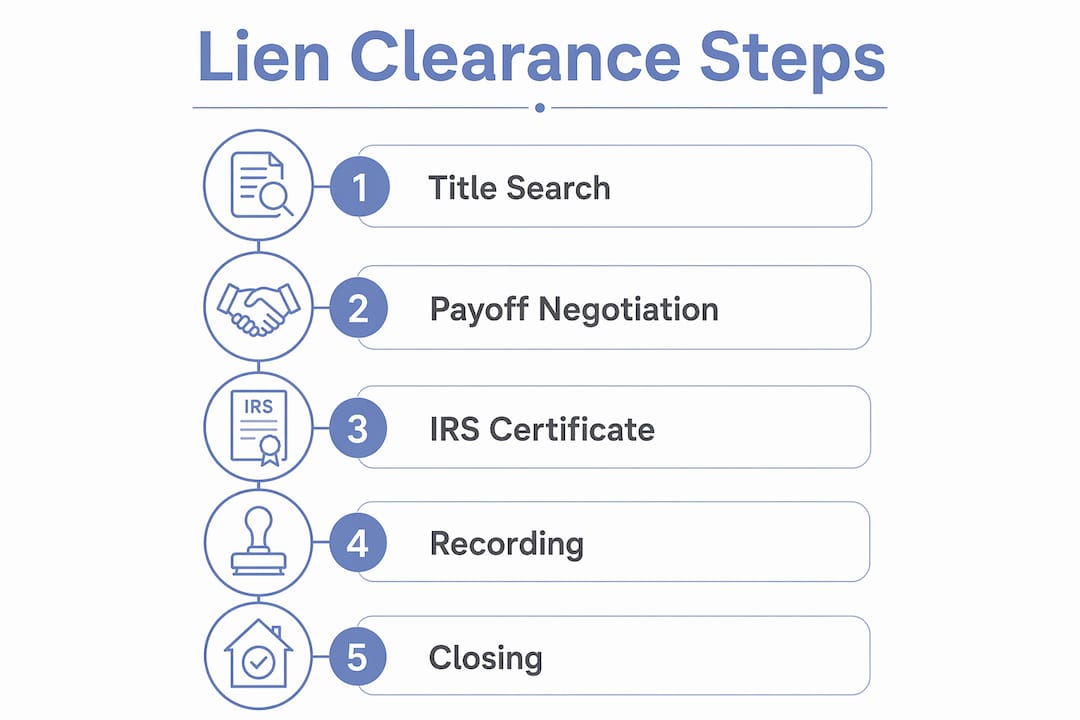
The IRS discharge window is the longest fixed variable. Filing well in advance before closing is the standard guidance, and that clock starts only when the IRS receives a complete application. An incomplete filing restarts the wait.
Recording lag is the other hidden delay. A lienholder may process your payoff within days, but the county recorder’s office may take two to four weeks to post the satisfaction. Build that gap into your contract timeline, or ask your closer whether they can accept a satisfaction letter in lieu of the recorded release.
Common mistakes that sink a sale when liens are involved
Most lien-related closings that fall apart do so for predictable reasons.
- Waiting until escrow opens to order title work. By then you have a buyer, a contract, and a closing date. Discovering a judgment lien or an IRS filing at that stage leaves almost no time to resolve it.
- Relying on informal payoff estimates. A lienholder’s verbal figure is not binding. Payoff amounts include per-diem interest and can change daily. Only a written payoff letter with an expiration date is usable at closing.
- Assuming a paid lien is a released lien. Payment and recordation are two separate events. A lien paid days before closing may still appear unsatisfied in public records on closing day, triggering an escrow holdback or a closing delay.
- Treating every lien the same. A county property tax lien operates on a foreclosure clock that is entirely separate from an IRS discharge timeline. Missing the distinction leads to missed deadlines.
- Not disclosing liens to the buyer. Buyers’ lenders run their own title searches. A lien you did not mention will surface, and the buyer’s lender will require resolution before funding. Transparency early keeps the deal alive.
Pro Tip: Ask your title company for a “net sheet” that shows estimated proceeds after all lien payoffs before you accept an offer. If the numbers are close, you want to know that before you’re under contract, not after.
When should you call a professional, and which one?
Not every lien situation needs an attorney. But some do, and calling the wrong person wastes time.
Title company or settlement agent: Your first call for almost any lien situation. They coordinate payoff letters, sequence disbursements, handle recording, and communicate with the buyer’s lender. They cannot give legal advice, but they manage the mechanical process.
Real estate attorney: Bring one in for disputed liens, short sales, or any situation where a lienholder is uncooperative. An attorney can negotiate directly with creditors, challenge improper liens, and draft the documentation a title company needs to close.
Tax attorney or enrolled agent: The right choice for federal or state tax liens, especially if you are also considering an IRS Offer in Compromise or need to file Form 14135. The IRS discharge process has specific documentation requirements, and a tax professional who handles these regularly will get the application right the first time.
Cash buyer or real estate investor: When speed matters more than price, or when the lien situation is complex enough that a traditional buyer’s lender will not fund, a cash buyer removes the financing variable entirely. Decostabuyshomes buys properties as-is and handles lien payoffs as part of the acquisition, which makes them a practical option for sellers facing tight timelines or inherited property with liens.
When you make the call, have these documents ready: the preliminary title report, all payoff letters, your purchase contract (if you have one), and any IRS or court correspondence related to the lien. The more complete your file, the faster the professional can assess your situation.
Key Takeaways
You can sell a house with liens, but every recorded claim must be paid, discharged, or released before the title transfers, and the sequencing of those steps determines whether your closing stays on schedule.
| Point | Details |
|---|---|
| Order title work first | A preliminary title report reveals every recorded lien before you list or accept an offer. |
| IRS discharge takes time | File Form 14135 at least 45 days before closing; the IRS review typically runs 30–45 days. |
| Recording lag is a real risk | A paid lien may not appear released in county records for up to 30 days after payment. |
| Negotiation works selectively | Judgment and mechanics liens may settle for less; government and mortgage liens rarely do. |
| Decostabuyshomes is a fast-exit option | Decostabuyshomes buys as-is, covers closing costs, and handles lien payoffs at acquisition for sellers who need speed. |
Why liens are more manageable than most sellers think
There is a version of this situation that paralyzes sellers: they discover a lien, assume the sale is dead, and either do nothing or panic-list at a steep discount. Both reactions are usually wrong.
The mechanics of a lien-encumbered sale are not complicated. The IRS has a formal, documented process for discharge. Title companies handle lien payoffs at closing every day. Judgment lienholders often prefer a negotiated settlement over years of collection attempts. The actual obstacle is almost never the lien itself. It is the seller’s timeline and whether they started the process early enough.
What practitioners see repeatedly is sellers conflating lien type with resolution time. A small mechanics lien and a federal tax lien are not the same problem on the same clock. Treating them identically is what causes missed IRS filing windows and county tax foreclosure deadlines. The fix is simple: identify every lien, understand its specific rules, and sequence the resolution steps accordingly.
The other underrated option is the cash buyer. Sellers often assume a below-market offer is a loss. Sometimes it is the right trade. If an IRS discharge is going to take 45 days and your county tax foreclosure window closes in 60, a cash buyer who can close in 21 days and absorb the lien coordination is not a consolation prize. It is the move that keeps equity in your pocket instead of losing the property entirely.
Decostabuyshomes can close your sale even when liens complicate the title
Liens add steps to a sale, but they do not have to add months of stress. Decostabuyshomes buys residential properties as-is, pays all closing costs, and coordinates lien payoffs directly through the settlement process. There are no agent commissions, no repair demands, and no financing contingencies that collapse when a title search surfaces a judgment or tax filing.
The process is straightforward. You share the property details and any known lien information. Decostabuyshomes reviews the title, structures a cash offer that accounts for payoff amounts, and works with the settlement agent to clear the liens at closing. For sellers facing IRS discharge timelines, county foreclosure clocks, or simply a lien situation too complex for a conventional buyer’s lender, this path removes the single biggest variable: whether the buyer can actually fund.
If you need to sell your house fast and liens are the obstacle, contact Decostabuyshomes today for a no-obligation cash offer. You can also review the as-is vs. fixing up decision guide to see whether a traditional sale or a direct cash offer fits your situation better.
Useful sources and official forms
Use these resources directly, and share them with your title company and attorney when you start the process.
- IRS Form 14135 and Publication 783: The official IRS guidance on applying for a Certificate of Discharge of property from a federal tax lien. Publication 783 explains eligibility, required documents, and the application process.
- IRS: What if there is a federal tax lien on my home?: Plain-language IRS explanation of payoff, discharge, and subordination options for sellers and refinancers.
- IRS: Understanding a federal tax lien: Covers how federal tax liens are filed, how they attach to property, and how they are released.
- County recorder’s office: Search your county’s official website for the recorder or register of deeds. Most offer online parcel searches by owner name or address.
- County tax collector or treasurer: Confirm current property tax status and any delinquent amounts directly with the tax office, not through third-party sites.
- Your title or settlement company: Request a preliminary title report before listing. Give the report and all payoff letters to your closer on day one.
- What is a mortgage lien?: Plain-language background on how mortgage liens work and their effect on sales and refinancing.