
Which approach actually makes you more money?
Selling a house as-is versus fixing it up is not a philosophical debate. It is a math problem. The right answer depends on your repair costs, your timeline, and what buyers in your market will actually pay.
Here is the short version:
Selling as-is works best when:
- Repairs are big-ticket (roof, foundation, HVAC, electrical) and you cannot or will not fund them
- You need to close fast due to a job change, divorce, foreclosure, or financial pressure
- The cost of fixing something equals or exceeds what it adds to the sale price
- You are selling an inherited property and want no renovation stress
- Cash and investor buyers are active in your local market
Fixing up works best when:
- The repairs are cosmetic and cheap (paint, fixtures, landscaping)
- Your market rewards move-in-ready homes with multiple offers
- You have the time and cash to finish before listing
- A single visible flaw is scaring buyers away from an otherwise solid home
- The fix resolves a safety or financing issue that would block a mortgage approval
The 2026 U.S. housing market has tightened buyer budgets, which means more buyers than ever are hunting for value. That cuts both ways: as-is properties attract investors, but well-priced renovated homes still command premiums in competitive suburbs.
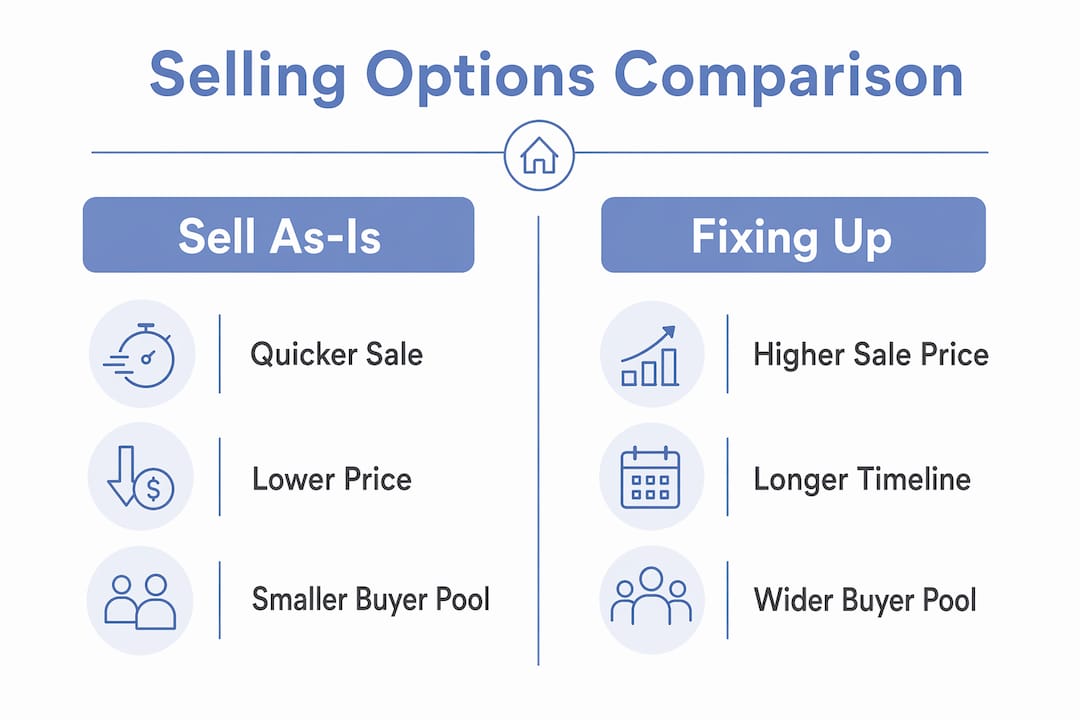
Pros and cons of selling a house as-is vs fixing it up
The financial reality
As-is homes typically sell for 10%–20% below comparable move-in-ready properties, with the discount stretching to 30% in slower markets or when major systems need replacement. That discount is the number every repair decision has to beat.
The calculation is straightforward. Subtract the as-is price from the expected fixed-up price. Then total your true repair costs, including carrying costs: extra mortgage payments, taxes, insurance, and utilities for every month you delay listing. If the price gap is clearly larger than total costs, fix it. If it is close or smaller, sell as-is.
Example: Repairs cost $30,000 but add only $20,000 to the sale price. Sell as-is. Alternatively, $3,000 of paint and landscaping adds $15,000 of buyer appeal. Fix it.
Pro Tip: Keep total pre-sale repair spending under a portion of your home’s current value, as excessive repairs often do not recoup their costs.
Timeline differences
An as-is cash sale can often close significantly faster than a renovation sale. A renovation can add several weeks to months before listing, plus the usual closing time with a financed buyer. If time is money for you, that gap is real.
Buyer pool and negotiation leverage
Traditional financing often will not approve loans for homes needing significant repairs, which narrows your buyer pool to cash buyers and investors. That narrower pool reduces competition and negotiation leverage. Fixing up the home reopens it to financed buyers, which usually means more offers and a stronger final price.
Repairs worth doing vs. repairs to skip
Exterior first impressions return the most for the least cost: a new garage door, fresh paint, and landscaping. Interior overhauls rarely return their full cost. Full kitchen or bath remodels, partial roof patches, and replacing working-but-dated appliances almost always cost more than they recover at resale. Buyers expect to make a home their own.
Even when selling as-is, a clean, decluttered, and lightly staged property reduces time on market and increases buyer interest. You do not need to renovate to present well.
Hidden risks of fixing up
Renovation budgets routinely overrun. Contractors find surprises inside walls. Permits take longer than expected. Every extra month you hold the property costs money. And if the market shifts while you renovate, you may list into a cooler environment than you planned for. Sellers who include renovation costs in their financing strategy sometimes find the math changes significantly once carrying costs are factored in.
How to decide: a practical framework for homeowners
The repair-or-sell decision should be a calculation, not an emotional reaction to the state of your kitchen.
Statistic callout: As-is homes sell for 10%–20% below move-in-ready comparables on average, with discounts up to 30% in slow markets or for homes needing major structural work.
Work through these four steps before you decide:
- Get the as-is number. Ask an agent for a realistic as-is list price based on recent comparable sales.
- Get the fixed-up number. What would the same home fetch fully repaired and move-in ready?
- Total the true cost of repairs. Include the work itself plus carrying costs for every month you delay.
- Compare. If (fixed price minus as-is price) clearly exceeds total costs, repair. If it is close or smaller, sell as-is.
Additional factors to weigh:
- Property condition: Cosmetic issues rarely justify skipping a sale. Structural or system failures (foundation, roof, HVAC) almost always tip the math toward selling as-is.
- Neighborhood trends: In areas where land value outweighs the home’s value, repair investments rarely increase the sale price.
- Disclosure obligations: Sellers must disclose all known material defects even in as-is sales. As-is limits your obligation to fix things, not your obligation to be honest about them.
- Inspection strategy: A pre-listing inspection on an as-is home lets you disclose issues upfront, filter out unprepared buyers, and prevent last-minute deal failures.
- Appraisal and financing: Homes with deferred maintenance often appraise below the contract price, which can kill financed deals. Cash buyers sidestep this entirely.
- Tax considerations: If you have owned and lived in the home for at least two of the past five years, you may exclude up to $250,000 in capital gains ($500,000 for married couples filing jointly) regardless of whether you sell as-is or fixed up. The selling method does not change your tax basis, but repair costs you can document may reduce your net gain.
Decostabuyshomes works with homeowners across all these scenarios, helping sellers run the actual numbers before committing to either path. State-specific guidance, such as the Virginia as-is selling guide and the Maryland as-is guide, covers local disclosure rules and market conditions that affect the calculation.
Verified cash home buyers for as-is sales across the U.S.
For homeowners who decide the as-is route is right, the next question is who to sell to. The buyers below operate in specific U.S. markets, buy homes in any condition, and charge no commissions or closing costs.
| Buyer | Location | Cash offer timeline | Closing speed | Key benefit |
|---|---|---|---|---|
| Sell My House Fast as IS Philadelphia | Philadelphia, PA | — | Flexible schedule | Handles foreclosure, divorce, inherited properties |
| As Is Cash Home Buyers Flushing | Flushing / Long Island, NY | 15–30 minutes | — | No inspections, appraisals, or showings; featured on HGTV and Yahoo Finance |
| As Is Cash Home Buyers Boston | Boston, MA | 15–30 minutes | — | No fees or commissions; handles probate and financial hardship |
| As Is Cash Home Buyers Wilmington | Wilmington, DE | 15–30 minutes | — | Covers foreclosure, divorce, inheritance; no closing costs |
| Sell House Home Buyers | Long Island, NY | Not publicly listed | — | Handles all paperwork; cash on closing day |
| As Is Cash Home Buyers Rockville | Rockville, MD | 15–30 minutes | — | Buys regardless of condition or situation; press-featured |
| As Is Cash Home Buyers Waldorf | Waldorf, MD | 15–30 minutes | — | No showings or open houses; handles probate and hardship |
| Sell My House Fast DC | Washington, DC | Not publicly listed | Fast closing | Cash offers for DC homes in any condition |
Every buyer in this list operates without agent fees, repair requirements, or staging demands. The trade-off is a price below open-market value, which is why running the four-step calculation first matters. If the discount is smaller than your renovation budget plus carrying costs, a cash buyer is the financially sound choice.
Pro Tip: Press features on outlets like Realtor.com, Homelight.com, and HGTV are a useful trust signal when vetting cash buyers. They indicate the company has been reviewed by third-party editorial teams, not just self-promoted.
For homeowners navigating inherited properties alongside this decision, the inherited house selling guide from Decostabuyshomes covers the additional legal and financial layers involved.
Decostabuyshomes buys homes in any condition across the United States, with no repair requirements, no commissions, and no obligation. Whether you are weighing a cash offer or want help running the numbers on a renovation, explore your options before you commit to either path.
Key Takeaways
Selling as-is wins when repair costs exceed the price increase they generate; fixing up wins when cheap cosmetic work unlocks a significantly higher sale price in a competitive market.
| Point | Details |
|---|---|
| As-is discount range | As-is homes typically sell for 10%–20% below move-in-ready properties, with discounts reaching 30% in slow markets or when major systems need replacement. |
| Run the four-step math | Compare (fixed price minus as-is price) against total repair plus carrying costs before deciding. |
| Buyer pool narrows as-is | Traditional financing often excludes homes needing major repairs, leaving cash buyers and investors as primary buyers. |
| Disclosure is still required | Sellers must disclose all known material defects even in as-is sales, regardless of state. |
| Cosmetic fixes beat full remodels | Exterior upgrades like paint and landscaping return more per dollar than kitchen or bath overhauls. |