
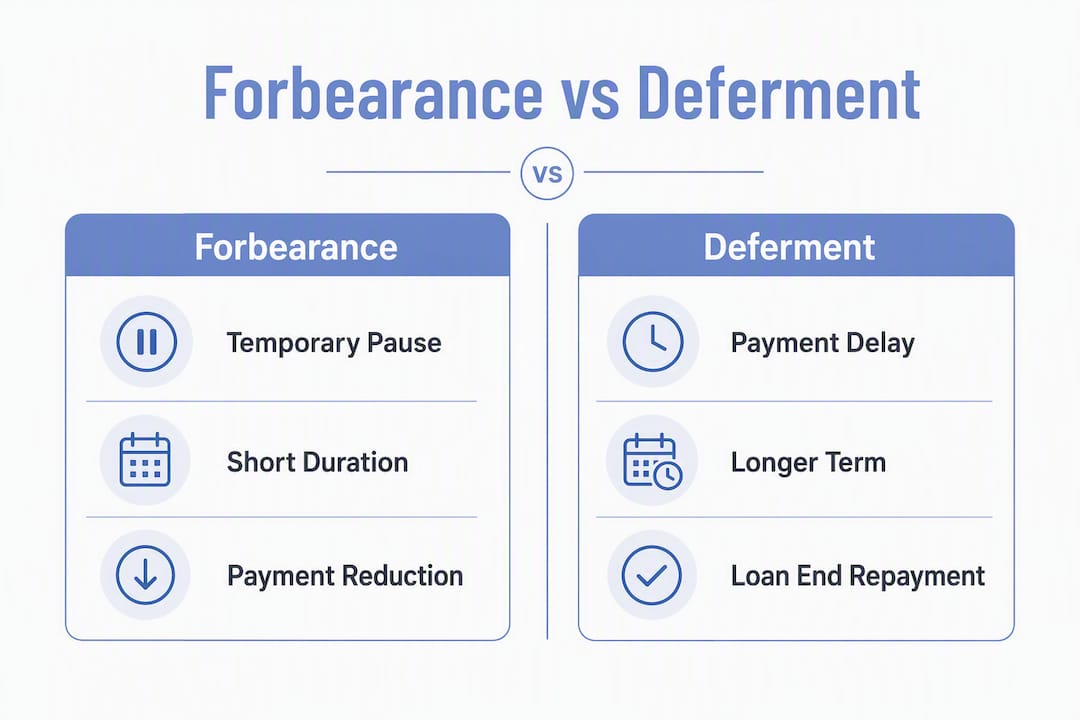
Forbearance temporarily pauses or reduces your mortgage payments for a set period, generally lasting several months. Deferment moves those missed payments to the end of your loan, often as a non-interest-bearing subordinate lien you repay when you sell, refinance, or the loan matures. That distinction is the difference between a short-term breathing room and a hidden closing cost that can blindside both sellers and investors.
HUD’s loss mitigation program and FHA guidance are the primary authorities here. Decostabuyshomes works with sellers navigating both situations every week. The closing complications are almost always traceable to one of three things: a seller who didn’t know a partial-claim lien existed, a payoff statement that took too long to arrive, or a buyer who didn’t price the deferred balance into the offer.
Three things to know right now:
- Sellers: Contact your servicer today and ask for a payoff ledger that shows any deferred amounts and whether a partial claim or subordinate lien has been recorded.
- Investors: Before making an offer, confirm whether the property carries a partial-claim deferral. That lien reduces seller net proceeds and must be cleared at closing.
- Immediate risk: Assuming forbearance automatically converts to a modification. It does not. Without a written plan in place, you may face a reinstatement demand the moment forbearance ends.
Your next 24–72 hours: call your servicer, request the payoff breakdown in writing, and ask specifically whether a partial claim exists.
Table of Contents
- How do forbearance and deferment compare side by side?
- How does mortgage forbearance actually work?
- What does deferment mean in practice?
- How does forbearance or deferment affect your closing?
- Homeowner checklist: how to sell quickly while in forbearance or deferment
- Investor due-diligence checklist for properties in forbearance or deferment
- When should you choose forbearance, deferment, or a loan modification?
- Common mistakes and red flags to watch for
- Key Takeaways
- What most guides get wrong about forbearance
- Sell fast and clear your lien with Decostabuyshomes
- Useful sources and further reading
How do forbearance and deferment compare side by side?
| Dimension | Forbearance | Deferment |
|---|---|---|
| Purpose / hardship duration | Temporary shock of short duration | Longer-term arrearage resolution |
| How payments are handled | Paused or reduced during relief period | Missed payments moved to loan end |
| Interest accrual | Continues to accrue on the loan balance | Deferred amounts typically do not accrue additional interest in partial claims |
| Repayment options after relief | Lump sum, repayment plan, modification, or deferral | Paid at sale, refinance, or loan maturity |
| Effect on selling and closing | Arrearage must be resolved at closing; no automatic lien | Partial-claim deferral creates a subordinate lien that must be cleared at closing |

Example A — Seller in forbearance: A homeowner paused four months of $1,800 payments ($7,200 total). At closing, the servicer will require that $7,200 resolved. Options: pay it from sale proceeds, roll it into a repayment plan before closing, or negotiate a deferral. If a deferral is approved, it becomes a subordinate lien paid from proceeds.
Example B — Investor evaluating a partial-claim deferral: A property lists at $280,000. The seller has a $6,000 partial-claim lien from a prior deferment. The investor’s net-proceeds model must account for that $6,000 coming off the seller’s side at closing, reducing what the seller walks away with and potentially affecting negotiation room.
How does mortgage forbearance actually work?
Forbearance periods commonly run 3–6 months and can extend up to 12 months depending on the servicer and loan type. During that window, your servicer pauses or reduces your required monthly payment. Interest keeps accruing on the outstanding balance the entire time.
When forbearance ends, you have several paths:
- Lump-sum reinstatement: Pay everything owed at once. Most servicers will accept this but few borrowers can execute it.
- Repayment plan: Add a portion of the arrearage to each future payment over a set period.
- Deferral: Move the missed payments to the loan end as a subordinate lien.
- Loan modification: Permanently restructure the loan terms.
Forbearance approval is generally faster than a modification; modification underwriting typically takes 30–90 days and requires a full hardship package. Servicers use forbearance as the immediate relief step while they underwrite a longer-term solution. Under CFPB rules, servicers must evaluate a complete application against all available loss-mitigation options and cannot pursue foreclosure while that review is active.
Documentation sellers should request from their servicer:
- Written forbearance agreement with exact terms and end date
- Payoff statement itemizing accrued interest and total arrearage
- Investor ID (servicers must provide this under 12 C.F.R. § 1024.36)
- Written confirmation of whether missed payments will be deferred or capitalized
Pro Tip: Ask your servicer directly: “Has a partial claim been filed, and what are the investor-specific disposition rules for my loan type?” That one question surfaces hidden subordinate claims before they appear on the closing statement.
What does deferment mean in practice?
Deferment moves missed payments to the end of the loan term, repaid when you sell, refinance, or the loan matures. In many FHA partial-claim scenarios, those deferred amounts do not accrue additional interest, which is the key cost difference versus forbearance. The HUD loss mitigation Q&A confirms that partial-claim deferrals create a subordinate lien that sits behind the primary mortgage and must be satisfied at closing.
Servicers typically offer deferment after forbearance when the borrower can resume regular payments but cannot afford a lump-sum reinstatement. Eligibility depends on the loan type (FHA, VA, conventional) and the investor’s specific guidelines. FHA partial-claim eligibility details are worth reviewing if your loan is FHA-backed, since the rules around partial-claim subordinate liens differ from conventional deferment programs.
Servicer verification steps before signing any contract:
- Request the full payoff ledger showing deferred amounts separately
- Ask for any subordinate lien memos or partial-claim documents
- Verify with your title company before the purchase contract is finalized
- Get investor-specific guidance in writing, not just a verbal confirmation
Deferment terms vary by investor. FHA, VA, Fannie Mae, and Freddie Mac each have different rules about when deferred amounts are due and whether they can be waived or renegotiated. Always get the exact repayment trigger confirmed in writing.
How does forbearance or deferment affect your closing?
Either option means the missed obligation must be resolved at closing. The mechanics differ, but the bottom line is the same: unresolved arrears or subordinate liens will delay or kill a transaction.
Payoff documents to pull before listing:
- Servicer payoff statement (request it early; servicer lead times can run days to weeks)
- Ledger showing deferred amounts as a separate line item
- Written notice of any subordinate liens or partial claims
Sample partial-claim impact at closing:
| Line item | Amount |
|---|---|
| Partial-claim subordinate lien | $6,000 |
| Closing costs (estimated) | $6,000 |
| Seller net proceeds | $29,000 |
Without knowing about that $6,000 lien, a seller expecting $35,000 at closing walks away with $29,000. That gap is the most common source of last-minute disputes.
Build servicer lead time into your sale timeline. Include contract language that gives you a contingency window for payoff processing. If timelines are tight, a fast cash sale can eliminate the servicer-delay risk entirely.
Homeowner checklist: how to sell quickly while in forbearance or deferment
- Get written terms. Obtain your forbearance or deferment agreement in writing, including the end date and exact repayment conditions.
- Request the payoff ledger. Ask your servicer for a detailed payoff statement that separates accrued interest, principal, and any deferred amounts.
- Get the investor ID. Under 12 C.F.R. § 1024.36, your servicer must identify the loan investor in writing. The investor’s rules govern your options.
- Inform your title company early. Share all servicer documents with the title company before the contract is signed, not after.
- Ask about partial claims. Specifically ask whether a partial-claim lien has been recorded. This is separate from the primary payoff.
- Discuss repayment timing with your servicer. Confirm whether the arrearage must be paid at closing or can be deferred to loan end.
- Compare net proceeds across sale options. Get estimates from both a traditional listing and a cash buyer. For FHA loans, HUD’s loss mitigation guidance affects documentation timing and repayment sequencing.
For sellers who need to move fast, Decostabuyshomes can provide a cash offer and coordinate directly with servicers and title companies. See fast-sale options if your timeline is under 30 days.
Investor due-diligence checklist for properties in forbearance or deferment
A property listed as “in forbearance” signals a motivated seller and potential timeline pressure. A property with a partial-claim deferral signals a subordinate lien that must be priced into your offer.
Before making an offer:
- Confirm current forbearance or deferment status directly with the servicer (require seller authorization)
- Obtain the payoff ledger showing deferred amounts as a separate line
- Check title for any recorded partial-claim or subordinate liens
- Verify whether the forbearance includes any foreclosure moratorium protections that affect your timeline
- Confirm investor-specific rules (FHA, VA, Fannie, Freddie) that determine how arrears must be cured
Negotiation and contract levers:
- Model the net-proceeds impact of any subordinate lien before submitting an offer
- Request full seller disclosures covering all relief agreements
- Include an escrow holdback for unknown arrears that surface after contract
- Add contract language addressing servicer lead time and specifying who is responsible for curing subordinate liens
Pro Tip: Require written seller authorization to contact the servicer directly before going under contract. Servicers will not discuss loan details without it, and you need that payoff ledger to price the deal accurately.
When should you choose forbearance, deferment, or a loan modification?
Modification is the permanent restructuring tool. Use forbearance for a temporary income shock and deferment to move arrears to the loan end when you can resume regular payments. Choose modification when your ability to afford the original payment has permanently changed.
Ask yourself these questions:
- Is my income loss temporary (under 12 months) or permanent?
- Can I resume regular payments once the hardship passes?
- Can I pay the arrearage as a lump sum, or do I need it moved to loan end?
- Am I planning to sell or refinance within the next 12–24 months?
Two scenarios:
- Homeowner with 3-month unemployment: Forbearance fits. The hardship is temporary, income will resume, and deferment can resolve the arrearage at the end. No need for a permanent restructure.
- Homeowner with permanent income reduction: Modification is the right tool. Forbearance only delays the problem. Under FHA rules, a homeowner is generally limited to one permanent retention option every 24 months, so choosing the wrong option wastes that window.
If you plan to sell within 12 months, neither modification nor deferment eliminates the closing obligation. The arrearage will appear on the payoff statement regardless.
Common mistakes and red flags to watch for
Homeowner mistakes:
- Assuming forbearance automatically converts to a modification. It does not. Without a written follow-up plan, the full arrearage becomes due when forbearance ends.
- Not securing written terms before the forbearance period begins.
- Failing to check for subordinate liens before listing the property.
- Waiting until the last minute to apply for loss mitigation, leaving no time for the 30–90 day modification review.
Investor red flags:
- Missing or incomplete payoff ledgers from the servicer
- Seller unwilling to authorize direct servicer contact
- Undisclosed partial-claim liens that surface only at title search
- Servicer non-responsiveness that signals a complicated loan history
Pro Tip: Request a preliminary title report before going under contract on any property where the seller mentions relief programs. Title searches surface recorded partial-claim liens that neither the seller nor the servicer may volunteer upfront. Pair that with a written payoff request and you have the full picture before you’re committed.
Key Takeaways
Forbearance pauses payments temporarily while deferment moves arrears to the loan end, often as a subordinate lien that reduces seller net proceeds at closing.
| Point | Details |
|---|---|
| Forbearance is temporary | Relief typically lasts 3–6 months and can extend up to 12 months; interest accrues the entire time on the loan balance. |
| Deferment creates a lien | Partial-claim deferrals produce a subordinate lien paid at sale, refinance, or loan maturity. |
| Get the payoff ledger early | Servicer lead times can run days to weeks; request it before listing, not after going under contract. |
| Modification is for permanent hardship | FHA limits homeowners to one permanent retention option every 24 months, so use it only when income has permanently changed. |
| Decostabuyshomes can accelerate closing | For sellers with tight timelines or subordinate liens, a direct cash offer removes servicer-delay risk and covers closing costs. |
What most guides get wrong about forbearance
The standard advice is to call your servicer and ask about your options. That is not wrong, but it misses the real problem: most homeowners do not know what question to ask, and servicers are not required to volunteer the answer.
The partial-claim lien is the piece that consistently blindsides people. It does not show up on your monthly statement. It does not appear in the forbearance agreement. It gets recorded quietly as a subordinate lien, and the first time many sellers see it is on the closing disclosure, three days before they hand over the keys.
The same gap exists on the investor side. A payoff statement that shows only the primary mortgage balance looks clean. But if a partial claim was filed six months ago, that number is incomplete. The deal math is wrong before negotiations even start.
The fix is simple but requires knowing to ask: “Has a partial claim been filed on this loan?” That one question, asked in writing, changes the entire transaction picture. Forbearance and deferment are legitimate tools when used correctly. The problem is not the programs. It is the assumption that the servicer will proactively explain every implication before you sign a purchase contract.
Sell fast and clear your lien with Decostabuyshomes
When forbearance or deferment complicates your sale, the biggest risk is time. Servicer payoff delays, partial-claim liens, and modification reviews can stretch a traditional closing by weeks or kill it entirely. Decostabuyshomes buys homes directly for cash, covers all closing costs, and coordinates with servicers and title companies to clear deferred balances and subordinate liens before closing. No agent commissions, no repair requirements, and no waiting on a buyer’s financing to come through.
If you need to sell your house fast for cash while navigating a forbearance or deferment, Decostabuyshomes can provide a no-obligation offer and walk through the payoff math with you. For sellers weighing a quick cash sale against a traditional listing, the as-is sale guide lays out exactly what each path costs and how long it takes. Reach out today for a straightforward offer and a clear picture of your net proceeds.
Useful sources and further reading
Authoritative references used in this article:
- FHA’s Loss Mitigation Program, HUD.gov
- HUD Loss Mitigation Q&A (FHA guidance on partial claims, interest treatment, and retention options)
- Mortgage Deferment vs. Forbearance, Bankrate
- Mortgage Forbearance vs. Deferment, Rocket Mortgage
- Loan Modification vs. Forbearance, Mortgage Options Network
- Loan Forbearance vs. Modification, FinHelp
- Naples FHA Partial Claim Eligibility, Platinum Capital Advisors
Sample servicer request phrases you can use:
- “Please provide a complete payoff statement itemizing the primary loan balance, accrued interest, any deferred amounts, and confirmation of whether a partial claim or subordinate lien has been recorded on this property.”
- “Under 12 C.F.R. § 1024.36, please identify the investor on this loan and provide the investor-specific guidelines governing deferment and partial-claim eligibility.”
Get everything your servicer tells you in writing. Verbal confirmations do not appear on closing statements. For a deeper look at mortgage payoff processes and timelines, Platinum Capital Advisors has a practical breakdown worth reading before you request your first payoff statement.
Recommended
- How To Sell An Inherited House: A Step-by-Step Guide | DeCosta Buys Homes
- Selling House As-Is Vs Fixing Up: 2026 Decision Guide | DeCosta Buys Homes
- Selling A House As Is: What Homeowners Need To Know | DeCosta Buys Homes
- Selling Inherited Property With Multiple Owners: 2026 Guide | DeCosta Buys Homes