
What does selling your house as is for cash actually mean?
Selling your house as is for cash means you transfer the property in its current condition, no repairs, no renovations, no staging, directly to a buyer who pays with cash rather than a mortgage. The buyer takes the home exactly as they find it. That is the whole deal.
A few realities come with that simplicity:
- No repair obligation. You are not required to fix anything before closing, whether that is a leaky roof, outdated electrical, or cosmetic damage.
- Lower sale price. Cash buyers price in the cost of repairs they will need to make, so offers typically run below what a move-in-ready home would fetch on the open market.
- Faster closing. Without lender approvals or repair negotiations, cash sales close in as few as 7–14 days.
- Disclosure still required. Selling as-is does not erase your legal duty to disclose known material defects. More on that below.
- Furniture and contents can stay. Many professional cash buyers handle belongings removal as part of the purchase agreement, so you are not stuck clearing out a full house.
The trade-off is straightforward: you give up some sale price in exchange for speed, certainty, and zero repair headaches. For homeowners facing divorce, job loss, an inherited property, or a medical emergency, that trade-off often makes complete sense.
Table of Contents
- Who buys houses as-is for cash?
- How the as-is cash sale process works, step by step
- What price should you expect when selling as-is for cash?
- Pros and cons of selling your house as-is for cash
- What are your legal disclosure obligations when selling as-is?
- Expert insights on getting the most from an as-is cash sale
- How long does an as-is cash sale take from listing to closing?
- What does an as-is cash sale actually cost you?
- Key Takeaways
- Decostabuyshomes buys your home as-is, on your timeline
Who buys houses as-is for cash?
Not every cash buyer is the same, and knowing who you are dealing with changes how you negotiate and what offer you can realistically expect.
Cash buyers typically fall into three main categories, each with a different pricing model and set of priorities:
- Real estate investors and flippers. These buyers are looking for properties they can renovate and resell at a profit. They move fast, rarely need inspections to close, and are comfortable with significant repair needs. The trade-off is that their offers reflect those renovation costs heavily.
- iBuyers. Technology-driven companies that make near-instant offers based on automated valuations. They typically pay most of market value, then deduct service fees. The net proceeds are usually higher than a flipper’s offer, but iBuyers tend to prefer homes in relatively decent condition.
- Traditional buyers seeking fixer-uppers. Not every cash buyer is a professional. Some individual buyers, especially in competitive markets, pay cash for as-is homes because they want a project or a bargain. They may offer closer to market value, but they often require more time and may still request inspections.
The buyer type you attract depends largely on how you market the property and what condition it is in. A home needing $80,000 in structural repairs will draw investors. A dated but structurally sound home in a hot zip code might attract a mix of all three.
How the as-is cash sale process works, step by step
The process is shorter than a traditional sale, but it still has real steps that require attention.

1. Know your home’s value before you talk to anyone. Pull recent comparable sales in your area. Without a baseline number, you have no way to evaluate whether an offer is fair or predatory. A quick comparative market analysis from a local agent, even if you are not listing with one, gives you that anchor.
2. Gather your documents. Collect the deed, any existing inspection reports, utility bills, HOA documents if applicable, and records of past repairs. Buyers move fast in cash deals, and having paperwork ready prevents delays.
3. Find and vet cash buyers. You can list the property publicly with “as-is” noted in the listing, reach out to local investors directly, or contact investment companies like Decostabuyshomes that specialize in buying homes in any condition. Check reviews and verify the buyer’s reputation before going further.
4. Request proof of funds. Before taking your home off the market, ask for a recent bank statement or a letter from a financial institution confirming the buyer has the cash. Earnest money, often a small percentage of the sale price held in escrow, is another sign of a serious buyer.
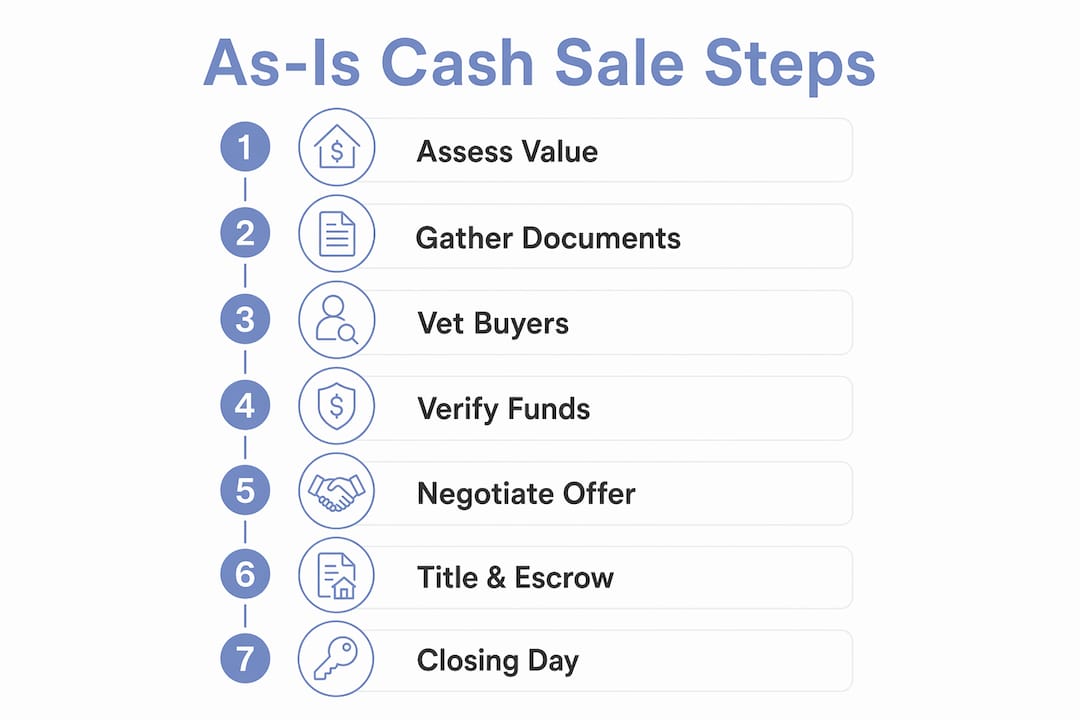
5. Negotiate and sign a purchase agreement. The contract should spell out the final price, what is included in the sale, any contingencies, and the closing date. Have an agent or real estate attorney review it before you sign.
6. Work with a title and escrow company. The title company confirms there are no liens on the property and issues title insurance. The escrow company manages the transfer of funds and closing documents. Both protect you and the buyer from surprises at the finish line.

7. Close. On closing day, you sign the deed and settlement documents, the funds are released, and ownership transfers. With cash, there is no waiting on a lender’s final approval.
Pro Tip: Get at least three offers before accepting one. Even a small difference in offer price or closing cost coverage can add up to thousands of dollars, and the process of comparing offers takes very little time.
What price should you expect when selling as-is for cash?
Expect to accept less than full market value. How much less depends on the buyer type, the condition of the home, and your local market.
Three pricing models dominate as-is cash sales:
- Discounted market value model. Price below comparable listings, typically 5%–20% below market, depending on repair needs. If similar homes sell for $400,000 but yours needs $30,000 in roof and plumbing work, listing around $370,000 is a reasonable starting point.
- Investor 70% Rule. Flippers typically offer about 70% of the after-repair value (ARV) minus estimated renovation costs. On a home with a $400,000 ARV and $40,000 in repairs, that math produces an offer around $240,000. It sounds low, but it reflects the investor’s risk and profit margin.
- iBuyer model. iBuyers pay roughly 85%–95% of market value, then subtract service fees of 5%–10%. On a $400,000 home, net proceeds often land in the $330,000–$360,000 range.
Market conditions matter too. In a seller’s market with low inventory, even cash investors compete harder and push offers up. In a slow market, buyers have more leverage and offers reflect that.
Pro Tip: Price your home based on its condition relative to comps, not on what you need to net. Overpricing an as-is property drives away the exact buyers you want and extends the timeline you were trying to avoid.
Pros and cons of selling your house as-is for cash
The honest version of this conversation acknowledges that as-is cash sales are not right for everyone.
Advantages worth knowing:
- Speed. A cash sale can close in as few as 7 days, compared to the 30–60 days a financed sale typically requires.
- No repair costs. You skip the upfront investment of fixing problems that may or may not increase your sale price proportionally.
- Certainty. Cash deals do not fall through because a lender denied the buyer’s mortgage at the last minute.
- Convenience for difficult situations. Inherited properties, homes with deferred maintenance, and properties tied up in divorce proceedings are all strong candidates for an as-is sale. Urgent life circumstances are the most common driver.
- Flexibility with contents. Many cash buyers will take the home with furniture and belongings included.
Drawbacks to weigh honestly:
- Lower sale price. This is the central trade-off. Investors price in their profit margin, and that comes out of your proceeds.
- Fewer buyers. Not every buyer wants a project, which narrows your pool.
- Misconceptions persist. “As-is means you can’t get a fair price” is a common assumption, but pricing strategically and targeting the right buyers can still produce a competitive offer. Separately, “only investors will be interested” is also not accurate. Traditional buyers in competitive markets regularly pursue as-is homes.
If your goal is to maximize net proceeds and you have the time and budget to make repairs, a traditional listing will likely outperform a cash sale. If you need to move fast, cannot afford repairs, or simply want the transaction done without complications, the as-is cash route fits.
What are your legal disclosure obligations when selling as-is?
Selling as-is does not mean selling blind. You still have a legal duty to disclose known material defects, and that obligation does not disappear because you labeled the sale “as-is.”
Mandatory disclosure requirements vary by state, but most require sellers to reveal issues like foundation problems, water damage, mold, roof condition, HVAC failures, pest infestations, and any known environmental hazards. The “as-is” designation tells the buyer you will not fix these issues. It does not give you permission to hide them.
Failing to disclose known defects exposes you to legal liability after closing, even on a cash sale. Buyers who discover concealed problems can sue for damages or attempt to rescind the contract. The risk is real and the legal costs are significant.
Transparency actually works in your favor. Sellers who disclose everything upfront and provide a pre-inspection report attract more serious buyers and close faster, because investors and flippers already know what they are getting into. There is no inspection surprise to renegotiate around.
A few practical steps: complete a seller’s disclosure form honestly, consider ordering a pre-listing inspection so you know exactly what exists, and keep copies of everything you provide to buyers. If you are unsure what your state requires, a real estate attorney can walk you through it in an hour.
Expert insights on getting the most from an as-is cash sale
The sellers who do best in as-is cash transactions are the ones who treat the process like a business transaction rather than an emotional one.
- Sell when your circumstances demand it, not when you feel forced. The best as-is cash sales happen when sellers recognize that speed and certainty are worth more to them than a higher price. Inherited properties, financial distress, and relocation deadlines are all legitimate reasons to prioritize a fast close over maximum proceeds.
- Disclose everything and use it as a selling tool. A complete pre-inspection report handed to every buyer signals that you are organized and honest. Serious investors appreciate it because it removes uncertainty from their underwriting. It also tends to reduce lowball offers, since buyers cannot pad their discount for “unknown” problems.
- Minor cosmetic improvements pay off without major investment. You do not need to renovate to make a better impression. Cleaning the property thoroughly, removing clutter, and fixing small cosmetic issues like broken light fixtures or scuffed paint costs very little and can meaningfully improve buyer perception.
- Negotiate on terms, not just price. Closing cost coverage, a flexible move-out date, or waiving certain contingencies can be worth real money without changing the headline offer price. Cash buyers often have more flexibility on terms than on price.
Pro Tip: Order a pre-inspection before you list. It costs a few hundred dollars and gives you a complete picture of the property’s condition. Buyers who see a clean, organized disclosure package make faster decisions and stronger offers.
For a deeper look at how as-is sales compare to traditional listings, the practical differences guide at Decostabuyshomes covers the key distinctions in detail.
How long does an as-is cash sale take from listing to closing?
Speed is the defining advantage of a cash sale, and the timeline reflects it. A typical as-is cash transaction moves through these stages:
Days 1–3: You contact buyers or list the property. Cash investors and investment companies often respond within 24–48 hours with an initial offer or a request to view the property.
Days 3–7: Offer review, negotiation, and contract signing. Because there is no lender involved, this stage moves quickly. Proof of funds verification and contract review can happen in parallel.
Days 7–14: Title search, escrow setup, and closing preparation. The title company confirms ownership and checks for liens. The escrow company prepares closing documents.
Days 14–21 (or sooner): Closing day. You sign the deed and settlement documents, funds are released, and the sale is complete.
The full process from first contact to closed sale can take as few as 7 days when both parties are prepared and no title issues exist. More typically, 2–3 weeks is a realistic expectation. Compare that to the 30–60 days a financed sale requires, and the time savings are substantial.
Delays usually come from title complications, incomplete seller documentation, or buyers who are not as liquid as they claimed. Vetting proof of funds early eliminates the last problem.
For more on how to sell fast without sacrificing your position, Decostabuyshomes has a full breakdown of methods that work in 2026.
What does an as-is cash sale actually cost you?
The common pitch for cash sales is “no fees, no commissions.” The reality is more nuanced.
Closing costs. Sellers typically pay a few percent of the sale price in closing costs, covering items like transfer taxes, title insurance, recording fees, and prorated property taxes. Some cash buyers offer to cover all closing costs as part of their offer, which is worth factoring into your comparison of offers.
Agent commissions. If you work with a real estate agent to find or negotiate with cash buyers, you will owe a commission, typically 2%–3% of the sale price on the seller’s side. If you sell directly to an investor or investment company without an agent, you avoid this cost entirely.
Pre-inspection costs. A pre-listing inspection runs a few hundred dollars but is optional. Given the protection it provides against post-closing disputes, most sellers find it worth the expense.
No repair costs. This is the genuine saving. Skipping repairs that might cost $10,000–$50,000 or more is a real financial benefit, even if the sale price is lower as a result.
Transfer taxes and recording fees. These vary by state and county. In some states, the seller pays transfer taxes; in others, it is split or covered by the buyer. Know your state’s rules before you finalize any deal.
The net result: an as-is cash sale costs less in fees and preparation than a traditional listing, but the lower sale price is the real cost. Running the numbers on both scenarios, with and without repairs, gives you a clear picture of which path actually puts more money in your pocket.
Key Takeaways
Selling your house as is for cash is the fastest way to close a home sale, but the price discount is real and the legal disclosure obligations remain fully in force.
| Point | Details |
|---|---|
| Price expectations | As-is cash offers are commonly discounted 5%–20% below market comparable listings, depending on repair needs, with investor offers using the 70% Rule producing the steepest discounts. |
| Buyer types matter | Investors, iBuyers, and traditional buyers each use different pricing models; knowing which type you are targeting shapes your negotiation. |
| Timeline advantage | Cash sales can close in as few as 7 days, compared to 30–60 days for a financed transaction. |
| Disclosure is mandatory | Selling as-is does not remove your legal duty to disclose known material defects; concealing problems creates post-closing liability. |
| Decostabuyshomes option | Decostabuyshomes buys homes in any condition across the U.S., offering multiple selling solutions including direct cash offers with no agent commissions. |
Decostabuyshomes buys your home as-is, on your timeline
If you have read this far, you already know the core trade-off: speed and certainty versus maximum sale price. Decostabuyshomes is built for sellers who have decided that trade-off makes sense for their situation.
Decostabuyshomes acquires residential properties across the United States in any condition, including single-family homes, manufactured homes, and properties that need significant work. There are no agent commissions, no repair requirements, and no open houses. The company covers closing costs and works around your timeline, whether you need to close in two weeks or need a few months to make arrangements. Unlike a one-size-fits-all cash buyer, Decostabuyshomes offers multiple selling structures, including direct cash purchases, novation agreements through its Retail Buyer Program, and wholesale options, so the deal is structured around what actually works for you.
If you are selling a property as-is and want a straightforward offer without the runaround, get started here to see what Decostabuyshomes can do for your specific property.