
Selling the marital home and splitting the net proceeds is the cleanest, fastest route for most divorcing couples. It converts shared equity into cash both parties can use independently. Two other solid paths exist: a one-spouse buyout (where one partner refinances and keeps the home) and an as-is cash sale through a buyer like Decostabuyshomes, which skips repairs, showings, and the 60–90 day traditional timeline entirely.
When each option fits best:
- Sell and split proceeds: Both spouses cooperate, want a clean break, and can wait several weeks to a few months. Selling while still legally married may preserve a a significant joint capital gains tax exclusion for married couples under IRS rules, provided you meet the two-out-of-five-year residency requirement.
- One-spouse buyout: One partner wants to stay, qualifies for a solo mortgage, and can fund an equalization payment. Requires refinancing under a single income.
- As-is cash sale via Decostabuyshomes: Timeline is urgent, cooperation is low, the home needs work, or both parties want to avoid showings and negotiations. Closes in days, not months.
Look for an agent with a Certified Divorce Real Estate Expert (DRES) credential when listing traditionally. These specialists produce court-acceptable Comparative Market Analyses and can communicate neutrally with both spouses.
Table of Contents
- Which selling option is right for your situation?
- How to sell a house during divorce: step-by-step
- How are sale proceeds divided in a U.S. divorce?
- What does it actually cost, and how long does it take?
- How do you choose the right professional to handle the sale?
- Legal and emotional items you need to handle before and during the sale
- Ready-to-use checklist and sample settlement language
- Key Takeaways
- What most people get wrong about selling during a divorce
- Decostabuyshomes: a faster path when a traditional listing isn’t realistic
- Useful sources and further reading
Which selling option is right for your situation?
Four paths exist. Each has a different cost, speed, and cooperation requirement.
| Option | Speed | Net Proceeds | Coordination Needed | Legal Complexity |
|---|---|---|---|---|
| Agent listing | several weeks to a few months | Highest potential | High | Moderate |
| As-is cash sale | about one to three weeks | Below market | Low | Low |
| One-spouse buyout | roughly one to two months (refinance) | N/A (equity transfer) | Moderate | Moderate–High |
| Hold and rent | Ongoing | Deferred | Very high | High |
A voluntary sale is almost always faster and cheaper than a court-ordered one. Forced sales compress timelines and reduce cooperation, which typically produces worse financial outcomes for both parties.
Quick decision rule: If maximizing sale price is the priority and both spouses can communicate civilly, list with an agent. If speed, certainty, or a difficult property condition matters more, an as-is cash sale wins. Holding and renting requires the highest ongoing coordination and rarely ends cleanly during an active divorce. You can compare the as-is vs. fix-up tradeoffs in detail before committing to a route.
How to sell a house during divorce: step-by-step
Step 1: Establish legal authority to sell. Check the deed. If both names appear, both spouses must sign to list and close. Temporary court orders issued at the start of a divorce sometimes restrict transferring marital assets, so confirm with your attorney before contacting any agent or buyer. If one spouse refuses to cooperate, a court can authorize the sale, though that process adds weeks or months to the timeline.
Step 2: Get a proper valuation. Order one or two independent appraisals, or ask a DRES-trained agent for a Comparative Market Analysis. Automated online estimates (Zillow’s Zestimate, for example) are not accepted by most courts and can be off by a meaningful margin. A formal appraisal typically costs $300–$600 and gives both parties a defensible number.
Step 3: Prepare the home. If you’re listing with an agent and want top dollar, budget roughly 1–3% of the expected list price for repairs, cleaning, and staging. When cooperation between spouses is low, skip cosmetic upgrades and sell as-is. Fewer decisions to make together means fewer arguments.
Step 4: Choose listing vs. as-is sale. With an agent, agree in writing on who handles showings, who approves repairs, and what the minimum acceptable offer is before you list. With an as-is cash buyer, neither spouse needs to manage showings or negotiate repairs. According to divorce real estate specialists, establishing these rules up front is one of the most effective ways to prevent last-minute stalls.
Step 5: Handle offers, escrow, and closing. Have your attorney review any accepted offer. Set a written minimum price and a delegated negotiator if direct communication between spouses is contentious. Proceeds go into escrow at closing and are distributed according to your settlement agreement or court order. Neither party should receive funds before the split is documented.
Timeline callout: A standard agent listing runs several weeks to a few months from list to close under normal conditions. Add court involvement and that stretches further. An as-is cash sale can close in as few as 7–14 days.
Pro Tip: Set a standard one to two day response deadline for offers in your written listing agreement. Missed deadlines are one of the most common ways divorce sales fall apart at the offer stage.
How are sale proceeds divided in a U.S. divorce?
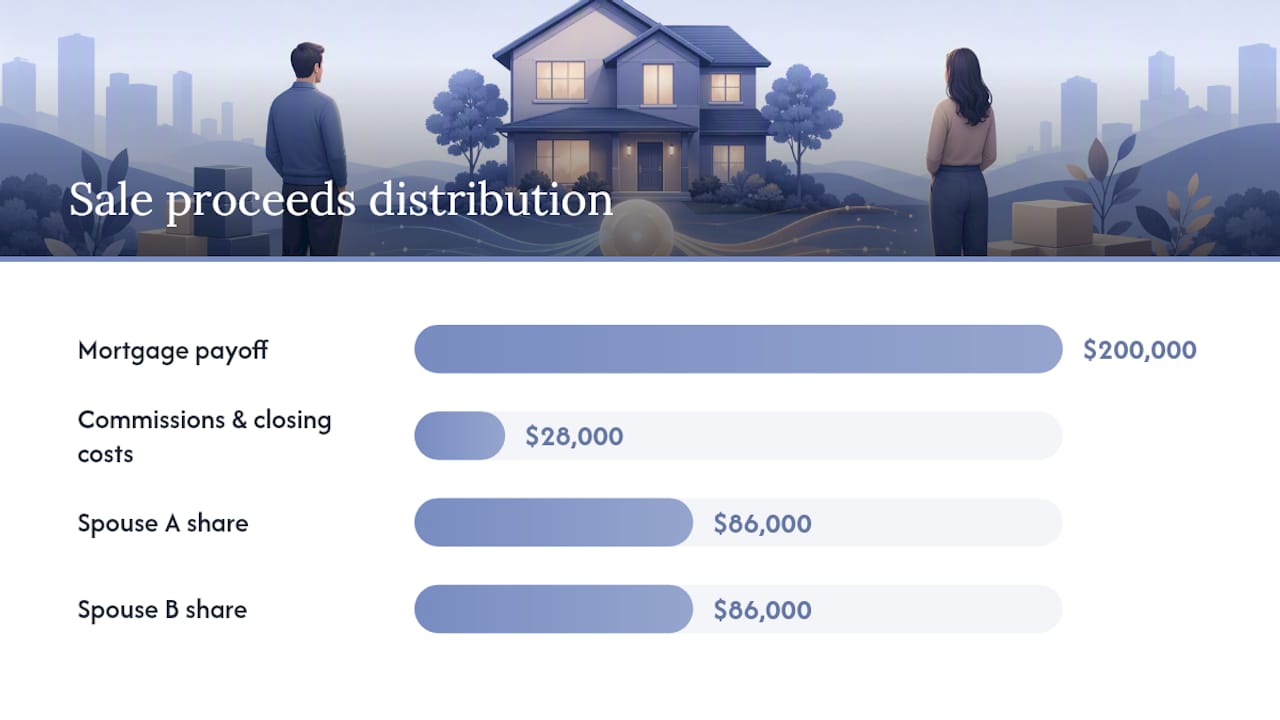
Net proceeds equal the sale price minus the mortgage payoff, agent commissions, closing costs, and any liens on the property. Escrow holds those funds until the court or a signed settlement agreement directs distribution.
Two legal frameworks govern the split:
- Community property states (Arizona, California, Idaho, Louisiana, Nevada, New Mexico, Texas, Washington, Wisconsin): marital property is generally split 50/50 by default.
- Equitable distribution states (all others): courts divide property “fairly,” which does not always mean equally. Contributions, length of marriage, and financial circumstances all factor in.
Example scenarios:
- 50/50 split: Home sells for $400,000. Mortgage payoff is $200,000. Commissions and closing costs total $28,000. Net proceeds: $172,000. Each spouse receives $86,000.
- Asset offset: One spouse keeps the home equity; the other keeps a retirement account of equivalent value. No cash changes hands at closing.
- Buyout with refinance: One spouse refinances into a solo mortgage, pulls out enough equity to pay the other their share, and takes full ownership.
Courts decide the split if spouses cannot agree, using proportional contribution, 50/50 division, or offsets against other assets as common methods.
This is general information, not legal or tax advice. Consult a divorce attorney and CPA for decisions specific to your state and situation.
What does it actually cost, and how long does it take?
| Route | Typical Timeline | Agent Commission | Closing Costs | Holding Costs |
|---|---|---|---|---|
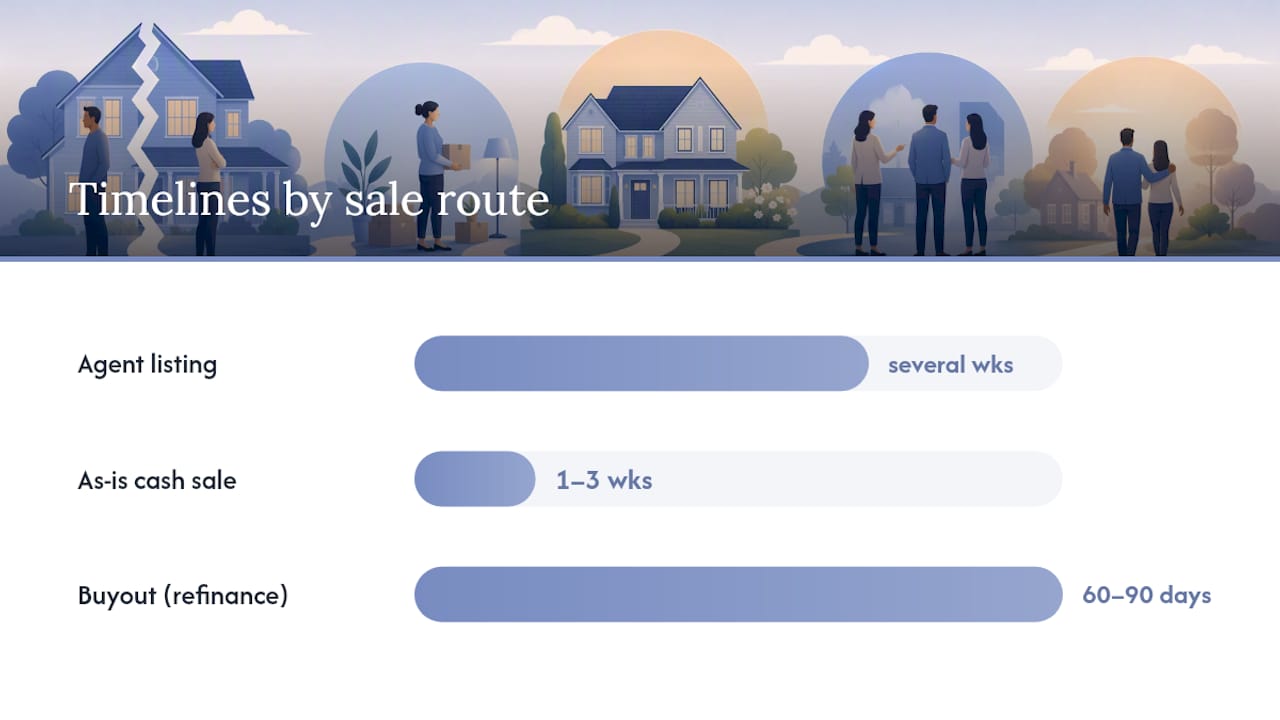
| Agent listing | several weeks to a few months | a typical agent commission percentage | a common range for closing costs | Mortgage + insurance + utilities monthly |
| As-is cash sale | about one to three weeks | None | Often covered by buyer | Minimal (fast close) |
| Buyout (refinance) | 60–90 days | None | 2–5% of loan amount | Ongoing as sole owner |
Tax note: Selling while still legally married can preserve the IRS joint exclusion of up to $500,000 in capital gains, provided both spouses meet the two-out-of-five-year ownership and use test. After the divorce is final, each individual can exclude only up to $250,000 in capital gains as a single filer under IRS rules. Timing the sale before the divorce is finalized can be financially significant when the home has appreciated substantially, though it may delay the divorce itself until closing.
For the buyout route, the remaining spouse must qualify for a new mortgage on a single income. Lenders evaluate credit score, debt-to-income ratio, and employment history independently, and many buyers who could qualify jointly cannot qualify alone.
How do you choose the right professional to handle the sale?
The right choice depends on four factors: how urgently you need to close, how well you and your spouse can communicate, how much net proceeds matter versus speed, and whether the home needs repairs.
Questions to ask any listing agent:
- Do you have experience with divorce sales or a DRES credential?
- Can you produce a CMA or BPO that a family-law court will accept?
- Do you have references from divorce attorneys?
When a cash buyer is the better call: The home needs significant repairs, one spouse is uncooperative, the mortgage is becoming a burden, or both parties simply want it over. Decostabuyshomes buys homes as-is, covers closing costs, and works around the timeline that fits the settlement process. If you need to sell your house fast, a cash offer removes most of the friction that stalls divorce sales.
Pro Tip: Before listing, put the negotiation rules in writing: minimum acceptable price, who has authority to accept or counter an offer, and a hard deadline for responding. This single document prevents most last-minute disputes.
Legal and emotional items you need to handle before and during the sale
Legal checkpoints:
- Verify both names on the deed and confirm no automatic court orders restrict the transfer.
- Run a lien search. Unpaid contractor bills, tax liens, or HOA arrears attach to the property and must be cleared at closing.
- If a spouse refuses to sign, consult your attorney about a partition action or court-ordered sale.
Occupancy and communication rules:
- Decide in writing who manages showings, who pays utilities and maintenance while listed, and how repair decisions get made.
- If children are in the home, coordinate showing schedules around custody arrangements.
- Use a neutral third party (agent, mediator, or attorney) to relay communications if direct contact is too contentious.
A court-ordered sale is always an option, but voluntary cooperation produces better financial outcomes for both parties. Contested sales take longer and often close at lower prices.
Ready-to-use checklist and sample settlement language
Pre-listing checklist:
- Confirm deed names and check for court orders restricting sale.
- Order an independent appraisal or DRES-prepared CMA.
- Run a lien search and clear any title issues.
- Agree in writing on repair budget, staging decisions, and who manages showings.
- Set a minimum acceptable offer price and a delegated negotiator.
- Confirm photography and listing date with the agent.
Sample settlement clause: immediate sale and split
Sample clause: buyout with refinance contingency
Simple net proceeds calculation:
| Item | Amount |
|---|---|
| Gross sale price | $400,000 |
| Mortgage payoff | ($200,000) |
| Agent commission (~6%) | ($28,000) |
| Net proceeds | $172,000 |
| Each spouse (50/50) | $86,000 |
Keep receipts and bank transfer records for any improvements you funded. These records support a claim for a larger share of proceeds if your contribution was disproportionate.
Key Takeaways
Selling the marital home and splitting net proceeds is the fastest, cleanest exit for most divorcing couples, but the right route depends on timeline, cooperation level, and tax timing.
| Point | Details |
|---|---|
| Confirm legal authority first | Verify deed names and check for court orders before listing or accepting any offer. |
| Tax timing matters | Selling before the divorce is final may preserve the IRS joint exclusion of up to $500,000 in capital gains under IRS rules. |
| Voluntary beats court-ordered | Cooperative sales close faster and at higher prices than court-forced ones. |
| Put offer rules in writing | Set a minimum price, a delegated negotiator, and a a standard one to two day response deadline before listing. |
| Decostabuyshomes for speed | When repairs, urgency, or low cooperation rule out a traditional listing, Decostabuyshomes buys as-is with no commissions and covers closing costs. |
What most people get wrong about selling during a divorce
The conventional advice is to wait until the divorce is final before selling. That instinct is understandable, but it often costs both parties money. Every month the home sits unsold is another month of shared mortgage payments, insurance, and utilities, plus the ongoing legal fees that accumulate when a contested asset stays on the table.
The bigger mistake is treating the home sale as a secondary task. The house is usually the largest single asset in the marriage. Decisions made under emotional pressure, without written rules or a neutral agent, tend to produce the worst outcomes: last-minute refusals to sign, lowball offers accepted out of exhaustion, or a court-ordered sale that closes below market.
Speed and fairness are not opposites here. A clean, well-structured sale, whether through a traditional listing or a cash buyer, gives both parties liquidity and a defined endpoint. The couples who fare best are the ones who treat the sale like a business transaction from day one, even when everything else feels personal.
Decostabuyshomes: a faster path when a traditional listing isn’t realistic
When a contested property, needed repairs, or an urgent mortgage burden makes a traditional listing impractical, Decostabuyshomes offers a direct alternative. The company buys homes as-is, covers closing costs, charges no agent commissions, and works around the timeline your settlement requires.
The process is straightforward: submit basic property details, receive a no-obligation cash offer, and choose a closing date that fits your legal timeline. No showings, no repair negotiations, no waiting on buyer financing to clear. For divorcing homeowners dealing with complex shared ownership, the as-is route removes most of the friction that stalls traditional sales.
This option fits best when:
- The mortgage is a monthly burden neither party wants to carry.
- The home needs repairs neither spouse will fund.
- One spouse is uncooperative and a fast resolution matters more than top dollar.
- Both parties want a defined close date to finalize the settlement.
Request a no-obligation offer at decostabuyshomes.com. Have the property address, a rough sense of its condition, and both spouses’ contact information ready.
Useful sources and further reading
- How to Sell Your Home During a Divorce: A Complete Guide
- A Guide to Selling A House During A Divorce | Redfin
- Is It Better to Sell Your House Before or After a Divorce?
- Selling the Family Home in Divorce
- You’ve decided to sell your house in divorce. What should you do? | Raleigh Divorce Law Firm
For state-specific rules, tax treatment of your gain, and binding settlement language, consult a licensed divorce attorney and a CPA before finalizing any decisions.