
Yes, you can sell your house without a realtor in every U.S. state. Millions of homeowners do it each year, and the process is entirely legal. The question isn’t whether you can do it. It’s which of the three realistic paths fits your situation.
- Pure FSBO: You handle everything yourself. Pricing, listing, showings, negotiation, paperwork. Maximum control, maximum effort. Works best when you have time, a buyer already lined up, or strong local market knowledge.
- Flat-fee MLS / assisted FSBO: You pay a one-time fee (typically $100–$500) to get your home on the MLS, then manage the sale yourself. Better exposure than pure FSBO, still no listing commission. The middle ground most serious FSBO sellers should consider.
- Sell to a cash buyer or investor: You skip the listing process entirely. No repairs, no showings, no waiting. You trade some price for speed and certainty. The right call for inherited properties, distressed homes, or sellers who need to close fast.
This guide walks you through all three paths in enough detail to make a confident decision, price your home, list it, negotiate offers, and close without paying a listing agent.
Table of Contents
- What do the numbers say about selling without an agent?
- Is selling without a realtor legal — and what risks should you know?
- Is selling without a realtor worth the effort for you?
- What does FSBO actually cost versus selling with an agent?
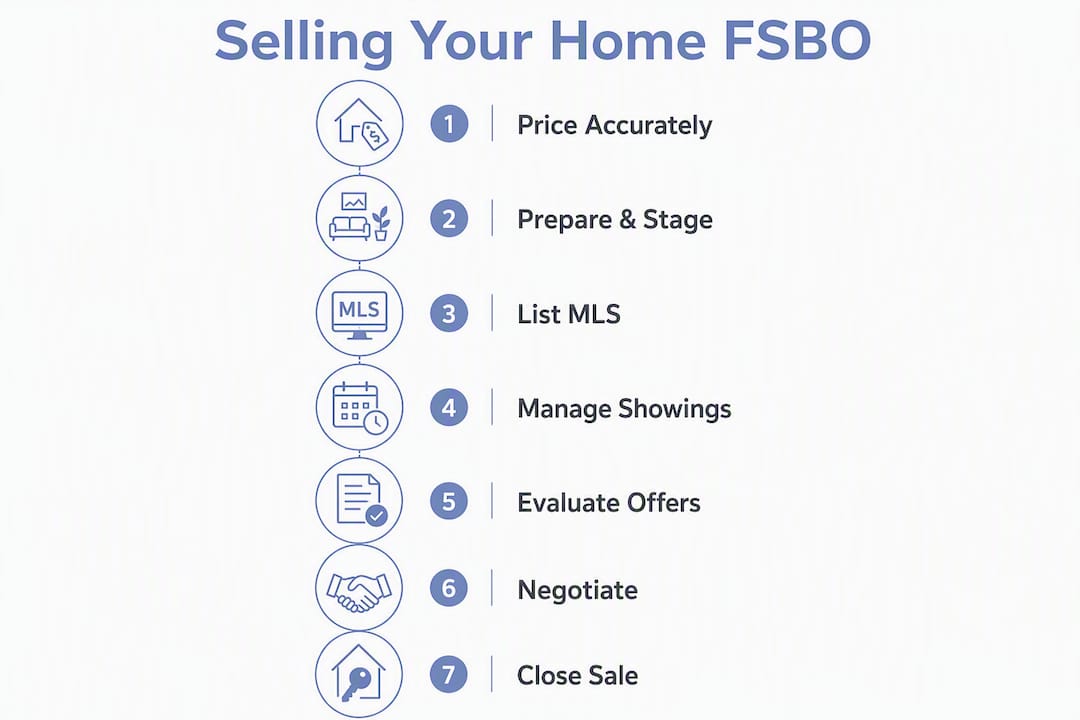
- How to sell your house without a realtor: the full step-by-step checklist
- How do you price your home accurately without an agent?
- How to prepare, repair, and photograph your home to sell faster
- Where and how should you advertise your FSBO listing?
- How do you manage showings, vet buyers, and negotiate offers?
- What paperwork and closing steps do you handle as the seller?
- What state-specific rules do you need to check before listing?
- What are the most common FSBO problems and how do you avoid them?
- When DIY isn’t the right choice: alternatives to FSBO
- Key Takeaways
- When FSBO works and when it doesn’t: a frank assessment
- Skip the listing process entirely: how Decostabuyshomes can help
- Useful sources and further reading
What do the numbers say about selling without an agent?
According to the National Association of Realtors, FSBO transactions made up a small share of all home sales in the most recent profile year, while agent-assisted sales accounted for the vast majority. The median FSBO sale price trailed that of agent-assisted sales. That $65,000 gap gets cited constantly, and it deserves context: FSBO homes tend to cluster in lower-priced segments and rural markets, which pulls the median down. The gap is real, but it isn’t purely a negotiation penalty.
The core math: A typical agent charges 5–6% total commission, split between the listing agent and the buyer’s agent. On a $400,000 home, that’s $20,000–$24,000. Go FSBO and you eliminate the listing side (roughly 2.5–3%), saving $10,000–$12,000. But most FSBO sellers still offer buyer-agent compensation to attract represented buyers, cutting true savings roughly in half.
Timeline-wise, FSBO sales can close in 30–60 days in a hot market when a buyer is already identified. In a slower market without MLS exposure, expect 90–120 days or longer. Agent-assisted sales in most U.S. markets average 30–60 days from listing to close, with the benefit of broader buyer reach from day one.
Is selling without a realtor legal — and what risks should you know?
Selling without a realtor is legal in all 50 states, but the procedures vary enough that skipping the legal homework is where sellers get hurt. Here’s what to know before you list.

Attorney-required states: Several states require a licensed real estate attorney to handle closing or prepare the purchase contract. Georgia, South Carolina, Massachusetts, Connecticut, and New York are among the most commonly cited. In these states, “no realtor” does not mean “no professional help.” Budget for attorney fees.
Mandatory disclosures: Every state requires sellers to disclose known material defects. Federal law requires lead-paint disclosure for homes built before 1978. State forms vary widely. Missing a required disclosure is one of the fastest ways to face post-closing litigation.
Wire fraud: Real estate transactions are a primary target for wire fraud. Criminals intercept closing communications and redirect wire transfers. The FBI has flagged this as one of the costliest cybercrime categories in the U.S. Always verify wiring instructions by phone using a number you independently sourced, never one from an email.
Buyer qualification: Without an agent screening buyers, you risk accepting an offer from someone who can’t actually close. Require a mortgage pre-approval letter (not just pre-qualification) or proof of funds for cash buyers before you accept any offer.
Personal safety during showings: You’re inviting strangers into your home. Never show alone if possible. Require an appointment and a name before any showing. Remove valuables and personal documents from visible areas.
Pro Tip: Before wiring any funds at closing, call the title company or attorney directly using a phone number from their official website to confirm the wire instructions. Never rely on instructions sent by email alone.
Is selling without a realtor worth the effort for you?
The honest answer: it depends on your situation more than it depends on the market.
Main benefits:
- Save the listing-side commission (typically 2.5–3% of sale price)
- Full control over pricing, timing, and who you negotiate with
- Flexible closing timeline on your terms
Main drawbacks:
- Risk of underpricing or overpricing without professional pricing guidance
- Significant time commitment for showings, marketing, and paperwork
- Legal liability if disclosures or contracts are handled incorrectly
- Lower median sale prices on average, partly due to reduced marketing reach
Run through this checklist before you commit:
| Decision Factor | FSBO-Friendly | Consider an Agent |
|---|---|---|
| Time available | 10+ hours/week during listing | Limited availability |
| Buyer already identified | Yes | No |
| Negotiation experience | Comfortable | Little to none |
| Market conditions | Strong seller’s market | Balanced or buyer’s market |
| Property condition | Move-in ready | Needs significant repairs |
| Comfort with paperwork | High | Low |
| Urgency to close | Flexible | Tight deadline |
FSBO works best for sellers who already have a buyer (a neighbor, family member, or coworker), sellers in very hot markets where homes sell themselves, and sellers with real estate or legal backgrounds. It tends to go sideways for first-time sellers in complex markets, sellers with properties that need significant work, and anyone who underestimates the time required.
What does FSBO actually cost versus selling with an agent?
The savings are real but smaller than the headline number suggests. Here’s the math on a $400,000 sale.
Cost comparison: FSBO vs. agent-assisted sale
| Cost Item | FSBO | Agent-Assisted |
|---|---|---|
| Listing agent commission | — | $10,000–$12,000 (2.5–3%) |
| Buyer agent commission | $10,000–$12,000 (if offered) | $10,000–$12,000 (2.5–3%) |
| Flat-fee MLS service | $100–$500 | — (included) |
| Real estate attorney | $500–$1,500 | $500–$1,500 |
| Professional photography | $200–$500 | Often included |
| Home inspection (pre-listing) | $300–$500 | $300–$500 |
| Staging | $500 | $500 |
| Seller closing costs | 2.5–3% | 2.5–3% |
Net savings example on a $400,000 sale:
If you offer buyer-agent compensation and use a flat-fee MLS, your total FSBO cost runs roughly $11,000–$15,000 versus $20,000–$24,000 for a full-commission agent sale. That’s a realistic net saving of $5,000–$10,000, not the full $20,000 the “skip the commission” pitch implies. If you sell to a buyer who is unrepresented, you keep the full listing-side savings and potentially more.
The math shifts further if your FSBO home sells for less than an agent-assisted sale would have. A 5% price difference on a $400,000 home is $20,000. That’s the break-even point where the commission savings disappear entirely.
How to sell your house without a realtor: the full step-by-step checklist
Step 1: Price your home accurately (weeks 1–2)
Pull recent comparable sales (comps) within a half-mile radius, sold in the last 90 days, with similar square footage, bedroom/bathroom count, and condition. Zillow’s Zestimate and Redfin’s estimate are starting points, not final answers. For a more reliable number, pay $300–$500 for a licensed appraiser’s opinion or request a broker price opinion (BPO) from a local agent for $100–$200.
Step 2: Prepare, repair, and stage (weeks 2–4)
Prioritize repairs that affect safety, systems (HVAC, roof, electrical), and curb appeal before cosmetic fixes. A fresh coat of neutral paint and clean landscaping return more per dollar than most renovations. Hire a professional photographer. Listings with professional photos consistently attract more buyer interest than those with phone snapshots.
Step 3: Create your listing and get MLS exposure (week 3–4)
Flat-fee MLS services let you list on the MLS for a one-time fee, giving your home exposure to every buyer’s agent in your market. Without MLS access, you’re limited to Zillow’s FSBO section, Facebook Marketplace, Craigslist, and FSBO-specific sites. That’s a meaningful reduction in buyer traffic. Post on all available platforms and include professional photos, a floor plan, and a virtual tour if possible.

Pro Tip: Offering buyer-agent compensation in your MLS listing (typically 2–2.5%) dramatically increases the number of agents who will show your home to their clients. Skipping it saves money on paper but often reduces showings significantly.
Step 4: Manage showings (ongoing, weeks 4–10)
Use appointment-only scheduling. A lockbox works for agent-accompanied showings; for unrepresented buyers, be present or have someone with you. Keep a sign-in sheet. Follow up with every showing within 24 hours.
Step 5: Evaluate offers (as they arrive)
Don’t evaluate offers on price alone. Look at: net proceeds after concessions, contingencies (inspection, financing, appraisal), closing timeline, earnest money amount, and the buyer’s financing strength. A cash offer at $380,000 with a 10-day close often beats a financed offer at $400,000 with a 45-day close and an appraisal contingency.
Step 6: Negotiate (as needed)
Counter in writing. Keep emotion out of it. Common negotiation scenarios: a lowball offer (counter at your price with a short deadline), a repair request after inspection (offer a credit instead of doing the work yourself), an appraisal gap (negotiate who covers the difference or adjust price). If you’re uncomfortable with contract language, hire a real estate attorney to review or draft the purchase agreement. Attorney fees for contract review typically run $300–$800.
Step 7: Escrow, title, inspections, and closing (weeks 6–12)
Once you have an accepted offer, the buyer typically orders a home inspection within 7–10 days. Title is ordered by the title company or closing attorney. You’ll receive a closing disclosure showing all costs. At closing, you sign the deed and transfer documents, the title company or attorney records the deed, and funds are disbursed. The whole process from accepted offer to closing typically takes 30–45 days for financed buyers, 10–21 days for cash buyers.
How do you price your home accurately without an agent?
Pricing is where most FSBO sellers make their costliest mistake, and it cuts both ways. Overprice and the home sits; buyers assume something is wrong. Underprice and you leave real money on the table.
Gathering comps: Search public records or sites like Zillow, Redfin, or Realtor.com for homes sold in the last 90 days within a half-mile of your property. Match on: square footage (within 10–15%), bedroom and bathroom count, lot size, age, and condition. Adjust for differences. A home with a finished basement or a renovated kitchen warrants a premium; a home on a busy road or with dated systems warrants a discount.
What to ignore: Active listings are not comps. They show what sellers are asking, not what buyers are paying. Pending sales are better signals but not final. Only closed sales count.
Professional appraisal vs. BPO: A licensed appraisal ($300–$500) gives you a defensible, lender-grade value opinion. It’s worth the cost if your home is unusual, if you’re in a thin market with few comps, or if you expect a buyer’s lender appraisal to be a sticking point. A broker price opinion is cheaper and faster but carries less weight with lenders.
Pricing strategy: In a seller’s market, pricing slightly below the top comparable sale often triggers multiple offers and drives the final price above asking. In a balanced or buyer’s market, price at or slightly below market value to attract attention quickly. Homes that sit for 30+ days without offers signal overpricing to buyers and agents alike.
Pro Tip: Give yourself a two-week pricing test. If you have fewer than 10 showings in the first two weeks, your price is likely too high for current market conditions. Drop it by 2–3% and reassess.
How to prepare, repair, and photograph your home to sell faster
Buyers form an opinion in the first 30 seconds of a showing, and often before that, from your listing photos. What you spend here directly affects how fast you sell and at what price.
Repair priority list:
- Safety and structural first: Fix anything that will fail a home inspection or raise red flags: leaking roof, faulty electrical panels, foundation cracks, non-functioning HVAC. These are deal-killers.
- Systems second: Buyers and their inspectors scrutinize HVAC age, water heater condition, and roof remaining life. A recent service record on your HVAC costs nothing to produce and builds buyer confidence.
- Curb appeal third: Mow, edge, trim, and pressure-wash. Paint the front door. Replace worn house numbers. First impressions drive whether buyers even come inside.
- Cosmetic items last: Fresh neutral paint, clean grout, and updated light fixtures show well in photos and cost relatively little. Skip expensive renovations. Kitchens and bathrooms rarely return full cost in a quick FSBO sale.
Staging on a budget: Declutter every room. Remove personal photos and excess furniture. Rent a storage unit if needed. A clean, sparse home photographs larger and shows better. If the home is vacant, consider virtual staging for listing photos.
Photo-shoot checklist:
- Shoot on a sunny day or use a photographer with HDR equipment
- Photograph every room, including bathrooms and laundry
- Lead with the best exterior shot as your primary photo
- Include a wide-angle kitchen shot, primary bedroom, and main living area
- Capture the backyard, garage, and any standout features (fireplace, built-ins, view)
- Add a floor plan image if possible; it reduces unqualified showings
- Consider a 3D virtual tour for out-of-town buyers
If you’re considering whether repairs are worth doing before listing, the selling as-is vs. fixing up guide from Decostabuyshomes lays out the decision clearly.
Where and how should you advertise your FSBO listing?
Exposure is the single biggest structural disadvantage of selling without an agent. The MLS feeds buyer-agent networks, which represent the majority of active buyers. Without it, you’re fishing in a much smaller pond.
Platform strategy:
- Flat-fee MLS: The highest-leverage move for most FSBO sellers. Services like Houzeo, FSBO.com’s MLS option, and similar providers list your home on the local MLS for a one-time fee. Zillow’s research confirms that MLS exposure and agent networks typically increase buyer traffic and sale price.
- Zillow and Trulia: Zillow allows FSBO listings directly. These reach buyers searching without an agent but miss agent-represented buyers unless you’re also on the MLS.
- Facebook Marketplace and local groups: Surprisingly effective for lower-priced homes and in tight-knit communities. Free and immediate.
- Realtor.com: Primarily fed by MLS data. A flat-fee MLS listing will syndicate here automatically.
- Yard sign: Still works. “For Sale By Owner” with your phone number captures drive-by interest from neighbors and buyers already touring the area.
- Targeted social ads: A $100–$200 Facebook or Instagram ad campaign targeting buyers in your zip code can generate meaningful traffic for a fraction of traditional marketing costs.
Writing listing copy that works:
Lead with the home’s strongest feature in the headline. “3BR/2BA with renovated kitchen and fenced backyard in [neighborhood]” beats “Lovely home for sale.” Include: square footage, bedroom/bath count, lot size, year built, recent upgrades, school district, and distance to key amenities. End with a clear call to action and your contact information.
Listing copy bullet template:
- Beds/baths and square footage up front
- Year built and recent major upgrades (roof, HVAC, kitchen)
- Lot size and outdoor features
- School district and nearby amenities
- Parking (garage, driveway)
- HOA status and fees if applicable
- Showing instructions and contact info
How do you manage showings, vet buyers, and negotiate offers?
Showing protocols
Schedule all showings by appointment. Give yourself at least two hours’ notice to prepare. For agent-accompanied showings, a lockbox is standard. For unrepresented buyers, be present or have a trusted person with you. Never leave a buyer alone in your home.
After each showing, follow up by text or email within 24 hours. Ask for feedback. Patterns in feedback (e.g., “felt dark,” “kitchen felt small”) are pricing or staging signals, not just opinions.
Vetting buyers before you accept an offer
- Cash buyers: — Require proof of funds, a recent bank or investment statement showing liquid assets sufficient to close. Be skeptical of buyers who claim cash but delay producing documentation.
For a deeper look at vetting cash buyers specifically, the guide on whether cash home buyers are legitimate covers the key protections sellers should demand.
Also worth reading before you accept any financed offer: understanding common mortgage pitfalls that can derail a buyer’s financing at the last minute.
Offer evaluation checklist
- Net proceeds after all concessions and credits
- Contingencies: inspection, financing, appraisal, sale of buyer’s home
- Closing timeline and flexibility
- Earnest money amount (1–3% of purchase price is typical)
- Financing type: conventional, FHA, VA, or cash
- Inspection period length
Negotiation moves for homeowner sellers
Lowball offer: Don’t reject it outright. Counter at your price with a 24–48 hour deadline. A buyer who lowballs is still a buyer.
Repair requests after inspection: Offer a closing credit instead of doing the work yourself. It’s cleaner, faster, and avoids disputes over workmanship.
Appraisal gap: If the home appraises below the purchase price, you have three options: reduce the price to the appraised value, ask the buyer to cover the gap in cash, or split the difference. Having a strong comp file ready before listing helps you defend your price if an appraisal comes in low.
What paperwork and closing steps do you handle as the seller?
Bankrate’s FSBO guide is direct on this point: contracts and paperwork are where FSBO sellers face the most legal exposure. Here’s what you’re responsible for.
- Purchase and sale agreement: The binding contract. Use your state’s standard form (available from your state’s real estate commission website) or have an attorney draft it. Never use a generic template downloaded from an unknown source.
- State-required seller disclosures: Every state has a specific form. Common items: known defects, water intrusion history, HOA status, permit history, and environmental hazards.
- Federal lead-paint disclosure: Required for all homes built before 1978. Buyers get 10 days to test; you must provide the EPA pamphlet.
- HOA documents: If applicable, provide CC&Rs, bylaws, current financials, and transfer documents.
- Title commitment: Ordered by the title company or closing attorney. Confirms the title is clear of liens or encumbrances.
- Survey: May be required by the lender or title company depending on your state and property type.
- Inspection reports: Provide any pre-listing inspection reports you commissioned. Concealing known defects is a disclosure violation.
- Closing disclosure / settlement statement: Prepared by the title company or attorney. Review it carefully before closing day.
Escrow and title process: The buyer’s lender (or the buyer directly, for cash sales) typically selects the title company or closing attorney. Escrow holds the earnest money and coordinates document collection. At closing, you sign the deed, the title company records it with the county, and funds are disbursed.
When to hire an attorney: In attorney-required states, you have no choice. In other states, hire one if: the contract is complex, there are title issues, the buyer is unrepresented and using their own contract, or you’re selling a property with liens, estate issues, or easement disputes. Attorney fees for closing typically run $500–$1,500.
What state-specific rules do you need to check before listing?
State rules vary enough that a checklist that works in Texas can get you in legal trouble in Massachusetts. Three checks every FSBO seller must make before listing:
- Required seller disclosure forms: Find your state’s official form on your state real estate commission’s website. Some states (like California) have multi-page disclosure packets; others have shorter forms. Using an outdated or incorrect form exposes you to post-closing liability.
- Closing requirements: Determine whether your state requires a licensed real estate attorney at closing or whether a title company can handle it. Attorney-required states include Georgia, South Carolina, Massachusetts, Connecticut, New York, Vermont, Delaware, and several others. This list changes; verify with your state bar association.
- Transfer taxes and state-specific forms: Some states (New York, Pennsylvania, Maryland) impose real estate transfer taxes that the seller pays at closing. Others have specific forms for property condition, well/septic status, or flood zone disclosure.
For a state-specific example of how these rules play out in practice, the Virginia as-is selling guide from Decostabuyshomes walks through attorney requirements and disclosure obligations in that state.
When in doubt, a one-hour consultation with a local real estate attorney ($150–$300) is cheaper than a post-closing lawsuit.
What are the most common FSBO problems and how do you avoid them?
Most FSBO failures are predictable. Here’s where sellers go wrong and what to do instead.
- Overpricing: The most common mistake. Homes that sit develop a stigma. Run comps carefully, consider a professional appraisal, and commit to a two-week pricing test before adjusting.
- No MLS exposure: Listing only on free FSBO portals dramatically limits buyer reach. A flat-fee MLS listing solves this for $100–$500.
- Weak buyer vetting: Accepting an offer from an unqualified buyer wastes weeks and kills deals at the last minute. Require pre-approval letters and proof of funds before signing anything.
- Disclosure errors: Failing to disclose known defects is the most common source of post-closing litigation. Use your state’s official disclosure form and disclose everything you know.
- Contract mistakes: A poorly written purchase agreement can void the deal or expose you to damages. Have an attorney review any contract you didn’t prepare with professional help.
- Appraisal shortfalls: If your price isn’t supported by comps, a buyer’s lender appraisal will come in low and the deal will stall. Price with the appraisal in mind from the start.
- Wire fraud: Never wire funds based on email instructions alone. Always verify by phone using a number from the title company’s official website.
When to stop and get help: If your home has been on the market for 60+ days without a serious offer, if you’ve received an offer with contract terms you don’t understand, or if a title search reveals a lien or ownership dispute, bring in a professional. An attorney or a flat-fee agent can often resolve the issue faster than you can alone.
When DIY isn’t the right choice: alternatives to FSBO
Not every seller is a good FSBO candidate, and not every property is a good FSBO listing. Here’s an honest look at the alternatives.
| Selling Method | Best For | Typical Cost | Speed |
|---|---|---|---|
| Full-service agent | Most sellers; complex transactions | 5–6% commission | 30–60 days |
| Flat-fee MLS + FSBO | Confident sellers; move-in ready homes | $100–$500 + buyer-agent comp | 30–90 days |
| Discounted/limited-service agent | Sellers wanting some help at lower cost | 1–2% listing fee | 30–60 days |
| iBuyer | Move-in ready homes in select markets | Service fee 5–8% | 30–60 days |
| Cash buyer / investor | Distressed, inherited, or as-is properties | Below market value | 7–21 days |
When a cash offer makes the most sense:
A seller inheriting a property in another state, facing foreclosure, dealing with a home that needs $40,000 in repairs, or relocating on a tight timeline often finds that the speed and certainty of a cash offer outweighs the price difference. There’s no inspection contingency to blow up the deal, no appraisal to come in low, and no 45-day financing window to wait out.
For sellers considering the as-is route, the selling a house as-is guide from Decostabuyshomes covers what to expect and how the process works.
Pro Tip: When vetting a cash buyer, ask for proof of funds before signing anything, use your own title company (not one the buyer insists on), and make sure the purchase agreement includes a realistic closing date with a penalty for delays. A legitimate cash buyer will have no objection to any of these requests.
Key Takeaways
Selling without a realtor is legal everywhere in the U.S., but your net savings depend heavily on whether you offer buyer-agent compensation, how accurately you price, and whether your state requires an attorney at closing.
| Point | Details |
|---|---|
| FSBO median price gap | The median FSBO sale price was $360,000, trailing the $425,000 median for agent-assisted sales, a $65,000 gap in the most recent NAR profile. This gap is influenced by FSBOs clustering in lower-priced and rural markets. |
| Real commission savings | Realistic net savings on a $400,000 FSBO sale run $5,000–$10,000 after buyer-agent compensation and costs. |
| MLS exposure is critical | A flat-fee MLS listing ($100–$500) is the highest-leverage move for most FSBO sellers. |
| State rules vary significantly | Check attorney requirements, mandatory disclosure forms, and transfer taxes before listing in your state. |
| Decostabuyshomes cash offer | For sellers who need speed or want to sell as-is, Decostabuyshomes provides no-commission cash offers with flexible timelines. |
When FSBO works and when it doesn’t: a frank assessment
The sellers who do best with FSBO share a few traits: they have a buyer already identified, they’re in a market where homes sell quickly regardless of marketing, or they have a professional background in real estate, law, or negotiation. For them, the savings are real and the process is manageable.
The sellers who regret it most often made one of two mistakes. They overpriced because they couldn’t separate emotional attachment from market value, and watched the home sit for months before eventually selling for less than a well-priced listing would have fetched on day one. Or they skipped the attorney and signed a contract with terms they didn’t fully understand, which created problems at closing or after.
The flat-fee MLS path is genuinely underused. Most homeowners think of FSBO as binary: full agent or full DIY. The middle option, paying $200–$400 for MLS access while managing the sale yourself, captures most of the savings while solving the exposure problem. That’s the path worth serious consideration for sellers who are organized and have the time.
If speed, condition, or avoiding the whole process matters more than squeezing the last dollar out of the sale, a cash buyer is often the cleaner answer. Not because it’s the highest price, but because it’s the most certain outcome with the least friction. For sellers in that situation, the fast sale options guide is a useful next read.
Skip the listing process entirely: how Decostabuyshomes can help
For sellers who want certainty over maximum price, Decostabuyshomes offers a direct path: a no-obligation cash offer, no agent commissions, no repairs required, and no waiting on buyer financing. The company buys single-family homes, manufactured homes, and properties in any condition across the United States, covering all closing costs and working around your timeline.
This option fits sellers dealing with inherited properties, homes that need significant work, tight relocation deadlines, or situations where the FSBO process simply isn’t practical. There’s no MLS listing, no open houses, and no risk of a deal falling through at the financing stage.
To get started, visit Decostabuyshomes to understand exactly what to expect from a cash offer, then request your no-obligation offer directly. Have your property address, a rough sense of condition, and any known title issues ready. Most sellers receive an initial offer within 24–48 hours.
Useful sources and further reading
The following sources were used in preparing this guide and are worth bookmarking for verification and state-specific research:
- NAR: FSBOs reach all-time low, more sellers rely on agents — FSBO market share and median price data
- Bankrate: How to sell a house without a Realtor — Step-by-step process and attorney guidance
- Consumer Financial Protection Bureau: Owning a Home — Closing process and buyer financing resources
- Decostabuyshomes: How to sell my house fast — Fast-sale alternatives and investor pathways
For state-specific disclosure forms and closing requirements: Visit your state’s real estate commission website directly. Search “[your state] real estate commission seller disclosure form” for the official current version. For attorney referrals in attorney-required states, your state bar association’s referral service is the most reliable starting point.