
Escrow holds and moves the money and documents. A title company verifies and protects ownership. Those are two different jobs, and confusing them is one of the most common mistakes buyers and sellers make when they reach the closing table.
Your escrow officer is the person you call about your earnest money deposit, loan payoff figures, and final disbursement. Your title company is the one researching whether the seller actually has a clean right to sell. In many states, one company does both. In others, they are separate licensed entities. The CFPB, ALTA, and state licensing departments all regulate these roles differently, which is why the answer to “who handles my closing?” genuinely depends on where you live. Decostabuyshomes works with both types of closing partners across the country, and this guide explains exactly what each one does and when you need more than either can legally provide.
Key takeaways
Escrow protects your money during the transaction; title insurance protects your ownership rights after closing, and which entity leads your closing depends entirely on your state’s legal convention.
| Point | Details |
|---|---|
| Escrow vs title: different jobs | Escrow manages funds and documents; a title company researches and insures ownership. |
| State convention determines who leads | Attorney, title-company, and escrow-driven states each assign the closing role differently. |
| Read the title commitment | Schedule B exceptions show what title insurance will NOT cover — review it before closing day. |
| Owner’s policy is a one-time cost | Paid at closing, it protects you for as long as you own the property. |
| Attorneys fill the legal gap | Hire one for complex ownership, disputes, estate sales, or any attorney-mandatory state. |
This article is general information, not a substitute for advice from a qualified lawyer. Consult a qualified legal professional about your own circumstances before acting on anything here.
Table of Contents
- Escrow vs title company: what each one actually does
- What an escrow company and escrow officer do at closing
- What a title company does: searches, clears defects, and insures ownership
- How escrow and title companies coordinate across the transaction
- Owner’s vs lender’s title insurance: why both matter
- How state law changes who runs the closing
- When to hire a real estate attorney instead of relying on title or escrow
- A note from Decostabuyshomes
- What the escrow and title distinction means for your deal
- Authoritative resources to consult next
- My take on what most buyers get wrong
- Sources
Escrow vs title company: what each one actually does
| Dimension | Escrow Company | Title Company |
|---|---|---|
| Primary function | Holds funds and documents; disburses on closing conditions | Searches title, clears defects, issues title insurance |
| Who holds funds | Escrow company (neutral custodian) | Title company when it also acts as escrow agent |
| Title search / insurance | Not responsible | Core responsibility |
| Role at closing | Coordinates document signing, fund collection, disbursement | Prepares closing docs, issues policies, often runs the closing |
| Who chooses the party | Negotiated in purchase contract; varies by state custom | Same; lender often requires an approved title company |
| Attorney involvement | Not required in most states | Not required in title-company states; mandatory in attorney states |
| Typical fees / who pays | Escrow fee split buyer/seller by custom or contract | Title search, title insurance premium; buyer usually pays lender policy, seller often pays owner’s policy |
Three quick scenarios where this distinction matters:
- Standard residential sale in California: A separately licensed escrow company holds funds while a title insurer issues the policy. Two entities, two licenses, coordinated handoffs.
- Lender-required closing in Texas: A title company handles both the title work and the escrow function under one roof. The lender mandates an approved title insurer.
- Complex sale in New York or Georgia: A real estate attorney is required by state law or strong custom. The attorney may coordinate with a title company for the insurance policy but leads the closing.
Many title companies offer escrow services, but the functions remain legally distinct. Bundled or not, someone is always performing each role.
What an escrow company and escrow officer do at closing
Escrow is the neutral custody arrangement where a third party holds funds and documents until every condition in the purchase agreement is satisfied. Here is how that plays out in a typical residential transaction:
- Escrow opens. The buyer deposits earnest money into the escrow account, usually within three days of an accepted offer. The escrow officer receives the purchase agreement and opens the file.
- Instructions are drafted. The escrow officer prepares escrow instructions, a binding document that tells the escrow company exactly what conditions must be met before funds move. Both buyer and seller sign these.
- Loan documents arrive. Once the lender approves the loan, it sends the loan package to escrow. The escrow officer coordinates the signing appointment.
- Funds are collected. The buyer wires the down payment and closing costs. The lender wires loan proceeds. Escrow holds everything in a trust account.
- Conditions are cleared. Escrow confirms all contingencies are removed, title is clear, and lender conditions are satisfied.
- Recording and disbursement. Escrow sends documents to the county recorder. Once recording is confirmed, escrow disburses funds: seller proceeds, agent commissions, payoff demands, and any prorations.
Licensing oversight varies by state. California’s Department of Financial Protection and Innovation (DFPI) licenses independent escrow companies separately from title insurers, which is why the Western escrow model looks different from the rest of the country. Escrow fees are often split between buyer and seller by custom or contract, though local custom and contract negotiation can shift that.
Pro Tip: Read your escrow instructions before you sign them. Pay close attention to timing triggers (how many days to remove contingencies), payoff demand expiration dates, and proration calculations for property taxes and HOA dues. A missed deadline in the instructions can delay closing by days.
What a title company does: searches, clears defects, and insures ownership
A title company’s job starts well before closing day. Its core work is answering one question: does the seller have a clean, unencumbered right to transfer this property?
To answer that, a title examiner pulls the chain of title, sometimes going back 40 to 60 years, and looks for:
- Unpaid liens (tax liens, mechanic’s liens, HOA assessments)
- Judgments against the seller
- Easements or encroachments not disclosed in the listing
- Errors in prior deeds or recording mistakes
- Undisclosed heirs or probate issues
- Forged or fraudulent prior conveyances
When a defect turns up, the title company works to clear it before closing. That might mean getting a lien release, correcting a recording error, or requiring the seller to resolve a judgment. If a defect cannot be cleared, the title company may decline to insure or flag it for the buyer’s attorney.
After the search is clean, the title company issues a title commitment, which is the promise to issue a policy at closing. At closing, it issues the actual title insurance policies.
What title insurance covers (and what it doesn’t): A standard policy covers undisclosed liens, recording errors, unknown heirs, and forged documents in the chain of title. It does NOT automatically cover zoning violations, survey disputes, or issues that a current inspection would reveal. Endorsements can expand coverage, but you have to ask for them.
Title companies are licensed by state insurance departments and operate under standards set by ALTA (American Land Title Association). Their neutrality is both their strength and their limit: as neutral facilitators, they cannot give legal advice or represent either party. If a contract dispute erupts at the table, a title officer cannot tell you what your rights are. That is the job of an attorney.
Who pays for title insurance? In most markets, the seller pays for the owner’s policy and the buyer pays for the lender’s policy, but this is negotiable and varies by state. The Guida Law Firm notes that title companies often charge lower flat closing fees than attorneys, though attorneys provide legal representation that title companies legally cannot.

How escrow and title companies coordinate across the transaction
The handoffs between escrow, title, and lender follow a predictable sequence in most residential deals. Knowing where each one fits helps you spot delays before they blow up your closing date.
- Contract accepted: Buyer deposits earnest money; escrow opens the file.
- Title ordered: Escrow or the lender orders the title search, usually within the first few days.
- Title commitment issued: The title company delivers its commitment, typically within 10–14 days. Buyer and lender review Schedule B exceptions.
- Lender processing: Appraisal, underwriting, and loan approval run in parallel. Escrow tracks lender conditions.
- Clear to close: Lender issues the clear-to-close. Escrow prepares the closing disclosure and coordinates signing.
- Signing and funding: Buyer signs loan docs. Lender funds the loan into escrow. Escrow confirms all conditions are met.
- Recording: Escrow sends the deed and deed of trust to the county recorder. Title company confirms recording.
- Disbursement: Escrow pays out all parties. Transaction is complete.
Common delay points and what they signal:
- Title defect discovered: Expect a hold while the title company works to clear it. Ask for a written timeline and what documentation the seller must provide.
- Payoff demand expired: Mortgage payoff letters are only valid for a set number of days. If closing slips, escrow must request a new one. Build buffer time into your schedule.
- Lender funding delay: The most common cause of a same-day closing falling apart. Confirm with escrow the day before that the lender has confirmed wire timing.
For buyers and sellers, the practical move is to designate one point of contact at escrow and respond to document requests within 24 hours. Transaction coordinators should confirm the title commitment has been reviewed and all Schedule B exceptions are addressed before the final week.
Owner’s vs lender’s title insurance: why both matter
Title insurance works backward. Unlike homeowners insurance, which covers future events, title insurance protects against problems that already existed before you bought the property but weren’t discovered until later.
Owner’s policy: Protects the buyer. It covers the purchase price of the home and stays in force as long as you or your heirs own the property. It is a one-time premium paid at closing. If a title defect surfaces after closing, the owner’s policy covers legal defense costs and financial losses up to the policy limit.
Lender’s policy: Protects the mortgage lender, not you. If you have a loan, your lender will almost certainly require it. The coverage amount decreases as you pay down the mortgage and expires when the loan is paid off.
Common covered risks:
- Undisclosed liens from prior owners
- Forged signatures in the chain of title
- Recording errors at the county level
- Unknown heirs who later claim ownership
- Boundary disputes based on prior deeds
Typical exclusions (without endorsements):
- Zoning violations or land-use restrictions
- Survey issues not reflected in prior recorded documents
- Environmental hazards
- Issues you knew about before closing
The premium is a one-time charge at closing, calculated as a percentage of the purchase price or loan amount. Rates are regulated by state insurance departments, so they don’t vary much between title companies in the same state.
Buyer/seller checklist:
- Ask the title company for a copy of the title commitment before closing day.
- Review Schedule B, Part II for exceptions that will NOT be covered.
- Ask whether an extended coverage endorsement makes sense for your property.
- Confirm the owner’s policy coverage limit matches the purchase price.
How state law changes who runs the closing
Where you buy or sell determines who sits at the head of the closing table. The U.S. uses three broad conventions, though a finer taxonomy identifies five distinct categories.
| Convention | What it means | Example states |
|---|---|---|
| Attorney-mandatory | A licensed real estate attorney must be present and conduct the closing | Georgia, New York, South Carolina, Massachusetts, Connecticut |
| Attorney-common (hybrid) | Attorneys are not legally required but are strongly customary | North Carolina, Virginia, West Virginia |
| Title-company-driven | A title company handles the closing without an attorney | Texas, Florida, Michigan, Ohio, Colorado |
| Escrow-driven | A separately licensed escrow company handles funds; title company issues insurance | California, Washington, Oregon, Nevada, Arizona |
| Flexible / negotiated | Practice varies by county or transaction type | Several Midwestern and Mountain states |
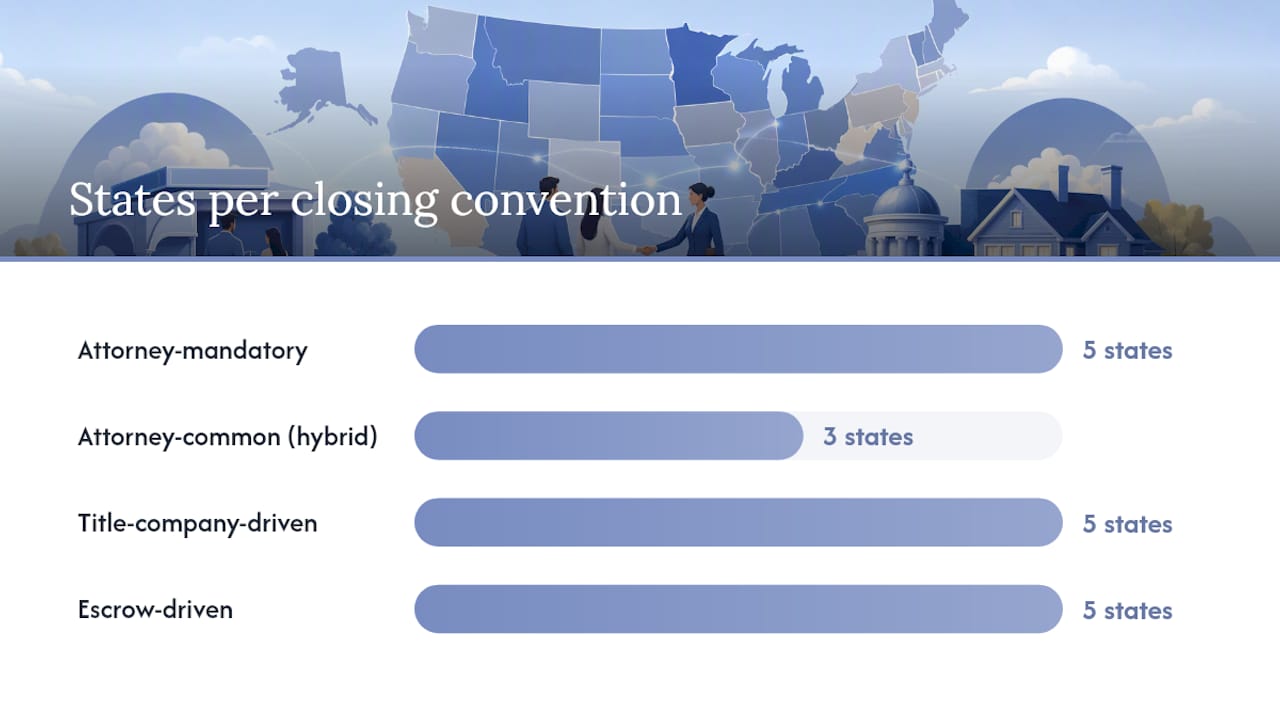
In escrow-driven states, the escrow function and title insurance function are typically handled by separately licensed entities. The escrow company manages funds and document flow; the title company issues the policy. They coordinate, but they are not the same company.
The unauthorized practice of law (UPL) constraint applies everywhere. Title officers and escrow agents cannot draft or interpret contract clauses, which means if a dispute arises mid-closing, work stops until an attorney weighs in.
Checklist to confirm your state’s closing convention:
- Ask your real estate agent what is customary in that county.
- Check your state bar association’s website for closing practice guidance.
- Ask your lender whether they require an attorney or an approved title company.
- Confirm who will hold earnest money and under what license.
- If you are selling an inherited property or a home with existing liens, confirm whether your state requires attorney involvement for those situations specifically.
When to hire a real estate attorney instead of relying on title or escrow
Title companies and escrow officers are skilled at standard transactions. The moment a deal steps outside the standard, their legal neutrality becomes a liability for you.
Hire a real estate attorney when:
- The property has title defects that cannot be cleared through routine means (disputed ownership, probate complications, boundary encroachments).
- The sale involves an estate, trust, or LLC with multiple decision-makers or fiduciary obligations.
- You are selling a home with existing liens and need legal advice on negotiating payoffs or challenging their validity.
- The purchase contract has been modified, disputed, or is the subject of a threatened lawsuit.
- The property straddles a state line or involves commercial elements.
- You are buying in an attorney-mandatory state and need someone who can represent your interests, not just administer the paperwork.
On cost: title companies typically charge flat closing fees that cover their administrative and insurance work. Attorneys charge either an hourly rate or a flat fee for real estate closings, and that fee is generally higher because it includes legal representation and the ability to draft or modify documents. Attorney fee structures differ from title-company closing fees in that you are paying for advocacy, not just administration.
When you hire an attorney, bring the purchase agreement, the title commitment, any prior survey, and a list of known issues with the property. Tell the attorney upfront that a title company or escrow company is already involved so they can coordinate rather than duplicate work.
A note from Decostabuyshomes
At Decostabuyshomes, we buy residential properties directly from homeowners across the United States, including homes with title complications, liens, and deferred maintenance that make a traditional listing difficult. Every deal we close goes through a licensed title company or escrow company appropriate to the state, and we cover closing costs so sellers are not left navigating these fees on their own.
This article is published as general educational information, not legal advice. If your transaction involves legal complexity, a real estate attorney in your state is the right call. Decostabuyshomes is not a law firm and does not provide legal representation.
If you are weighing a fast sale against a traditional listing, our as-is selling guide walks through the financial trade-offs in plain terms.
What the escrow and title distinction means for your deal
The single most important thing to take away: escrow protects your money during the transaction, and title insurance protects your ownership after it. Both matter, and neither replaces the other.
| Point | Details |
|---|---|
| Escrow holds funds | Your earnest money and loan proceeds sit in a neutral escrow account until all conditions are met. |
| Title company insures ownership | A title search and insurance policy protect you from defects that predate your purchase. |
| State convention determines who leads | Confirm whether your state uses an attorney, title company, or escrow company to run the closing before you sign. |
| Title insurance is a one-time cost | The owner’s policy premium is paid once at closing and covers you for as long as you own the property. |
| Attorneys fill the gap title and escrow cannot | For legal complexity, disputes, or attorney-mandatory states, hire a real estate attorney separately. |
Immediate action items:
- Request a preliminary title report as soon as you have an accepted offer.
- Ask your lender or agent who will hold escrow and confirm that party’s license in your state.
- If you are in an attorney state, identify a real estate attorney before you open escrow, not after a problem surfaces.
Authoritative resources to consult next
These are the most reliable public sources for confirming state-specific closing practice, licensing requirements, and regulatory definitions:
- ALTA (American Land Title Association): The national trade body for title insurance and settlement services. Publishes best practices, policy standards, and a state-by-state regulatory overview.
- CFPB — Buying a House: Plain-language explanations of closing costs, title insurance, and escrow from the federal consumer protection regulator.
- Quill TC — 50-State Closing Convention List: Practical breakdown of which states are attorney-mandatory, title-driven, or escrow-driven, with notes for transaction coordinators.
- California DFPI — Escrow Law: The licensing authority for independent escrow companies in California; useful model for understanding escrow-state regulation.
- Your state’s Department of Insurance: Regulates title insurance rates and title company licensing. Search “[your state] department of insurance title insurance” for the direct regulatory page.
- DealRun — Escrow vs Title vs Attorney: Practical transaction-level breakdown of how the three roles divide in different state conventions.
Licensing requirements and closing customs change. Before you open escrow or sign a purchase agreement, verify the current rules with your state’s insurance department or a licensed real estate attorney in your market.
My take on what most buyers get wrong
Most buyers treat the title company as a formality. They sign the title commitment without reading Schedule B, assume the escrow officer will flag every problem, and only call an attorney after something has already gone wrong.
The smarter move is to read the title commitment the day it arrives. Schedule B, Part II lists every exception to coverage, meaning every risk the title company will NOT insure. An easement you didn’t know about, a recorded covenant that limits how you can use the property, an old assessment that survived the sale: these are not hypothetical. They show up in real transactions, and the title company’s job is to disclose them, not to resolve them for you.
The other thing buyers underestimate is how much the escrow officer’s neutrality limits them. Escrow officers are excellent at following instructions. They are not allowed to tell you whether those instructions are in your best interest. If the escrow instructions contain a term that disadvantages you, the escrow officer cannot say so. That is not a flaw in the system; it is the design. Neutrality is what makes escrow trustworthy. But it means you need to read what you sign.
For sellers, the practical insight is simpler: a clean title is worth more than a fast closing. If you know about a lien, a boundary dispute, or a probate issue, surface it before you accept an offer. Hiding it does not make it disappear. It makes it a closing-day crisis.
Sources
- Title Company vs. Escrow Company. What’s the Difference?
- Title Company vs. Closing Attorney: Who Handles Your Closing | Real Estate Transaction Authority
- Real Estate Closings: Attorney vs. Title Company – What’s the Difference? – Guida Law Firm