
Sellers typically pay a significant portion of the sale price in closing costs, which is notably higher when a real estate commission is involved and lower when it isn’t, according to Bankrate. The biggest single expense is almost always agent commission, followed by title insurance and settlement fees, transfer taxes, prorated property taxes, and payoff of any existing mortgage.
State rules and local custom swing these numbers more than most sellers expect. Once you have a signed offer, ask your title or escrow company for a preliminary net sheet. It’s a one-page estimate of every fee coming out of your proceeds, and it’s the fastest way to stop guessing.
- Total costs with commissions: about 8%–10% of sale price
- Total costs without commissions: about 1%–3% of sale price
- Biggest line items: commissions, title fees, transfer taxes, escrow fees, prorated taxes, mortgage payoff
Quick math: On a $350,000 home, that range translates to roughly $3,500 to $10,500 in fees before commission, or $28,000 to $35,000 once a typical commission structure is added.
Key Takeaways
Seller closing costs run about 8% to 10% of sale price with a commission and 1% to 3% without one, and getting an itemized net sheet early is the single best way to avoid surprises at the table.
| Point | Details |
|---|---|
| Know your range | Expect 8%–10% of sale price with commission included, 1%–3% without it. |
| Commission is negotiable | Post 2024 NAR changes mean buyer-agent compensation is openly negotiable, not automatic. |
| Transfer taxes vary sharply | Some states charge none, others charge over 1%, so confirm your county’s rate directly. |
| Ask for a net sheet immediately | Request an itemized preliminary settlement statement as soon as you have an accepted offer. |
| Direct sale is a real option | Decostabuyshomes often covers closing costs and skips commissions on direct purchases, worth comparing against a traditional listing. |
Table of Contents
- How Much Are Seller Closing Costs, Line by Line?
- What Do Seller Closing Costs Actually Look Like in Dollars?
- Which Closing Costs Can You Actually Negotiate?
- Real Ways to Cut Your Closing Cost Total
- What Should You Ask For Before You Sign Anything?
- Sources
How Much Are Seller Closing Costs, Line by Line?
Every fee on your settlement statement falls into one of six buckets. Knowing what each one covers helps you spot which ones are padded and which ones are simply unavoidable.
Real estate agent commissions traditionally represent the largest seller expense, typically split between listing and buyer’s agents. Since the 2024 NAR settlement changed how buyer-agent compensation gets offered and disclosed, that split is now openly negotiable, and sellers increasingly negotiate the buyer-side portion separately rather than baking it into the listing agreement automatically. This is still the largest cost most sellers face, and it’s also the most negotiable one.
Title insurance and title fees typically run about 0.3% to 0.6% of the sale price for the owner’s title policy, though the EffectiveAgents fee breakdown puts a common national average closer to 0.42%. Who actually pays this policy depends entirely on regional custom. Sellers cover it in much of the Southeast and parts of the Northeast; buyers cover it in many Western states. There’s no federal rule here, only local habit.
Transfer and deed taxes vary the most of any line item. Some states charge nothing at all. Others charge over 1% of the sale price, and a handful of cities layer a local transfer tax on top of the state one. This is one of the biggest reasons two sellers in different states can pay wildly different totals on identical sale prices.

Escrow and settlement fees generally range from $500 to $2,000, covering the neutral third party that holds funds and documents until closing. Add notary fees, document prep, and wire or courier charges, and you’re often looking at a few hundred dollars more in fees that rarely show up until the final disclosure.
Prorated property taxes and HOA fees get split based on how many days each party owned the home during the tax or billing period. If you’re in an HOA, expect an estoppel or transfer fee too, often $100 to $500, charged for producing a certificate confirming your dues are current.
Mortgage payoff and lien clearance aren’t technically “closing costs,” but they come off your proceeds the same way. Attorney fees, where required by state law, and any remaining liens round out the list.
What Do Seller Closing Costs Actually Look Like in Dollars?
Percentages are abstract until you attach them to a real sale price. Here’s how the ranges play out using a 5.5% blended commission, roughly 0.4% for title, and a placeholder 0.5% for transfer tax (check your county, since this varies significantly).
- These figures exclude any remaining mortgage balance, which is subtracted separately at closing.
- Transfer tax alone can shift the low end of any of these ranges by thousands, depending on your state.
- Treat this table as a starting point, not a substitute for a real net sheet from your title company.
Which Closing Costs Can You Actually Negotiate?
Not every line item is up for discussion, but more of them are movable than most sellers realize.
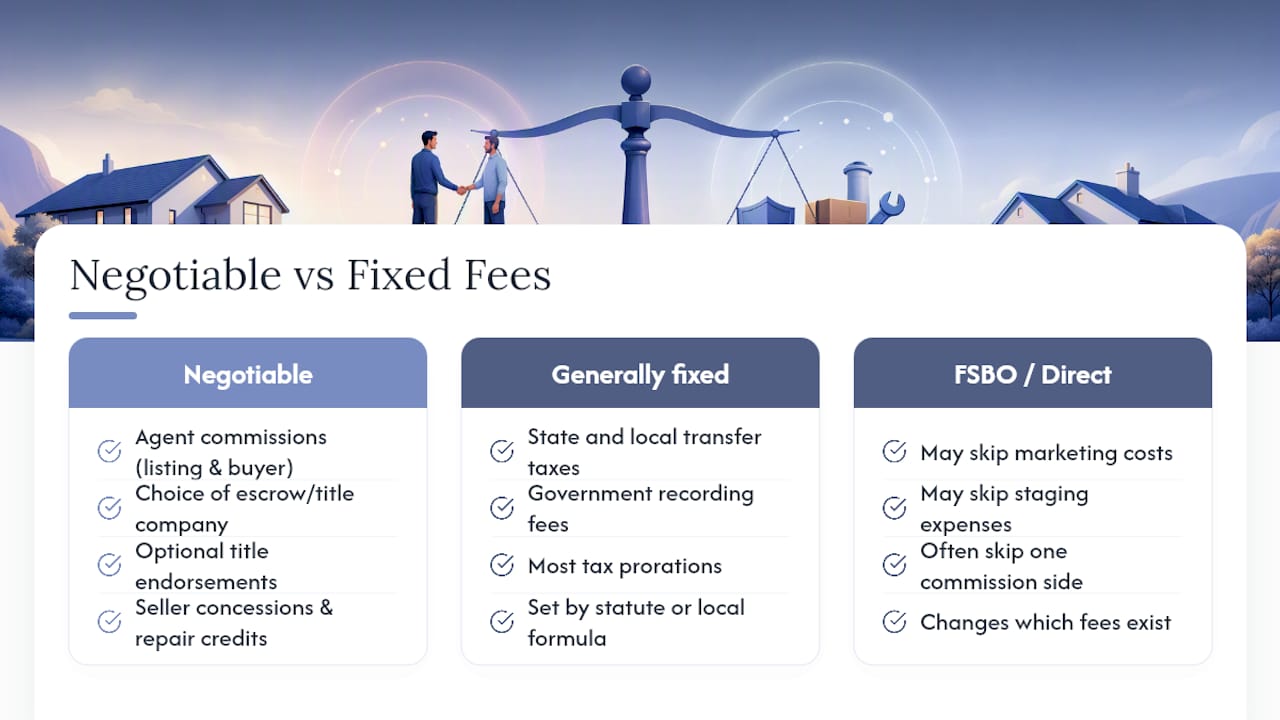
Negotiable: agent commission (both listing and buyer side), which escrow or title company handles the closing, optional title endorsements, and any seller concessions or repair credits you offer the buyer to close a deal. If you’re weighing a credit against a straight price cut, it’s worth understanding how seller concessions compare to a price reduction before you commit to either.
Generally fixed: state and local transfer taxes, government recording fees, and most tax prorations. These are set by statute or local formula, not by negotiation with your buyer.
Pro Tip: Selling without an agent or through a direct buyer changes which fees exist at all, not just who pays them. FSBO sellers and direct-sale transactions often skip marketing costs, staging, and one full commission side entirely.
Real Ways to Cut Your Closing Cost Total
A few tactics consistently move the needle more than others.
Ask for itemized net sheets from both your title company and any buyer making an offer, then compare them side by side. Vague estimates hide fees that itemized ones expose immediately.
If you bought the property recently, ask about a reissue rate on title insurance. This can cut the owner’s policy premium by 20% to 40% in many states, and plenty of sellers never ask.
- Get competing net sheets before you sign anything
- Ask about title reissue rates if you owned the home under ten years
- Shop escrow providers where your state permits it
- Keep every improvement receipt for accurate tax basis calculations
Sellers who choose a direct sale to an investor often eliminate listing commissions entirely and reduce the number of line items on the settlement statement, though that trade comes with a speed-versus-proceeds calculation worth running the numbers on before deciding.
If your home needs work you don’t want to fund upfront, comparing as-is sale versus fixing up first can also reshape which closing costs even apply.
What Should You Ask For Before You Sign Anything?
Get these documents and answers in hand before you commit to a listing agreement or an offer.
- Request a preliminary settlement statement (net sheet) from your title or escrow company.
- Request a payoff statement from your mortgage lender, including per-day interest accrual and any prepayment penalty.
- Ask which party customarily pays the buyer’s owner’s title policy in your county.
- Ask what proration method will be used for taxes and HOA dues.
- If you’re considering an investor buyer, request a written net offer listing every fee the buyer is covering.
A seller-first take on where the surprises hide
Most seller complaints I hear aren’t about the size of closing costs. They’re about the ones nobody mentioned until the final disclosure landed, an HOA estoppel fee, a courier charge, a transfer tax nobody flagged at listing. Get your net sheet early, shop your title provider where the law allows it, and treat a direct-sale offer as one more data point to compare, not a last resort.
A Faster Path When Speed or Certainty Matters More Than Squeezing Out Every Dollar
If your house needs repairs, you’re facing a tight timeline, or you’d rather skip showings and commission math altogether, a direct sale to Decostabuyshomes works differently than a traditional listing. There’s no listing commission to negotiate because there isn’t one, no staging or marketing costs, and closing dates that flex around your schedule instead of a buyer’s mortgage underwriting timeline.
Decostabuyshomes typically covers closing costs on properties it purchases directly, which removes several of the line items covered above before you ever see a settlement statement. This fits sellers dealing with deferred maintenance, an inherited property, a tight relocation window, or simply a preference for certainty over the open market. Sellers exploring creative structures, including properties with existing financing, can also look into how a subject-to purchase might apply to their situation. If that sounds like a better fit than a traditional listing, request a no-obligation cash offer and net-proceeds estimate directly from Decostabuyshomes to compare against your title company’s net sheet.
Sources
- What Are the Closing Costs for a Home Seller? – NerdWallet
- How Much Does It Cost To Sell A House? | Bankrate
- Seller Closing Costs: Complete Fee Breakdown, Calculator & Savings Guide | EffectiveAgents®
- The Ultimate Guide to Seller Closing Costs (2026 Edition) | Brokerless